. 2017 Apr;9(4):235-252.
doi: 10.1177/1758834016687482. Epub 2017 Feb 1.

Combination of metformin and curcumin targets breast cancer in mice by angiogenesis inhibition, immune system modulation and induction of p53 independent apoptosis

Affiliations

Combination of metformin and curcumin targets breast cancer in mice by angiogenesis inhibition, immune system modulation and induction of p53 independent apoptosis

Rabah Rashad Falah et al. Ther Adv Med Oncol. 2017 Apr.

Abstract

Background: The effects of metformin (MET) and curcumin (CUR) single treatments have been tested against breast cancer; however, their combination has not been explored. Here, we evaluated the antitumor activity of MET and CUR combination against breast cancer in mice.

Materials and methods: The antiproliferative activity of single and combined treatments against breast cancer cell lines was determined. Vascular endothelial growth factor (VEGF) and Trp53 expression was examined in EMT6/P cells. In vivo studies were carried out by inoculating BALB/c mice with EMT6/P cells and examining tumor growth and apoptosis induction in tumor sections. Furthermore, serum levels of different cytokines and transaminases and creatinine were measured to detect the immune response and toxicity, respectively.

Results: The combination treatment exhibited the highest effects against tumor proliferation and growth. It significantly reduced VEGF expression, induced Trp53 independent apoptosis, triggered Th2 immune response and showed no toxicity.

Conclusion: The combination can be a potential therapeutic option to treat breast cancer. However, further testing is needed to measure the exact serum levels of MET and CUR and to further explain the obtained results.

Keywords: breast cancer; combination therapy; curcumin; metformin.


Conflict of interest statement

Conflict of interest statement: The authors declare that there is no conflict of interest.

Figures
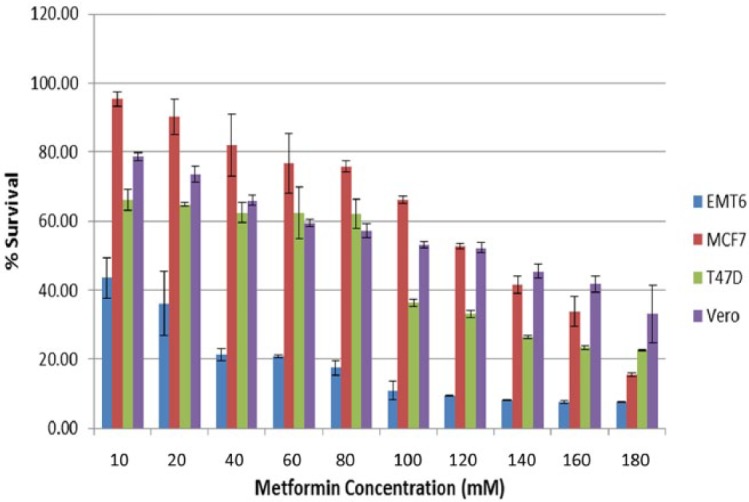
Figure 1.
Figure 1.
Effect of increasing concentrations of metformin (MET) on the viability of different cells lines (EMT6, MCF7, T47D and Vero).
Figure 2.
Figure 2.
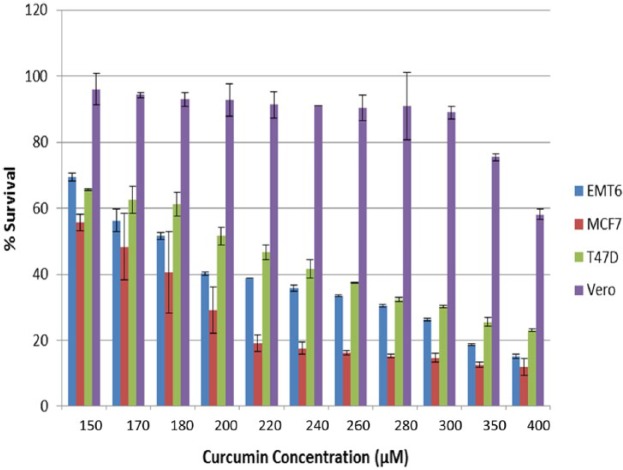
Effect of increasing concentrations of curcumin (CUR) on the viability of different cells lines (EMT6/P, MCF7, T47D and Vero).
Figure 3.
Figure 3.
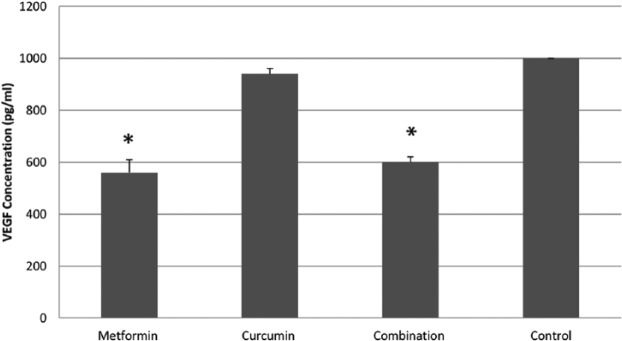
The effect of different treatments on the expression of vascular endothelial growth factor (VEGF). Concentration of VEGF (pg/ml) in cells treated with 8 mm metformin (MET), 110 µm curcumin (CUR) and a combination of both, as well as in untreated control cells. Each treatment was performed in duplicate. Results are expressed as means (bars) ± SEM (lines). The asterisks represent significant values.
Figure 4.
Figure 4.
Hematoxylin and eosin staining of tumors from different treatments. Tumors from animals treated once a day with 80 mg/kg metformin (MET) (A), 50 mg/kg curcumin (CUR) (B), combination of both (C) and a vehicle (D). N, necrotic area. Extensive necrosis was evident in tumors treated with a combination of MET and CUR (C). Four mice were used in each treatment.
Figure 5.
Figure 5.
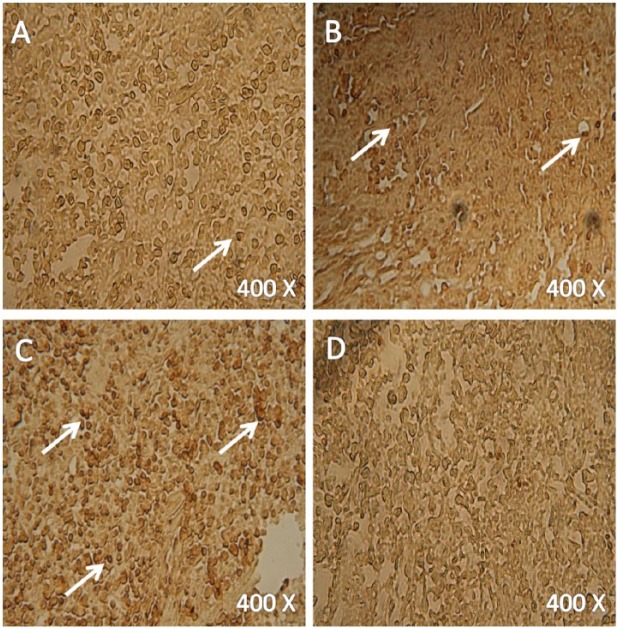
Colorimetric TUNEL assay to detect the induction of apoptosis in tumor sections from different treatments. Tumors from animals treated once a day with 80 mg/kg metformin (MET) (A), 50 mg/kg curcumin (CUR) (B), combination of both (C) and a vehicle (D). Apoptotic nuclei are stained dark brown. Four mice were examined in each treatment.
Figure 6.
Figure 6.
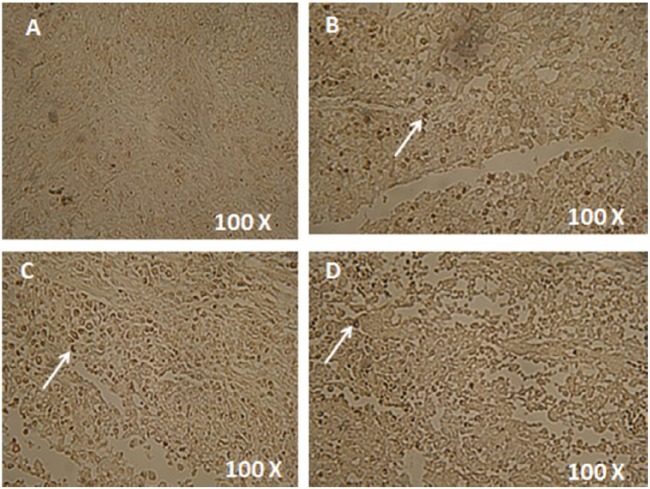
Colorimetric TUNEL assay to detect the induction of apoptosis in cultured EMT6/P cells after different treatments. Cancer cells treated for 48 h with 10 mm metformin (MET) (A), 180 µm curcumin (CUR) (B), combination of both (C) and a vehicle (D). Apoptotic nuclei are stained dark brown. Four mice were examined in each treatment.
Figure 7.
Figure 7.
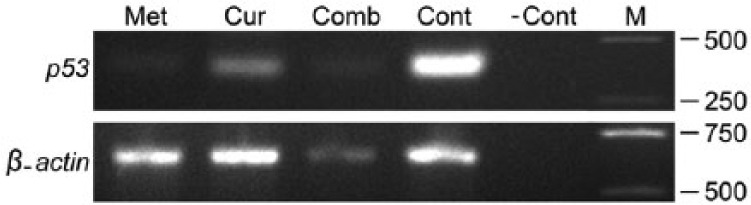
The expression of Trp53 and β-actin genes from cells under different treatments. Electrophoretic bands represent the expression of Trp53 (371 bp; upper row) and β-actin (659 bp; lower row) in cells treated with 8 mm metformin (MET), 110 µm curcumin (CUR), a combination of both (Comb), untreated control cells (Cont) and RT-PCR negative control (-Cont) which includes RNase free water instead of cDNA. M represents DNA markers with molecular weights in base pairs (bp) shown at the right.
Figure 8.
Figure 8.
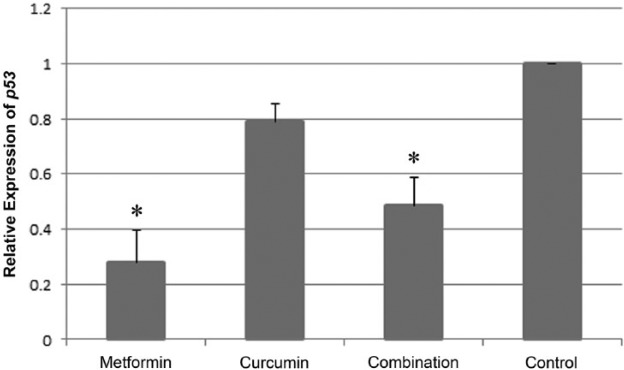
Relative expression of Trp53 from cells under different treatments. The mean of Trp53 relative expression normalized to the corresponding β-actin relative expression in cells treated with 8 mm metformin (MET), 110 µm curcumin (CUR) and a combination of both, as well as in untreated control cells. In each treatment, five independent experiments were performed and each experiment was done in duplicate. Results are expressed as means (bars) ± SEM (lines). The asterisks represent significant values.
Figure 9.
Figure 9.
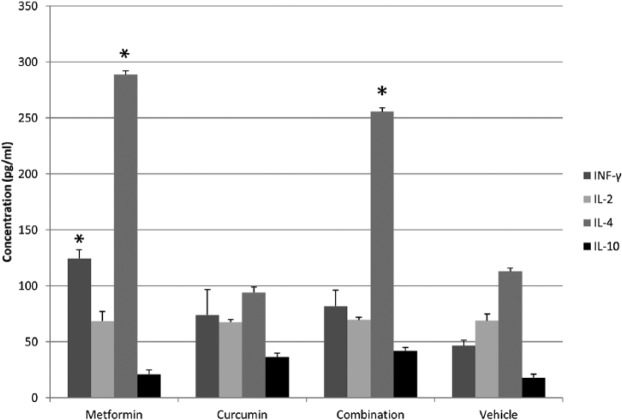
The effect of different treatments on the immune response of animals. The measured serum levels (pg/ml) of interferon-γ (IFN-γ), interleukin-2 (IL-2), IL-4 and IL-10 from animals treated once a day with 80 mg/kg metformin (MET), 50 mg/kg curcumin (CUR), combination of both and a vehicle (control). Each treatment was performed in duplicate. Results are expressed as means (bars) ± SEM (lines). The asterisks represent significant values.
Figure 10.
Figure 10.
The effect of different treatments on serum levels of aspartate transaminase (AST) and alanine transaminase (ALT). The measured levels (IU/l) of AST and ALT in animals treated once a day with 80 mg/kg metformin (MET), 50 mg/kg curcumin (CUR), combination of both and a vehicle, as well as in normal control animals. Each experiment was performed in duplicate. Results are expressed as means (bars) ± SEM (lines).
Figure 11.
Figure 11.
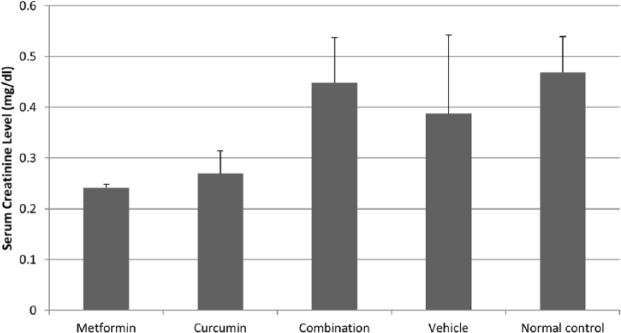
The effect of different treatments on serum levels of creatinine. The measured level (mg/dl) of creatinine in animals treated once a day with 80 mg/kg metformin (MET), 50 mg/kg curcumin (CUR), combination of both and a vehicle, as well as in normal control animals. Each experiment was performed duplicate. Results were expressed as means (bars) ± SEM (lines).

References

    1. Wang Y, Yu J, Cui R, et al. Curcumin in treating breast cancer: a review. J Lab Autom 2016; 21: 723–731. - PubMed
    1. Liu D, Chen Z. The effect of curcumin on breast cancer cells. J Breast Cancer 2013; 16: 133–137. - PMC - PubMed
    1. Ko EY, Moon A. Natural products for chemoprevention of breast cancer. J Cancer Prev 2015; 20: 223–231. - PMC - PubMed
    1. Sahin K, Tuzcu M, Sahin N, et al. Inhibitory effects of combination of lycopene and genistein on 7,12- dimethyl benz(a)anthracene-induced breast cancer in rats. Nutr Cancer 2011; 63: 1279–1286. - PubMed
    1. Grossmann ME, Yang D, Guo Z, et al. Metformin treatment for the prevention and/or treatment of breast/mammary tumorigenesis. Curr Pharmacol Rep 2015; 1: 312–323. - PMC - PubMed

LinkOut - more resources