


Food Insecurity among American Indians and Alaska Natives: A National Profile using the Current Population Survey-Food Security Supplement
- PMID: 28491205
- PMCID: PMC5422031
- DOI: 10.1080/19320248.2016.1227750
Food Insecurity among American Indians and Alaska Natives: A National Profile using the Current Population Survey-Food Security Supplement
Abstract
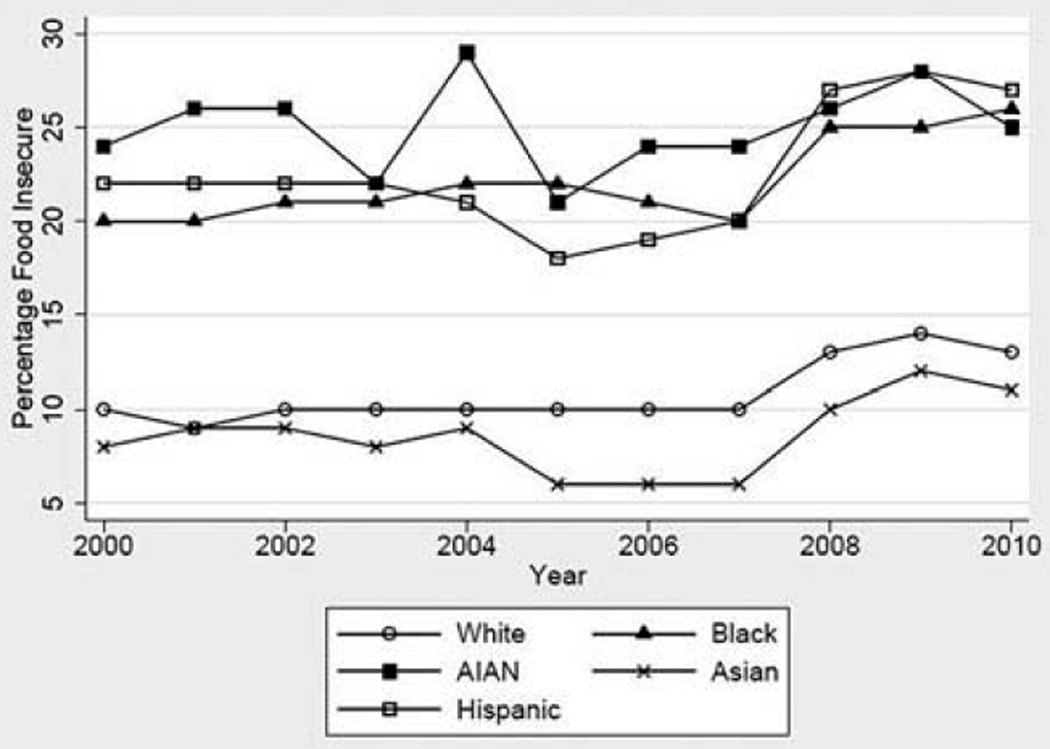
Food insecurity increases the risk for obesity, diabetes, hypertension, and cancer-conditions highly prevalent among American Indians and Alaska Natives (AI/ANs). Using the Current Population Survey Food Security Supplement, we analyzed the food insecurity trends of AI/ANs compared to other racial and ethnic groups in the United States from 2000 to 2010. From 2000 to 2010, 25% of AI/ANs remained consistently food insecure and AI/ANs were twice as likely to be food insecure compared to whites. Urban AI/ANs were more likely to experience food insecurity than rural AI/ANs. Our findings highlight the need for national and tribal policies that expand food assistance programs; promote and support increased access to healthy foods and community food security, in both rural and urban areas; and reduce the burden of diet-related disparities on low-income and racial/ethnic minority populations.
Keywords: Alaska native; American Indian; current population survey; food environments; food security; obesity.
Figures
References
-
- Bickel G, Nord M, Price C, Hamilton W, Cook J. Guide to measuring household food security. [Accessed January 9, 2016]; Available at: https://origin.drupal.fns.usda.gov/sites/default/files/FSGuide_0.pdf.
-
- US Department of Agriculture. Food security in the United States. [Accessed January 9, 2016]; Available at: http://www.ers.usda.gov/media/884525/err141.pdf.
-
- Dinour LM, Bergen D, Yeh M-C. The food insecurity–obesity paradox: a review of the literature and the role food stamps may play. J Am Diet Assoc. 2007;107:1952–1961. - PubMed
-
- Finney Rutten LJ, Yaroch AL, Coln-Ramos U, Johnson-Askew W, Story M. Poverty, food insecurity, and obesity: a conceptual framework for research, practice, and policy. J Hunger Environ Nutr. 2010;5:403–415.
-
- Adams EJ, Grummer-Strawn L, Chavez G. Food insecurity is associated with increased risk of obesity in California women. J Nutr. 2003;133:1070–1074. - PubMed
Grants and funding
LinkOut - more resources
Full Text Sources
Other Literature Sources