


Dissection of broad-spectrum resistance of the Thai rice variety Jao Hom Nin conferred by two resistance genes against rice blast
- PMID: 28493203
- PMCID: PMC5425360
- DOI: 10.1186/s12284-017-0159-0
Dissection of broad-spectrum resistance of the Thai rice variety Jao Hom Nin conferred by two resistance genes against rice blast
Abstract
Background: Rice (Oryza sativa) is one of the most important food crops in the world. Rice blast, caused by the fungal pathogen Magnaporthe oryzae, is one of the most destructive rice diseases worldwide. To effectively cope with this problem, the use of rice blast resistance varieties through innovative breeding programs is the best strategy to date. The Thai rice variety Jao Hom Nin (JHN) showed broad-spectrum resistance against Thai rice blast isolates. Two QTLs for blast resistance in JHN were reported on chromosome 1 (QTL1) and 11 (QTL11).
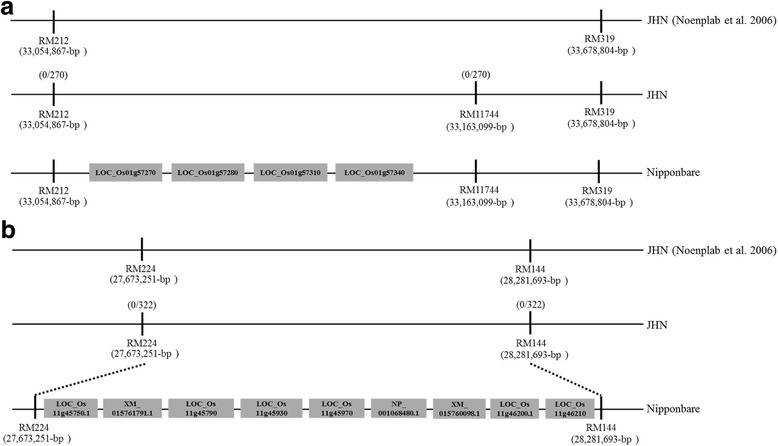
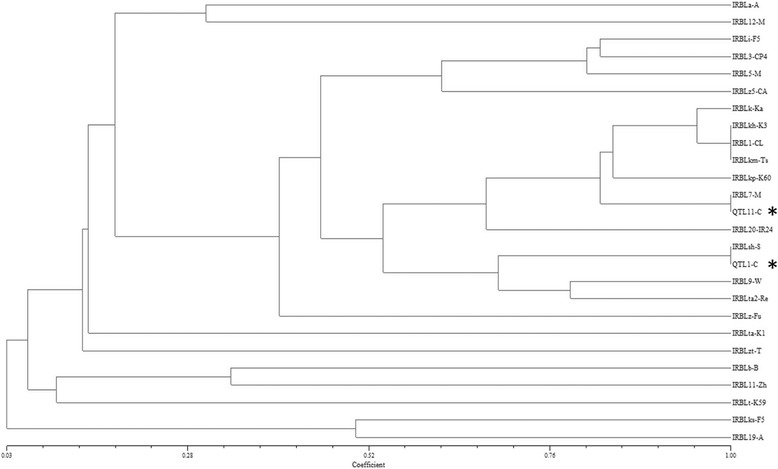
Results: Monogenic lines of QTL1 (QTL1-C) and QTL11 (QTL11-C) in the CO39 genetic background were generated. Cluster analysis based on the disease reaction pattern of QTL1-C and QTL11-C, together with IRBLs, showed that those two monogenic lines were clustered with IRBLsh-S (Pish) and IRBL7-M (Pi7), respectively. Moreover, sequence analysis revealed that Pish and Pi7 were embedded within the QTL1 and QTL11 delimited genomic intervals, respectively. This study thus concluded that QTL1 and QTL11 could encode alleles of Pish and Pi7, designated as Pish-J and Pi7-J, respectively. To validate this hypothesis, the genomic regions of Pish-J and Pi7-J were cloned and sequenced. Protein sequence comparison revealed that Pish-J and Pi7-J were identical to Pish and Pi7, respectively. The holistic disease spectrum of JHN was found to be exactly attributed to the additive ones of both QTL1-C and QTL11-C.
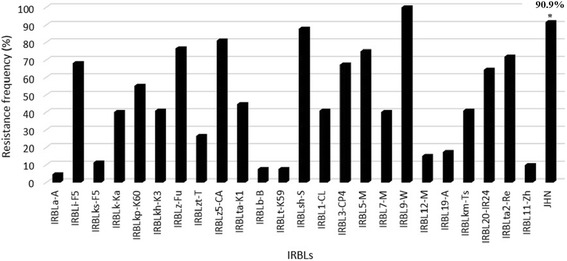
Conclusion: JHN showed broad spectrum resistance against Thai and Philippine rice blast isolates. As this study demonstrated, the combination of two resistance genes, Pish-J and Pi7-J, in JHN, with each controlling broad-spectrum resistance to rice blast disease, explains the high level of resistance. Thus, the combination of Pish and Pi7 can provide a practical scheme for breeding durable resistance in rice against rice blast disease.
Keywords: Durable resistance; Magnaporthe oryzae; Quantitative trait loci (QTL).
Figures
References
-
- Ahn SN, Kim YK, Hong HC, Han SS, Kwon SJ, Choi HC, Moon HP, McCouch S. Molecular mapping of a new gene for resistance to rice blast. Euphytica. 2000;116:17–22. doi: 10.1023/A:1004045812357. - DOI
-
- Araki E, Yanoria MJT, Ebron LA, Mercado-Escueta D, Takai T, Fukuta Y. Mapping of a rice blast resistance gene Pish. Breed Res. 2003;5(2):333.
-
- Ashikawa I, Hayashi N, Abe F, Wu J, Matsumoto T. Characterization of the rice blast resistance gene Pik cloned from Kanto51. Mol Breed. 2012;30:485–494. doi: 10.1007/s11032-011-9638-y. - DOI
LinkOut - more resources
Full Text Sources
Other Literature Sources
Research Materials
Miscellaneous
