. 2017 Aug;242(4):400-408.
doi: 10.1002/path.4915. Epub 2017 Jun 9.

Frequent IDH2 R172 mutations in undifferentiated and poorly-differentiated sinonasal carcinomas

Affiliations

Frequent IDH2 R172 mutations in undifferentiated and poorly-differentiated sinonasal carcinomas

Snjezana Dogan et al. J Pathol. 2017 Aug.

Abstract

Sinonasal undifferentiated carcinoma (SNUC) is a high-grade malignancy with limited treatment options and poor outcome. A morphological spectrum of 47 sinonasal tumours including 17 (36.2%) SNUCs was analysed at genomic level. Thirty carcinomas (cohort 1) were subjected to a hybridization exon-capture next-generation sequencing assay (MSK-IMPACTTM ) to interrogate somatic variants in 279 or 410 cancer-related genes. Seventeen sinonasal tumours (cohort 2) were examined only for the presence of IDH1/2 exon 4 mutations by Sanger sequencing. IDH2 R172 single nucleotide variants were overall detected in 14 (82.4%) SNUCs, in two (20%) poorly-differentiated carcinomas with glandular/acinar differentiation, and in one of two high-grade neuroendocrine carcinomas, large cell type (HGNECs). No IDH2 mutation was detected in any of five olfactory neuroblastomas or in any of five SMARCB1-deficient carcinomas. Among 12 IDH2-mutated cases in cohort 1, five (41.7%) harboured co-existing TP53 mutations, four (33.3%) CDKN2A/2B loss-of-function alterations, four (33.3%) MYC amplification, and three (25%) had concurrent SETD2 mutations. AKT1 E17K and KIT D816V hotspot variants were each detected in one IDH2-mutated SNUC. The vast majority of SNUCs and variable proportions of other poorly-differentiated sinonasal carcinomas may be amenable to IDH2-targeted therapy. Copyright © 2017 Pathological Society of Great Britain and Ireland. Published by John Wiley & Sons, Ltd.

Keywords: IDH2 R172; SNUC; sinonasal undifferentiated carcinoma.


Conflict of interest statement

Disclosure Statement:

No competing financial interests exist for all contributory authors.

Figures
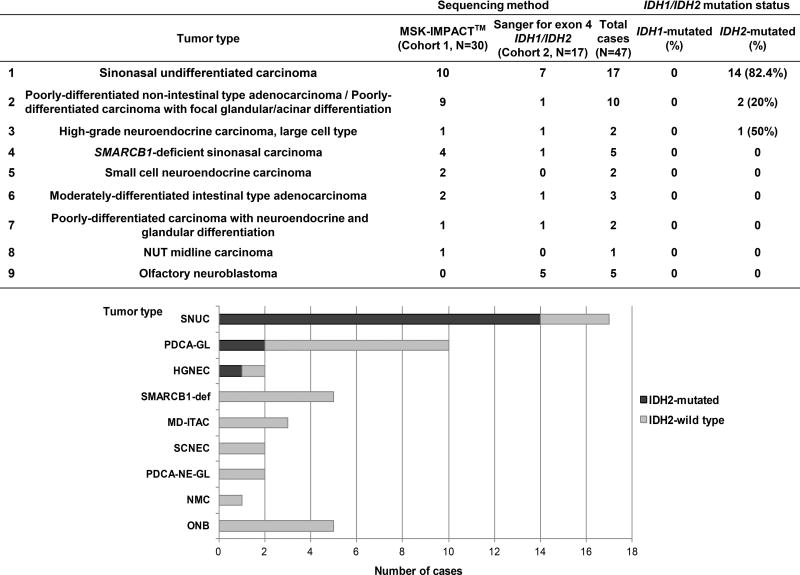
Figure 1
Figure 1. Frequencies of IDH1 and IDH2 mutations in sinonasal carcinomas and olfactory neuroblastoma
Abbreviations: SNUC=sinonasal undifferentiated carcinoma, PDCA-GL=poorly differentiated non-intestinal type adenocarcinoma/poorly-differentiated carcinoma with focal glandular differentiation, HGNEC=high-grade neuroendocrine carcinoma, large cell type, SCNEC=small cell neuroendocrine carcinoma, SMARCB1-def= SMARCB1-deficient sinonasal carcinoma, NMC=NUT midline carcinoma, MD-ITAC=moderately-differentiated intestinal type adenocarcinoma with signet-ring cells and mucinous features, PDCA-NE-GL=poorly differentiated carcinoma with neuroendocrine and glandular differentiation, ONB=olfactory neuroblastoma.
Figure 2
Figure 2
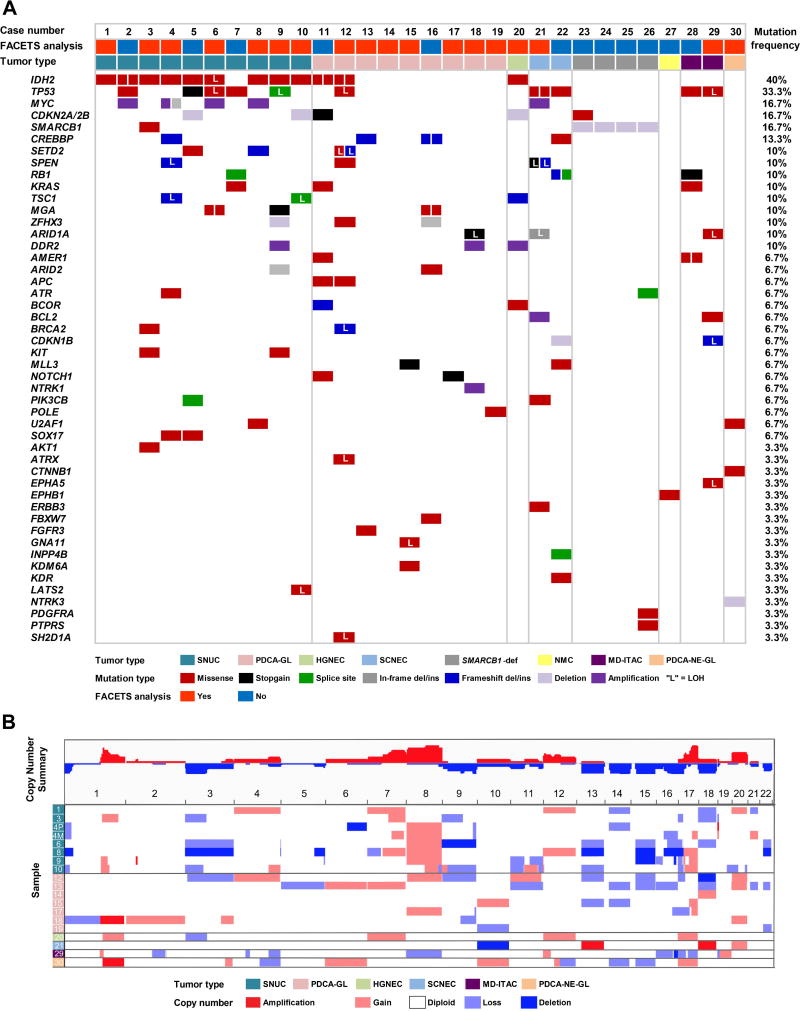
Genetic alterations detected by MSK-IMPACT™ in sinonasal carcinomas (Cohort 1). A. Cases are represented in columns; genes are depicted in rows. Tumor types and mutation types are color-coded according to the legend. B. Spectrum of somatic copy number alterations identified in sinonasal carcinomas detected by FACETS [5]. Genome wide copy number alterations are color-coded according to the legend and summarized at the cohort level and by tumor type. Abbreviations: SNUC=sinonasal undifferentiated carcinoma, PDCA-GL=poorly differentiated non-intestinal type adenocarcinoma/poorly-differentiated carcinoma with focal glandular/acinar differentiation, HGNEC=high-grade neuroendocrine carcinoma, large cell type, SCNEC=small cell neuroendocrine carcinoma, SMARCB1-def= SMARCB1-deficient sinonasal carcinoma, NMC=NUT midline carcinoma, MD-ITAC=moderately-differentiated intestinal type adenocarcinoma, PDCA-NE-GL=poorly differentiated carcinoma with neuroendocrine and glandular differentiation, LOH=loss of heterozygosity.
Figure 3
Figure 3
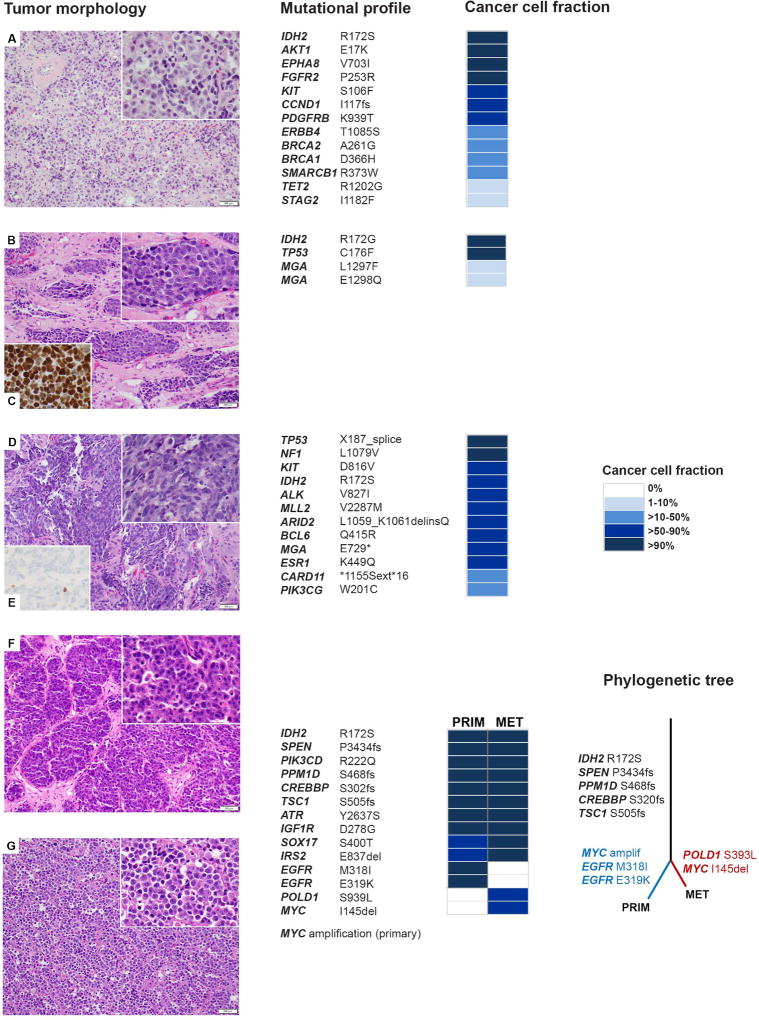
Phenotype and genetics of IDH2-mutated SNUC. Histology of the IDH2-mutated SNUCs including the matched metastasis in case 4 (G, 200× magnification) are shown with their respective genome plots and mutational profiles. Large undifferentiated epithelial tumor cells display high nuclear/cytoplasmic ratio, and in most cases they show open chromatin and prominent cherry-red nucleoli (insets A, B, D, F and G, 400× magnification). In case 6, somatic mutation in TP53 is consistent with an increased nuclear expression of p53 protein (C, 400× magnification), whereas in case 9, TP53 splice site variant with loss of heterozygosity is compatible with an absence of p53 protein (E, 400× magnification). In case 4, on the far right, the phylogenetic tree illustrates the clonal evolution of the primary tumor and the metastasis. The length of branches corresponds to the number of somatic mutations that distinguishes the primary or metastatic clone from their parental clone [22]. Key to cases: A=case 3, B, C=case 6, D, E=case 9, F=case 4, primary tumor, G=case 4, metastasis. Abbreviations: PRIM=primary tumor, MET= metastasis, amplif=amplification.

References

    1. Frierson HF, Mills SE, Fechner RE, et al. Sinonasal undifferentiated carcinoma. An aggressive neoplasm derived from the Schneiderian epithelium and distinct from olfactory neuroblastoma. Am J Surg Pathol. 1986;10:771–779. - PubMed
    1. Lin EM, Sparano A, Spalding A, et al. Sinonasal undifferentiated carcinoma: a 13-year experience at a single institution. Skull Base. 2010;20:61–67. - PMC - PubMed
    1. Kuo P, Manes RP, Schwam ZG, et al. Survival outcomes for combined modality therapy for sinonasal undifferentiated carcinoma. Otolaryngol Head Neck Surg. 2017;156:132–136. - PubMed
    1. Cheng DT, Mitchell TN, Zehir A, et al. Memorial Sloan Kettering-Integrated Mutation Profiling of Actionable Cancer Targets (MSK-IMPACT): A Hybridization Capture-Based Next-Generation Sequencing Clinical Assay for Solid Tumor Molecular Oncology. J Mol Diagn. 2015;17:251–264. - PMC - PubMed
    1. Shen R, Seshan VE. FACETS: allele-specific copy number and clonal heterogeneity analysis tool for high-throughput DNA sequencing. Nucleic Acids Res. 2016;44:e131. - PMC - PubMed

MeSH terms

Supplementary concepts