


Prediction of pancreatic fistula after pancreatoduodenectomy by preoperative dynamic CT and fecal elastase-1 levels
- PMID: 28493949
- PMCID: PMC5426704
- DOI: 10.1371/journal.pone.0177052
Prediction of pancreatic fistula after pancreatoduodenectomy by preoperative dynamic CT and fecal elastase-1 levels
Abstract
Objective: To validate preoperative dynamic CT and fecal elastase-1 level in predicting the development of pancreatic fistulae after pancreatoduodenectomy.
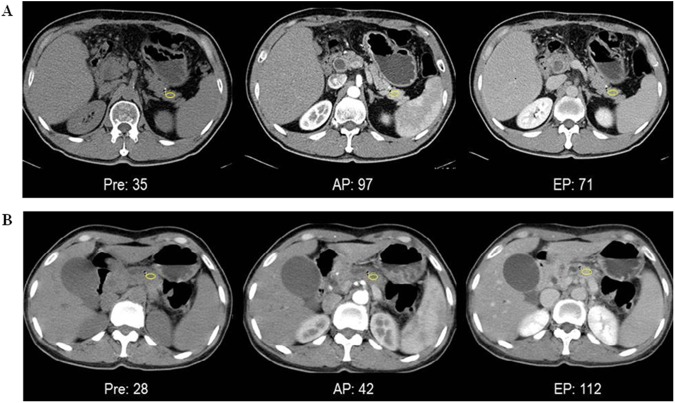
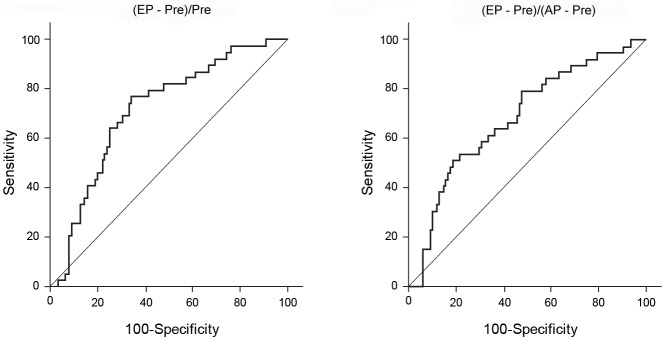
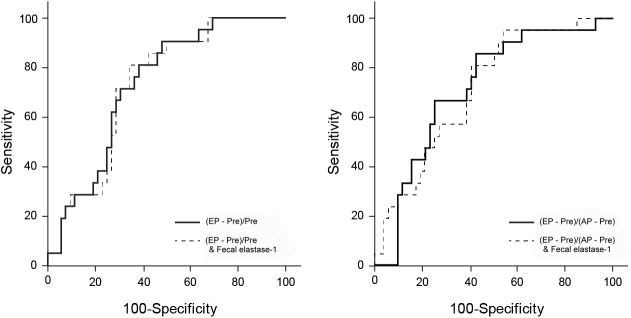
Materials and methods: For 146 consecutive patients, CT attenuation values of the nontumorous pancreatic parenchyma were retrospectively measured on precontrast, arterial and equilibrium phase images for calculation of enhancement ratios. CT enhancement ratios and preoperative fecal elastase-1 levels were correlated with the development of pancreatic fistulae using independent t-test, logistic regression models, ROC analysis, Youden method and tree analysis.
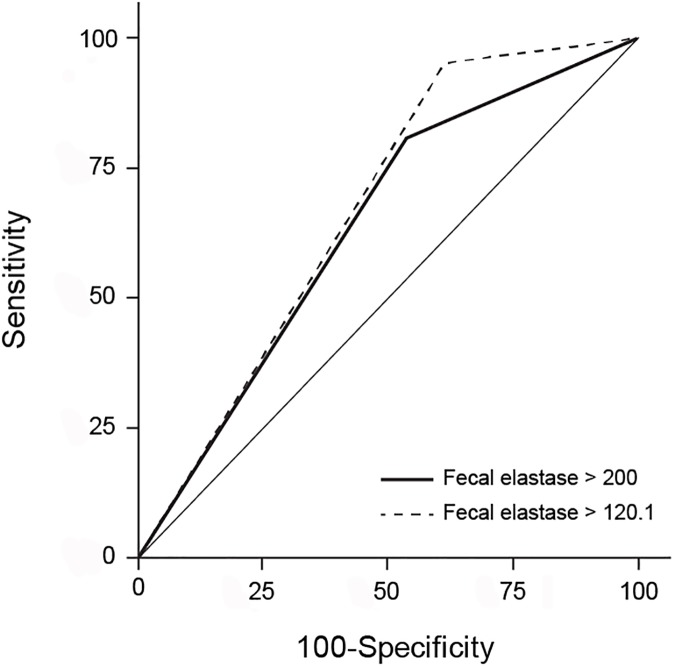
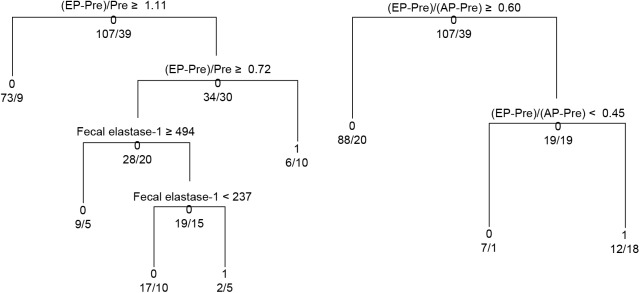
Results: The mean value of enhancement ratio on equilibrium phase was significantly higher (p = 0.001) in the patients without pancreatic fistula (n = 107; 2.26±3.63) than in the patients with pancreatic fistula (n = 39; 1.04±0.51); in the logistic regression analyses, it was significant predictor for the development of pancreatic fistulae (odds ratio = 0.243, p = 0.002). The mean preoperative fecal elastase-1 levels were higher (odds ratio = 1.003, p = 0.034) in the pancreatic fistula patients than other patients, but there were no significant differences in the areas under the curve between the prediction values of CT enhancement ratios and fecal elastase-1 combined and those of CT enhancement ratios alone (P = 0.897, p = 0.917) on ROC curve analysis. Tree analysis revealed that the CT enhancement ratio was more powerful predictor of pancreatic fistula than fecal elastase-1 levels.
Conclusion: The preoperative CT enhancement ratio of pancreas acquired at equilibrium phase regardless of combination with fecal elastase-1 levels might be a useful predictor of the risk of developing a pancreatic fistula following pancreatoduodenectomy.
Conflict of interest statement
Figures

References
-
- Richter A, Niedergethmann M, Sturm JW, Lorenz D, Post S, Trede M. Long-term results of partial pancreaticoduodenectomy for ductal adenocarcinoma of the pancreatic head: 25-year experience. World J Surg 2003;27:324–9. doi: 10.1007/s00268-002-6659-z - DOI - PubMed
-
- Adam U, Makowiec F, Riediger H, Schareck WD, Benz S, Hopt UT. Risk factors for complications after pancreatic head resection. Am J Surg 2004;187:201–8. doi: 10.1016/j.amjsurg.2003.11.004 - DOI - PubMed
-
- DeOliveira ML, Winter JM, Schafer M, Cunningham SC, Cameron JL, Yeo CJ, et al. Assessment of complications after pancreatic surgery: A novel grading system applied to 633 patients undergoing pancreaticoduodenectomy. Ann Surg 2006;244:931–7; discussion 7–9. doi: 10.1097/01.sla.0000246856.03918.9a - DOI - PMC - PubMed
-
- Hashimoto Y, Traverso LW. Incidence of pancreatic anastomotic failure and delayed gastric emptying after pancreatoduodenectomy in 507 consecutive patients: Use of a web-based calculator to improve homogeneity of definition. Surgery 2010;147:503–15. doi: 10.1016/j.surg.2009.10.034 - DOI - PubMed
MeSH terms
Substances
LinkOut - more resources
Full Text Sources
Other Literature Sources
