


Changes in the use practitioner-based complementary and alternative medicine over time in Canada: Cohort and period effects
- PMID: 28494011
- PMCID: PMC5426710
- DOI: 10.1371/journal.pone.0177307
Changes in the use practitioner-based complementary and alternative medicine over time in Canada: Cohort and period effects
Abstract
Background: The use of complementary and alternative medicine (CAM) is growing. However the factors contributing to changes over time and to birth cohort differences in CAM use are not well understood.
Setting: We used data from 10186 participants, who were aged 20-69 years at the first cycle of data collection in the longitudinal component of the Canadian National Population Health Survey (1994/95-2010/11). We examined chiropractic and other practitioner-based CAM use with a focus on five birth cohorts: pre-World War II (born 1925-1934); World War II (born 1935-1944); older baby boomers (born 1945-1954); younger baby boomers (born 1955-1964); and Gen Xers (born 1965-1974). The survey collected data every two years on predisposing (e.g., sex, education), enabling (e.g., income), behavior-related factors (e.g., obesity), need (e.g., chronic conditions), and use of conventional care (primary care and specialists).
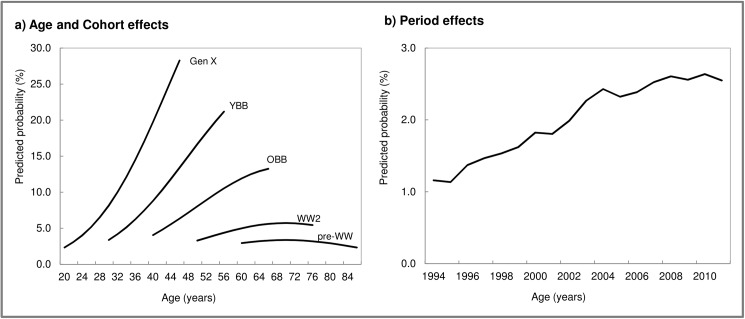
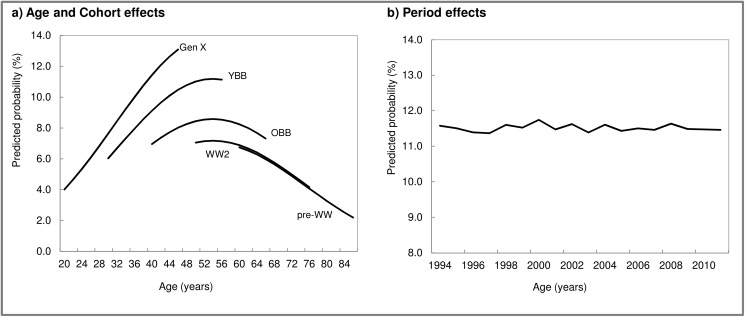
Results: The findings suggest that, at corresponding ages, more recent cohorts reported greater CAM (OR = 25.9, 95% CI: 20.0; 33.6 for Gen Xers vs. pre-World War) and chiropractic use than their predecessors (OR = 2.2, 95% CI: 1.7; 2.8 for Gen Xers vs. pre-World War). There was also a secular trend of increasing CAM use, but not chiropractic use, over time (period effect) across all ages. Factors associated with cohort differences were different for CAM and chiropractic use. Cohort differences in CAM use were partially related to a period effect of increasing CAM use over time across all ages while cohort differences in chiropractic use were related to the higher prevalence of chronic conditions among recent cohorts. The use of conventional care was positively related to greater CAM use (OR = 1.8, 95% CI: 1.6; 2.0) and chiropractic use (OR = 1.2, 95% CI: 1.1; 1.4) but did not contribute to changes over time or to cohort differences in CAM and chiropractic use.
Conclusion: The higher CAM use over time and in recent cohorts could reflect how recent generations are approaching their healthcare needs by expanding conventional care to include CAM therapies and practice for treatment and health promotion. The findings also underscore the importance of doctors discussing CAM use with their patients.
Conflict of interest statement
Figures
References
-
- Bishop FL, Lewith GT. Who Uses CAM? A Narrative Review of Demographic Characteristics and Health Factors Associated with CAM Use . Evid Based Complement Alternat Med. 2010;7(1):11–28. doi: 10.1093/ecam/nen023 - DOI - PMC - PubMed
-
- Murthy V, Sibbritt D, Adams J, Broom A, Kirby E, Refshauge KM. Consultations with complementary and alternative medicine practitioners amongst wider care options for back pain: a study of a nationally representative sample of 1,310 Australian women aged 60–65 years. Clin Rheumatol. 2014;33(2):253–62. doi: 10.1007/s10067-013-2357-5 - DOI - PubMed
MeSH terms
LinkOut - more resources
Full Text Sources
Other Literature Sources
Medical
