


An Update on Memory Reconsolidation Updating
- PMID: 28495311
- PMCID: PMC5605913
- DOI: 10.1016/j.tics.2017.04.006
An Update on Memory Reconsolidation Updating
Abstract
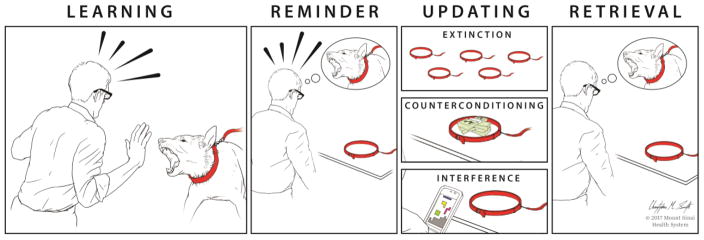
The reactivation of a stored memory in the brain can make the memory transiently labile. During the time it takes for the memory to restabilize (reconsolidate) the memory can either be reduced by an amnesic agent or enhanced by memory enhancers. The change in memory expression is related to changes in the brain correlates of long-term memory. Many have suggested that such retrieval-induced plasticity is ideally placed to enable memories to be updated with new information. This hypothesis has been tested experimentally, with a translational perspective, by attempts to update maladaptive memories to reduce their problematic impact. We review here progress on reconsolidation updating studies, highlighting their translational exploitation and addressing recent challenges to the reconsolidation field.
Keywords: addiction; counterconditioning; extinction; memory; reconsolidation; retrieval.
Copyright © 2017 Elsevier Ltd. All rights reserved.
Figures
References
-
- Duncan CP. The retroactive effect of electroshock on learning. J Comp Physiol Psychol. 1949;42:32–44. - PubMed
-
- Flexner LB, et al. Loss of memory as related to inhibition of cerebral protein synthesis. J Neurochem. 1965;12:535–541. - PubMed
-
- Gordon WC, Spear NE. Effect of reactivation of a previously acquired memory on the interaction between memories in the rat. Journal of Experimental Psychology. 1973;99:349–355. - PubMed
-
- McGaugh JL, Krivanek JA. Strychnine effects on discrimination learning in mice: effects of dose and time of administration. Physiol Behav. 1970;5:1437–1442. - PubMed
-
- McGaugh JL. Time–dependent processes in memory storage. Science. 1966;153:1351–1358. - PubMed
Publication types
MeSH terms
Grants and funding
LinkOut - more resources
Full Text Sources
Other Literature Sources
Medical
