. 2017 Aug;23(8):1303-1314.
doi: 10.1261/rna.061549.117. Epub 2017 May 11.

High-throughput and site-specific identification of 2'- O-methylation sites using ribose oxidation sequencing (RibOxi-seq)

Affiliations

High-throughput and site-specific identification of 2'- O-methylation sites using ribose oxidation sequencing (RibOxi-seq)

Yinzhou Zhu et al. RNA. 2017 Aug.

Abstract

Ribose methylation (2'-O-methylation, 2'-OMe) occurs at high frequencies in rRNAs and other small RNAs and is carried out using a shared mechanism across eukaryotes and archaea. As RNA modifications are important for ribosome maturation, and alterations in these modifications are associated with cellular defects and diseases, it is important to characterize the landscape of 2'-O-methylation. Here we report the development of a highly sensitive and accurate method for ribose methylation detection using next-generation sequencing. A key feature of this method is the generation of RNA fragments with random 3'-ends, followed by periodate oxidation of all molecules terminating in 2',3'-OH groups. This allows only RNAs harboring 2'-OMe groups at their 3'-ends to be sequenced. Although currently requiring microgram amounts of starting material, this method is robust for the analysis of rRNAs even at low sequencing depth.

Keywords: 2′-O-methylation; RNA editing; RNA modification; ribosomal RNA.


Figures

FIGURE 1.
FIGURE 1.
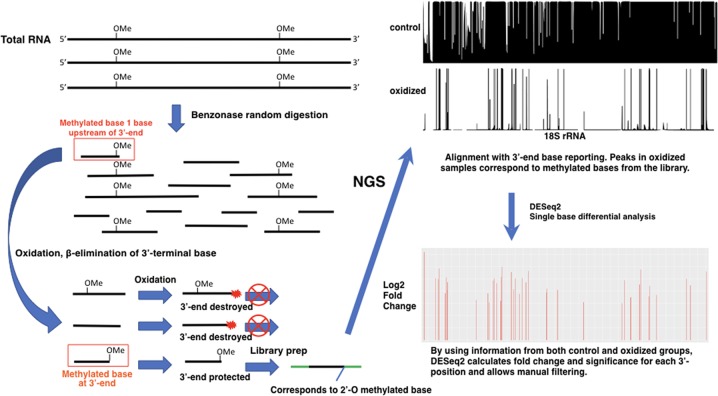
Work flow of the RibOxi-seq method. As shown on the left, rRNAs are digested randomly with Benzonase to generate RNA fragments that have 2′,3′-OH ends. Because the fragments are relatively small, some of those containing 2′-OMe will have methylated bases near their 3′-ends. β-Elimination is performed on the RNA fragments from the previous step to expose ribose methylated bases to the very 3′-ends. The resulting RNA pool is then oxidized so that fragments with methylated bases at the 3′-ends are protected. The fragments with ribose methylated bases at the 3′-end are available for linker ligation and are therefore enriched for RNA-seq library construction. After sequencing, data are processed and mapped to visualize the alignment of 3′-end bases to a reference genome in the UCSC Genome Browser (top right). The data are statistically analyzed using DESeq2 for enrichment, and significance for each base position is shown in the bottom right. (Boxed in red) Fragments susceptible to sequencing.
FIGURE 2.
FIGURE 2.
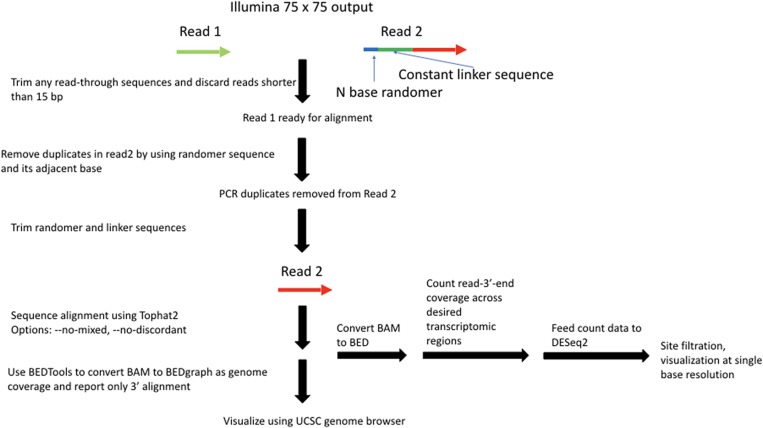
RibOxi-seq data processing and analysis pipeline.
FIGURE 3.
FIGURE 3.
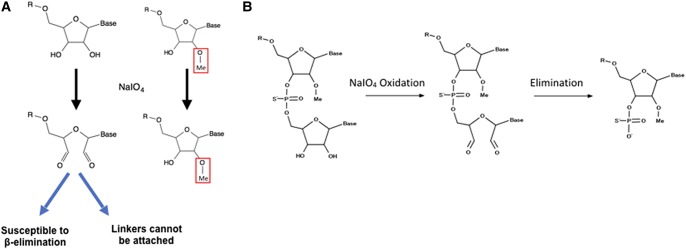
(A) Oxidation of RNA 3′-ends by sodium periodate (NaIO4). RNA fragments that are terminally methylated are protected from oxidation, while nonmethylated fragments will have their ends oxidized into dialdehyde, thus losing reactivity to ligation reactions. (B) To expose 2′-O-methylated bases at the 3′-terminus, at least one round of β-elimination is required. RNA fragments are first oxidized, then β-elimination catalyzes the leaving of 3′-terminal bases.
FIGURE 4.
FIGURE 4.
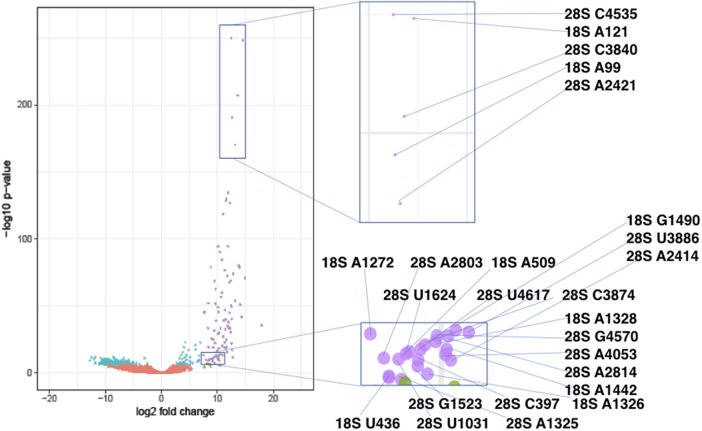
Volcano plot of the −log10 P-value versus log2 fold change in data from human PA1 cells. Each dot represents a single base position in 18S and 28S rRNAs. Base positions were artificially filtered by P-values and log2 fold changes and color-coded. Red dots represent positions with log2 fold change ≤7 and adjusted P-value >0.0001. Teal dots represent log2 fold change ≤7 and adjusted P-value <0.0001. Green dots represent log2 fold change >7 and adjusted P-value >0.0001. Purple dots represent log2 fold change >7 and adjusted P-value <0.0001. Positions labeled with purple were determined as highest confidence sites. The zoomed-in views for two regions indicate the actual methylation sites represented by the dots. The Volcano plot was generated using the R package ggplot2 (Heng et al. 2009). RibOxi-seq was used on 7 µg samples of total RNA from PA1 cells. The NextSeq500 150 cycle Mid Output Kit was used in the 75 bp by 75 bp configuration. Across three control samples, the sequencer output was ∼14 million, ∼13 million, and ∼36 million reads for each, while oxidized samples had ∼9 million, ∼10 million, and ∼16 million reads each.
FIGURE 5.
FIGURE 5.
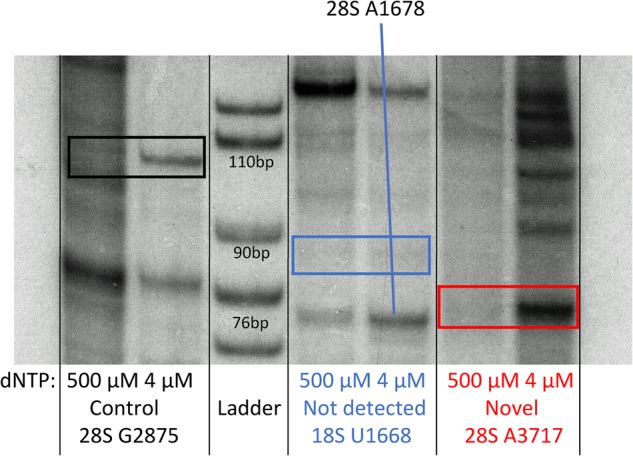
Primer extension analysis. For novel site validation, primers were P32 labeled. One microgram of total RNA, 1 µL (10 µM) labeled RT primer, 1 µL 100 µM or 1 µL 10 mM (control) concentrations of dNTPs, 7 µL of water were denatured at 65°C for 5 min, then chilled on ice. An RT Master mix (10 µL per reaction) containing 2 µL 10× RT Buffer, 1 µL (40 U) RNase Out, 1 µL AMV RT (NEB), and 6 µL water was prepared, and added to the RNA/primer mix. Incubation was at 42°C for 45 min. Reactions were ethanol precipitated and resuspended in loading buffer for TBE-PAGE electrophoresis. This experiment was performed for three selected sites from RibOxi-seq: positive control at 28S C1880 (lanes 1,2), known but not detected 18S U1668 (lanes 4,5) and newly detected and not previously reported 28S A3717 (lanes 6,7). The first lane of each set is a negative control where primer extension was performed with a higher dNTP concentration. The second lane of each set was performed at low dNTP concentration to promote polymerase pausing at sites of 2′-OMe.

References

    1. Alefelder S, Patel BK, Eckstein F. 1998. Incorporation of terminal phosphorothioates into oligonucleotides. Nucleic Acids Res 26: 4983–4988. - PMC - PubMed
    1. Cavaillé J, Bachellerie JP. 1998. SnoRNA-guided ribose methylation of rRNA: structural features of the guide RNA duplex influencing the extent of the reaction. Nucleic Acids Res 26: 1576–1587. - PMC - PubMed
    1. Daffis S, Szretter KJ, Schriewer J, Li J, Youn S, Errett J, Lin T-Y, Schneller S, Zust R, Dong H, et al. 2010. 2′-O methylation of the viral mRNA cap evades host restriction by IFIT family members. Nature 468: 452–456. - PMC - PubMed
    1. Das U, Shuman S. 2013. Mechanism of RNA 2′,3′-cyclic phosphate end healing by T4 polynucleotide kinase-phosphatase. Nucleic Acids Res 41: 355–365. - PMC - PubMed
    1. Decatur WA, Fournier MJ. 2002. rRNA modifications and ribosome function. Trends Biochem Sci 27: 344–351. - PubMed

Publication types