Gene expression signature of Gleason score is associated with prostate cancer outcomes in a radical prostatectomy cohort
- PMID: 28496006
- PMCID: PMC5522125
- DOI: 10.18632/oncotarget.17428
Gene expression signature of Gleason score is associated with prostate cancer outcomes in a radical prostatectomy cohort
Abstract
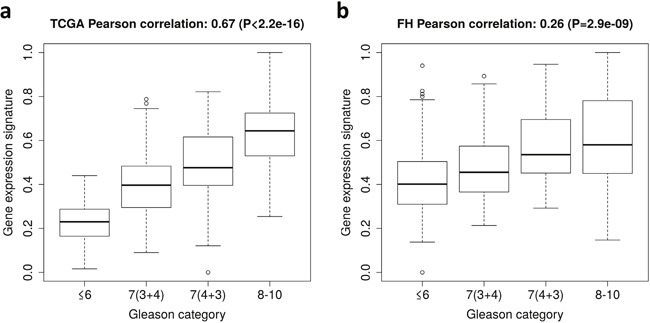
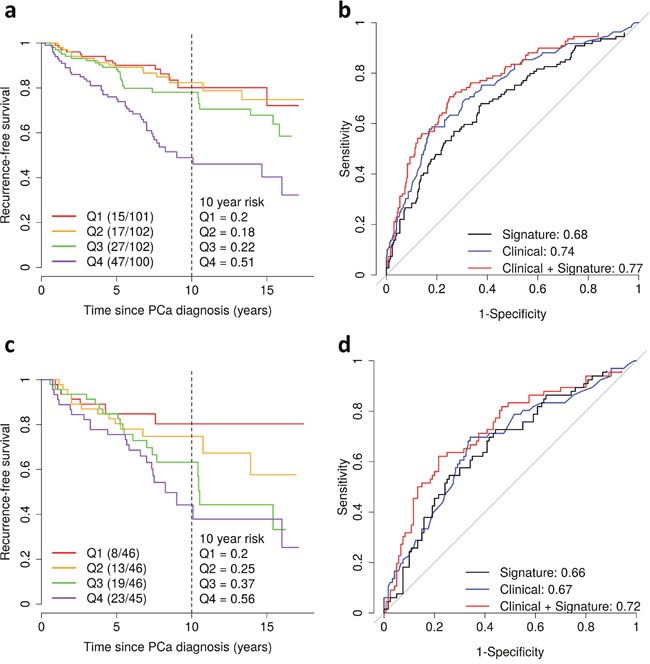
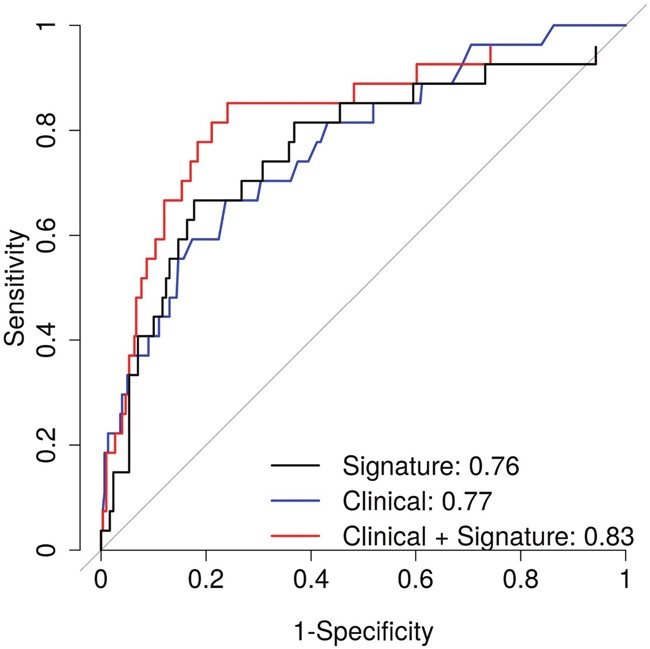
Prostate cancer (PCa) is a leading cause of cancer-related mortality worldwide. Gleason score (GS) is one of the best predictors of PCa aggressiveness, but additional tumor biomarkers may improve its prognostic accuracy. We developed a gene expression signature of GS to enhance the prediction of PCa outcomes. Elastic net was used to construct a gene expression signature by contrasting GS 8-10 vs. ≤6 tumors in The Cancer Genome Atlas (TCGA) dataset. The constructed signature was then evaluated for its ability to predict recurrence and metastatic-lethal (ML) progression in a Fred Hutchinson (FH) patient cohort (N=408; NRecurrence=109; NMLprogression=27). The expression signature included transcripts representing 49 genes. In the FH cohort, a 25% increase in the signature was associated with a hazard ratio (HR) of 1.51 (P=2.7×10⁻⁵) for recurrence. The signature's area under the curve (AUC) for predicting recurrence and ML progression was 0.68 and 0.76, respectively. Compared to a model with age at diagnosis, pathological stage and GS, the gene expression signature improved the AUC for recurrence (3%) and ML progression (6%). Higher levels of the signature were associated with increased expression of genes in cell cycle-related pathways and decreased expression of genes in androgen response, estrogen response, oxidative phosphorylation, and apoptosis. This gene expression signature based on GS may improve the prediction of recurrence as well as ML progression in PCa patients after radical prostatectomy.
Keywords: Gleason score; gene expression; metastasis; prostate cancer; recurrence.
Conflict of interest statement
The authors declare no conflicts of interest.
Figures
References
-
- Catalona WJ, Smith DS. 5-year tumor recurrence rates after anatomical radical retropubic prostatectomy for prostate cancer. J Urol. 1994;152:1837–42. - PubMed
-
- Cuzick J, Swanson GP, Fisher G, Brothman AR, Berney DM, Reid JE, Mesher D, Speights VO, Stankiewicz E, Foster CS, Moller H, Scardino P, Warren JD, et al. Prognostic value of an RNA expression signature derived from cell cycle proliferation genes in patients with prostate cancer: a retrospective study. Lancet Oncol. 2011;12:245–55. doi: 10.1016/S1470-2045(10)70295-3. - DOI - PMC - PubMed
-
- Knezevic D, Goddard AD, Natraj N, Cherbavaz DB, Clark-Langone KM, Snable J, Watson D, Falzarano SM, Magi-Galluzzi C, Klein EA, Quale C. Analytical validation of the Oncotype DX prostate cancer assay - a clinical RT-PCR assay optimized for prostate needle biopsies. BMC Genomics. 2013;14:690. doi: 10.1186/1471-2164-14-690. - DOI - PMC - PubMed
-
- Erho N, Crisan A, Vergara IA, Mitra AP, Ghadessi M, Buerki C, Bergstralh EJ, Kollmeyer T, Fink S, Haddad Z, Zimmermann B, Sierocinski T, Ballman KV, et al. Discovery and validation of a prostate cancer genomic classifier that predicts early metastasis following radical prostatectomy. PLoS One. 2013;8:e66855. doi: 10.1371/journal.pone.0066855. - DOI - PMC - PubMed
MeSH terms
Substances
Grants and funding
LinkOut - more resources
Full Text Sources
Other Literature Sources
Medical
Molecular Biology Databases
Miscellaneous