Case Reports
. 2017 Apr;7(2):e86-e92.
doi: 10.1055/s-0037-1602657.

Under Pressure: Intraluminal Filling Pressures of Postpartum Hemorrhage Tamponade Balloons

Affiliations
Case Reports

Under Pressure: Intraluminal Filling Pressures of Postpartum Hemorrhage Tamponade Balloons

Kathleen M Antony et al. AJP Rep. 2017 Apr.

Abstract

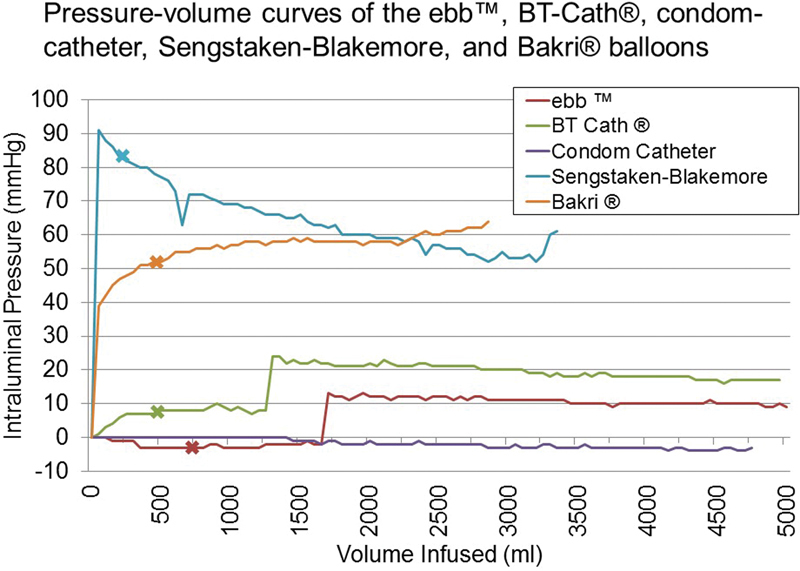
Objective Uterine tamponade by fluid-filled balloons is now an accepted method of controlling postpartum hemorrhage. Available tamponade balloons vary in design and material, which affects the filling attributes and volume at which they rupture. We aimed to characterize the filling capacity and pressure-volume relationship of various tamponade balloons. Study Design Balloons were filled with water ex vivo. Intraluminal pressure was measured incrementally (every 10 mL for the Foley balloons and every 50 mL for all other balloons). Balloons were filled until they ruptured or until 5,000 mL was reached. Results The Foley balloons had higher intraluminal pressures than the larger-volume balloons. The intraluminal pressure of the Sengstaken-Blakemore tube (gastric balloon) was initially high, but it decreased until shortly before rupture occurred. The Bakri intraluminal pressure steadily increased until rupture occurred at 2,850 mL. The condom catheter, BT-Cath, and ebb all had low intraluminal pressures. Both the BT-Cath and the ebb remained unruptured at 5,000 mL. Conclusion In the setting of acute hemorrhage, expeditious management is critical. Balloons that have a low intraluminal pressure-volume ratio may fill more rapidly, more easily, and to greater volumes. We found that the BT-Cath, the ebb, and the condom catheter all had low intraluminal pressures throughout filling.

Keywords: BT-Cath; Bakri balloon; ebb balloon; intraluminal pressure; postpartum hemorrhage; uterine balloon; uterine balloon tamponade; uterine tamponade; uterine tamponade balloon.


Conflict of interest statement

Financial Support Baylor College of Medicine Department of Obstetrics and Gynecology Fellowship Research Funds (DRA and KMA) for the BT-Cath and Blakemore Catheter. Glenveigh provided the ebb balloons. Harris Health System provided the Bard Foley catheters, Bakri balloons, and the Koala intrauterine pressure catheter system.

Figures

Fig. 1
Fig. 1
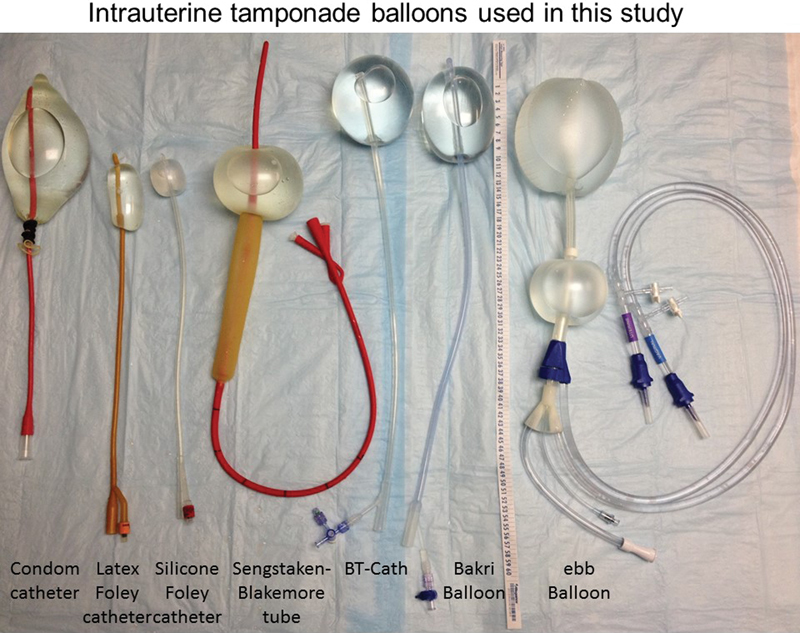
Intrauterine tamponade balloons used in this study. The condom catheter is shown filled to 500 mL of fluid (with a urologic syringe cover blocking extrusion of fluid). Unlike the other balloons in this study, the condom catheter has no drainage tip. The latex and silicone Foley pictured here each contains 30 mL of fluid. The Sengstaken is shown with only the gastric balloon filled to 300 mL. The BT-Cath's drainage tip is flush with the end of the balloon; here it is filled to 500 mL of fluid. The Bakri balloon is also filled to 500 mL. The ebb is filled to 750 mL in the uterine balloon and 300 mL in the vaginal balloon. The ebb's drainage tip protrudes from the end of the balloon initially, but as the balloon fills, it no longer protrudes. The vaginal balloon can also slide superiorly toward the uterine balloon (not shown).
Fig. 2
Fig. 2
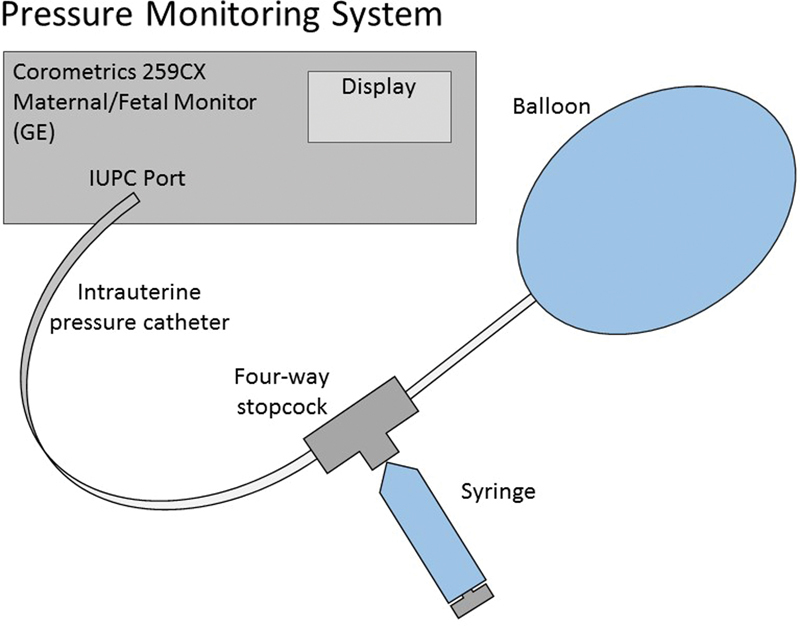
The pressure sensor of a Corometrics 259CX Series Maternal/Fetal Monitor was connected to a Koala IPC 5000 Intrauterine Pressure System to document intraluminal pressure. The cut tip of the catheter was inserted into the first port of a four-way stopcock. The second port of the stopcock was attached via a Luer lock to the syringes that were used to infuse water into the balloons. The third Luer lock of the stopcock was attached to the infusion port of the balloons.
Fig. 3
Fig. 3
Pressure-volume curves of the Foley catheters. Both Foleys had high filling pressures starting at 10 mL, but the silicone Foley continued to rise and ruptured after 50 mL. The latex Foley had a decrease in pressure from 10 to 50 mL followed by a steady increase. Both latex Foley catheters ruptured at 120 mL. X indicates the recommended filling volume.
Fig. 4
Fig. 4
Pressure-volume curves of the Sengstaken, condom catheter, Bakri, BT-Cath, and ebb balloons. The Sengstaken's intraluminal pressure was initially high but decreased until shortly before rupture occurred at 3,350 mL. The condom catheter had negligible intraluminal pressures until rupture occurred at 4,750 mL. The Bakri's intraluminal pressure steadily increased until rupture occurred at 2,850 mL. The BT-Cath had initially low intraluminal pressures until a slight but sudden increase between 1,250 and 1,300 mL and did not rupture at 5,000 mL. The ebb had a similar slight but sudden increase in intraluminal pressure that occurred between 1,650 and 1,700 mL, and did not rupture at 5,000 mL. X indicates the recommended filling volume; the condom catheter does not have a recommended filling volume as it is not FDA-approved.

References

    1. Calvert C, Thomas S L, Ronsmans C, Wagner K S, Adler A J, Filippi V. Identifying regional variation in the prevalence of postpartum haemorrhage: a systematic review and meta-analysis. PLoS One. 2012;7(07):e41114. - PMC - PubMed
    1. Callaghan W M, Kuklina E V, Berg C J. Trends in postpartum hemorrhage: United States, 1994–2006. Am J Obstet Gynecol. 2010;202(04):3530–3.53E8. - PubMed
    1. Kramer M S, Berg C, Abenhaim H et al. Incidence, risk factors, and temporal trends in severe postpartum hemorrhage. Am J Obstet Gynecol. 2013;209(05):4490–4.49E9. - PubMed
    1. Division of Reproductive Health Centers for Disease Control and Prevention NC for CDP and HP. Pregnancy Mortality Surveillance System: Causes of Pregnancy-Related Death in the United States, 2006–2009 Pregnancy Mortal Surveill Syst 200958972–975.
    1. Clark S L, Belfort M A, Dildy G A, Herbst M A, Meyers J A, Hankins G D.Maternal death in the 21st century: causes, prevention, and relationship to cesarean delivery Am J Obstet Gynecol 200819901360–3.6E6., discussion 91–92, e7–e11 - PubMed

Publication types