Review
. 2017 May 12;18(5):1051.
doi: 10.3390/ijms18051051.

The Roles of Glutamine in the Intestine and Its Implication in Intestinal Diseases

Affiliations
Review

The Roles of Glutamine in the Intestine and Its Implication in Intestinal Diseases

Min-Hyun Kim et al. Int J Mol Sci. .

Abstract

Glutamine, the most abundant free amino acid in the human body, is a major substrate utilized by intestinal cells. The roles of glutamine in intestinal physiology and management of multiple intestinal diseases have been reported. In gut physiology, glutamine promotes enterocyte proliferation, regulates tight junction proteins, suppresses pro-inflammatory signaling pathways, and protects cells against apoptosis and cellular stresses during normal and pathologic conditions. As glutamine stores are depleted during severe metabolic stress including trauma, sepsis, and inflammatory bowel diseases, glutamine supplementation has been examined in patients to improve their clinical outcomes. In this review, we discuss the physiological roles of glutamine for intestinal health and its underlying mechanisms. In addition, we discuss the current evidence for the efficacy of glutamine supplementation in intestinal diseases.

Keywords: glutamine; inflammatory bowel disease; intestinal function; nutritional therapy; short bowel syndrome.


Conflict of interest statement

The authors declare no conflict of interest.

Figures
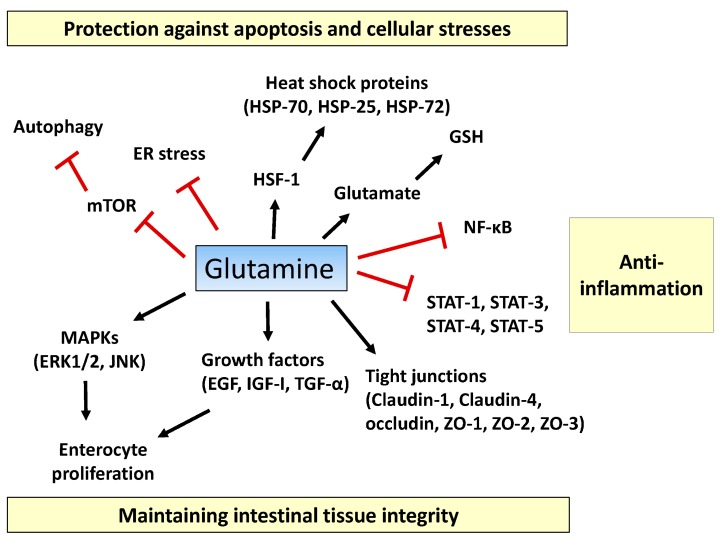
Figure 1
Figure 1
Proposed action mechanisms of glutamine in intestinal cells. Glutamine maintains intestinal tissue integrity via promoting enterocyte proliferation, activation of mitogen-activated protein kinases (MAPKs) (ERK1/2, JNK1/2), optimizing the actions of growth factors (epidermal growth factor (EGF), insulin-like growth factor (IGF)-I, transforming growth factor (TGF)-α), and inducing expression of tight-junction proteins (claudin-1, claudin-4, occludin, zonula occludens (ZO)-1, ZO-2, and ZO-3). Pro-inflammatory signaling pathways such as the nuclear factor-κB (NF-κB) and signal transducers and activators of transcription (STAT) pathways are inhibited by glutamine. Glutamine suppresses extensive apoptosis by participating in the synthesis of glutathione (GSH) and by regulating heat shock factor (HSF)-1-mediated expression of heat shock proteins (HSPs). Glutamine ameliorates endoplasmic reticulum (ER) stress and promotes autophagy by inhibiting the mechanistic target of rapamycin (mTOR) pathway, thus protecting intestinal cells from stressful conditions. T bars mean inhibition while arrows represent stimulation.

References

    1. Calder P. Glutamine and the immune system. Clin. Nutr. 1994;13:2–8. doi: 10.1016/0261-5614(94)90003-5. - DOI - PubMed
    1. Albrecht J., Sidoryk-Wegrzynowicz M., Zielinska M., Aschner M. Roles of glutamine in neurotransmission. Neuron. Glia Biol. 2010;6:263–276. doi: 10.1017/S1740925X11000093. - DOI - PubMed
    1. Amores-Sanchez M.I., Medina M.A. Glutamine, as a precursor of glutathione, and oxidative stress. Mol. Genet. Metab. 1999;67:100–105. doi: 10.1006/mgme.1999.2857. - DOI - PubMed
    1. Coster J., McCauley R., Hall J. Glutamine: Metabolism and application in nutrition support. Asia Pac. J. Clin. Nutr. 2004;13:25–31. - PubMed
    1. Patience J.F. A review of the role of acid-base balance in amino acid nutrition. J. Anim. Sci. 1990;68:398–408. doi: 10.2527/1990.682398x. - DOI - PubMed

MeSH terms

LinkOut - more resources
