


Associations of androgens with depressive symptoms and cognitive status in the general population
- PMID: 28498873
- PMCID: PMC5428943
- DOI: 10.1371/journal.pone.0177272
Associations of androgens with depressive symptoms and cognitive status in the general population
Abstract
Objectives: Associations between androgens and depressive symptoms were mostly reported from cross-sectional and patient-based studies.
Study design/main outcome measures: Longitudinal data from 4,110 participants of the Study of Health in Pomerania were used to assess sex-specific associations of baseline total and free testosterone, androstenedione and sex hormone-binding globulin with incident depressive symptoms and cognitive status at 5- and 10-year follow-up.
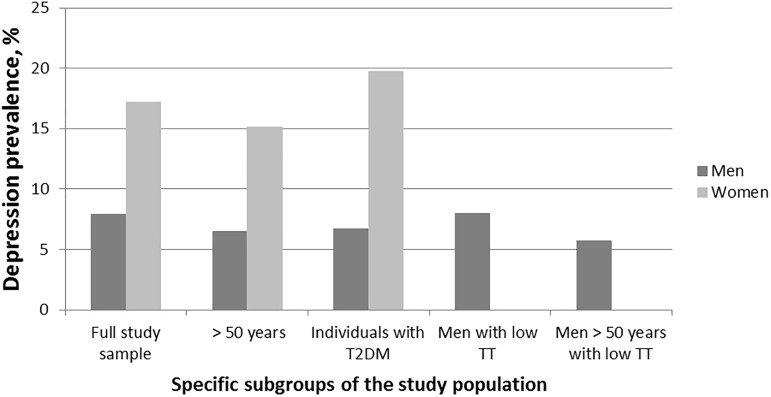
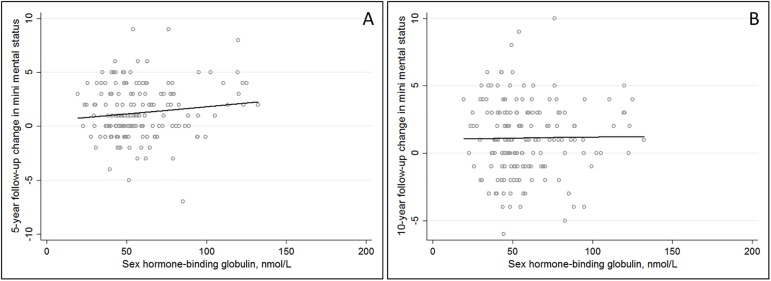
Results: Despite sex-specific differences in depressive symptoms prevalence at baseline (women: 17.4%, men: 8.1%), cross-sectional analyses showed no associations between sex hormones and depressive symptoms. In age-adjusted longitudinal analyses, total testosterone was associated with incident depressive symptoms (relative risk at 5-year follow-up: 0.73, 95% confidence interval: 0.58-0.92). Similarly, age-adjusted analyses showed a positive association between sex hormone-binding globulin and cognitive status in men (β-coefficient per standard deviation: 0.44, 95% confidence interval: 0.13-0.74). In women, age-adjusted associations of androstenedione with baseline depressive symptoms (relative risk: 0.88, 95% confidence interval: 0.77-0.99) were found. None of the observed associations remained after multivariable adjustment.
Conclusions: The present population-based, longitudinal study revealed inverse associations between sex hormones and depressive symptoms. However, the null finding after multivariable adjustment suggests, that the observed associations were not independent of relevant confounders including body mass index, smoking and physical inactivity. Furthermore, the low number of incident endpoints in our non-clinical population-based sample limited the statistical power and reduced the chance to detect a statistically significant effect.
Conflict of interest statement
Figures
References
-
- Bromberger JT, Schott LL, Kravitz HM, Sowers MF, Avis NE, et al. (2010) Longitudinal change in reproductive hormones and depressive symptoms across the menopausal transition: Results from the study of women´s health across the nation (SWAN). Archives of General Psychiatry 67: 598–607. 10.1001/archgenpsychiatry.2010.55 - DOI - PMC - PubMed
-
- Barrett-Connor E, von Mühlen DG, Kritz-Silverstein D (1999) Bioavailable Testosterone and Depressed Mood in Older Men: The Rancho Bernardo Study. pp. 573–577. - PubMed
MeSH terms
Substances
LinkOut - more resources
Full Text Sources
Other Literature Sources
Medical
