


The Prevalence of Anosmia and Associated Factors Among U.S. Black and White Older Adults
- PMID: 28498937
- PMCID: PMC5861899
- DOI: 10.1093/gerona/glx081
The Prevalence of Anosmia and Associated Factors Among U.S. Black and White Older Adults
Abstract
Background: Olfactory impairment is common among older adults; however, data are largely limited to whites.
Methods: We conducted pooled analyses of two community-based studies: the Atherosclerosis Risk in Communities study (ARIC, 1,398 blacks and 4,665 whites), and the Health, Aging, and Body Composition study (Health ABC, 958 blacks and 1,536 whites) to determine the prevalence of anosmia and associated factors for black and white older adults in the United States.
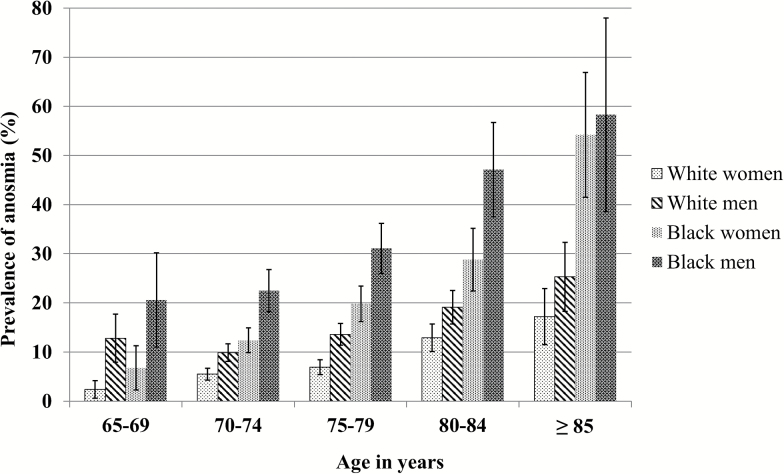
Results: The overall prevalence of anosmia was 22.3% among blacks and 10.4% among whites. Blacks had a markedly higher odds of anosmia compared to whites in age and sex adjusted analyses (odds ratio [OR] 2.96, 95% confidence interval [CI] = 2.59-3.38). In both blacks and whites, higher anosmia prevalence was associated with older age and male sex. The highest prevalence was found in black men 85 years or older (58.3%), and the lowest in white women aged 65-69 years (2.4%). Higher education level, lower cognitive score, ApoE ε4, daytime sleepiness, poorer general health status, lower body mass index, and Parkinson disease were associated with higher prevalence of anosmia in one or both races. However, the racial difference in anosmia remained statistically significant after adjusting for these factors (fully adjusted OR = 1.76, 95%CI: 1.50-2.07). Results were comparable between the two cohorts.
Discussion: Anosmia is common in older adults, particularly among blacks. Further studies are needed to identify risk factors for anosmia and to investigate racial disparities in this sensory deficit.
Keywords: Anosmia; Prevalence; Racial disparity.
Published by Oxford University Press on behalf of The Gerontological Society of America 2017. This work is written by (a) US Government employee(s) and is in the public domain in the US.
Figures
References
-
- Murphy C, Schubert CR, Cruickshanks KJ, Klein BE, Klein R, Nondahl DM. Prevalence of olfactory impairment in older adults. JAMA. 2002;288:2307–2312. - PubMed
-
- Ekstrom I, Sjolund S, Nordin S, et al. Smell loss predicts mortality risk regardless of dementia conversion. Journal of the American Geriatrics Society [Epub ahead of print]. 2017. doi:10.1111/jgs.14770 - PubMed
MeSH terms
Substances
Grants and funding
LinkOut - more resources
Full Text Sources
Other Literature Sources
Medical
Miscellaneous
