. 2017 May 12;8(1):17.
doi: 10.1038/s41467-017-00019-3.

Ultrafast all-optical tuning of direct-gap semiconductor metasurfaces

Affiliations

Ultrafast all-optical tuning of direct-gap semiconductor metasurfaces

Maxim R Shcherbakov et al. Nat Commun. .

Abstract

Optical metasurfaces are regular quasi-planar nanopatterns that can apply diverse spatial and spectral transformations to light waves. However, metasurfaces are no longer adjustable after fabrication, and a critical challenge is to realise a technique of tuning their optical properties that is both fast and efficient. We experimentally realise an ultrafast tunable metasurface consisting of subwavelength gallium arsenide nanoparticles supporting Mie-type resonances in the near infrared. Using transient reflectance spectroscopy, we demonstrate a picosecond-scale absolute reflectance modulation of up to 0.35 at the magnetic dipole resonance of the metasurfaces and a spectral shift of the resonance by 30 nm, both achieved at unprecedentedly low pump fluences of less than 400 μJ cm-2. Our findings thereby enable a versatile tool for ultrafast and efficient control of light using light.Metasurfaces are not adjustable after fabrication, and a critical challenge is to realise a technique of tuning their optical properties that is both fast and efficient. Here, Shcherbakov et al. realise an ultrafast tunable metasurface with picosecond-scale large absolute reflectance modulation at low pump fluences.


Conflict of interest statement

The authors declare no competing financial interests.

Figures
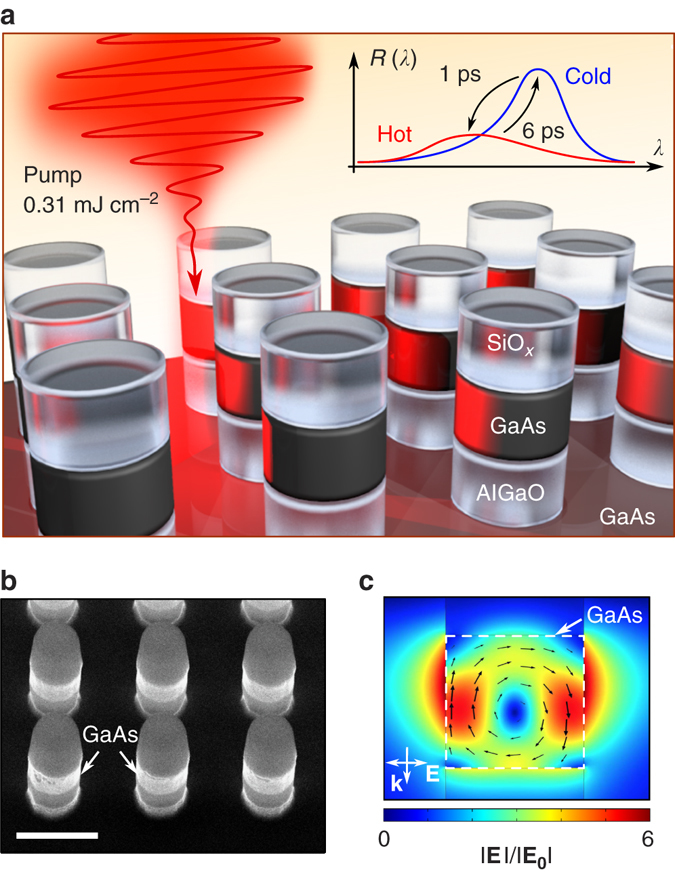
Fig. 1
Fig. 1
Tuning GaAs metasurfaces with femtosecond laser pulses. a Illustration of ultrafast tuning of the MD mode at low pump fluences. The resonance position is tuned within a 6-ps time window due to free carrier injection and subsequent recombination. b Scanning electron micrograph of a metasurface sample. The scale bar is 500 nm. c Electric fields of the MD mode in the vertical cross-section of a nanodisks, as excited by the probe beam
Fig. 2
Fig. 2
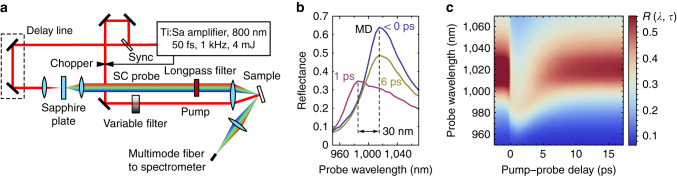
Experimental ultrafast all-optical tuning of GaAs metasurfaces. a Setup for broadband pump–probe spectroscopy. Amplified femtosecond pulses are used both for pumping metasurfaces and for generation of the supercontinuum (SC) probe. Transients are measured as a function of both time delay between the pump and probe pulses and probe wavelength. b Experimental reflectance of the sample at different pump–probe delays. The MD mode blueshift of 30 nm is observed at a pump fluence of 310 μJ cm−2. c Transient reflectance spectra that reveal the ultrafast modulation of the resonance within a 6-ps time window. Note that the reflectance values higher than 0.56 are clipped with the false-colour scale for the sake of better visualisation of the post-pump processes
Fig. 3
Fig. 3
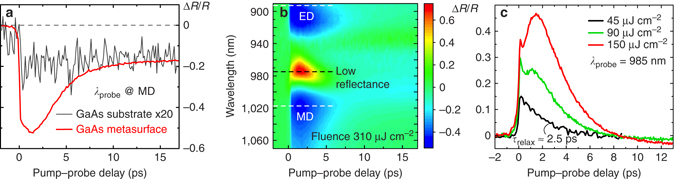
Transient optical properties of GaAs metasurfaces. a Transient reflectance measurement results for the sample (red curve) and for the substrate (black curve; ordinate values are multiplied by 20 for comparison) at a pump fluence of 380 μJ cm−2. An enhancement factor of about 50 is attained for the modulation depth at the metasurface sample. b Measured differential reflectance as a function of probe wavelength and time delay between the pump and probe pulses. White dashed lines denote the spectral positions of the ED and MD modes, while the black one indicates the area of low reflectance situated in between the resonances. c Power-dependent transient reflectance traces. The low-perturbation regime (black curve) reveals exponential decay with a time constant of τ relax ≈ 2.5 ps, whereas higher fluences (red and green curves) provide more complicated traces owing to the blue shift of the MD resonance
Fig. 4
Fig. 4
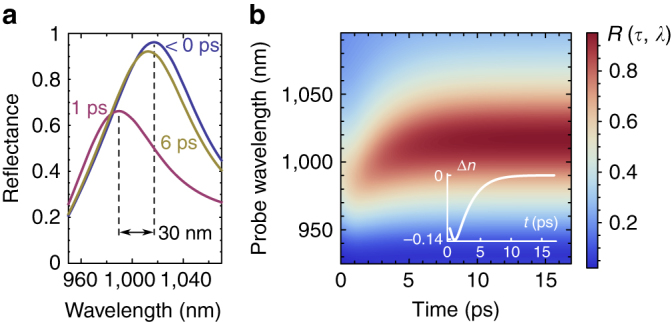
Full-wave simulation results. Transient reflectance spectra obtained using COMSOL Multiphysics with Eqs. (2), (4), and (5) describing the refractive index dynamics. a Reflectance of the sample at τ < 0 ps (pre-pump, blue curve), τ = 1 ps (carriers cooled, purple curve) and τ = 6 ps (carriers recombined, yellow curve). b Reflectance as a function of probe wavelength and time. The inset shows the time-dependent addition to the index of GaAs used in calculations

References

    1. Yu N, et al. Light propagation with phase discontinuities: generalized laws of reflection and refraction. Science. 2011;334:333–337. doi: 10.1126/science.1210713. - DOI - PubMed
    1. Ni X, Emani NK, Kildishev AV, Boltasseva A, Shalaev VM. Broadband light bending with plasmonic nanoantennas. Science. 2012;335:427. doi: 10.1126/science.1214686. - DOI - PubMed
    1. Yu N, Capasso F. Flat optics with designer metasurfaces. Nat. Mater. 2014;13:139–150. doi: 10.1038/nmat3839. - DOI - PubMed
    1. Meinzer N, Barnes WL, Hooper IR. Plasmonic meta-atoms and metasurfaces. Nat. Photonics. 2014;8:889–898. doi: 10.1038/nphoton.2014.247. - DOI
    1. Paik T, et al. Solution-processed phase-change VO2 metamaterials from colloidal vanadium oxide (VOx) nanocrystals. ACS Nano. 2014;8:797–806. doi: 10.1021/nn4054446. - DOI - PubMed

Publication types