


To sleep or not to sleep: neuronal and ecological insights
- PMID: 28500869
- PMCID: PMC5519825
- DOI: 10.1016/j.conb.2017.04.010
To sleep or not to sleep: neuronal and ecological insights
Abstract
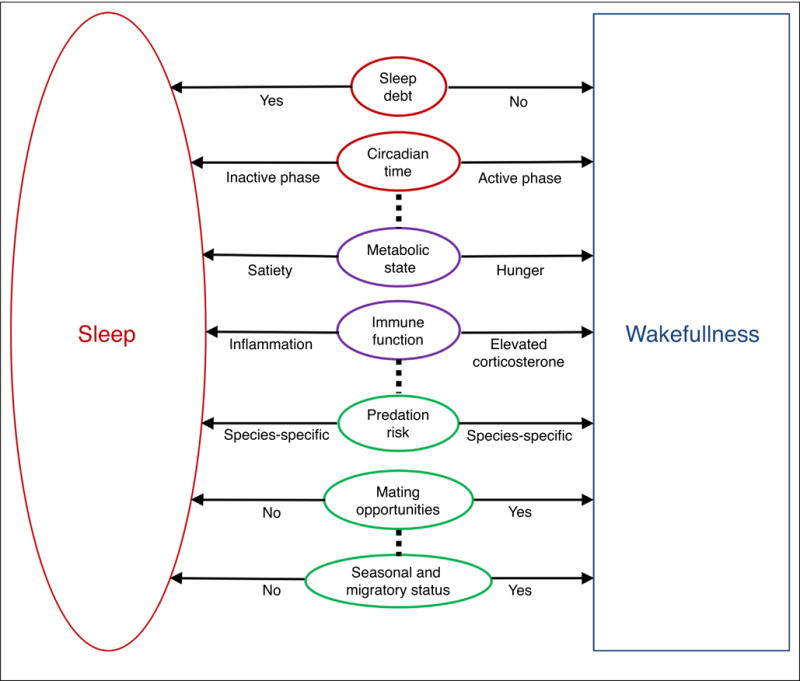
Daily, animals need to decide when to stop engaging in cognitive processes and behavioral responses to the environment, and go to sleep. The main processes regulating the daily organization of sleep and wakefulness are circadian rhythms and homeostatic sleep pressure. In addition, motivational processes such as food seeking and predator evasion can modulate sleep/wake behaviors. Here, we discuss the principal processes regulating the propensity to stay awake or go to sleep-focusing on neuronal and behavioral aspects. We first introduce the neuronal populations involved in sleep/wake regulation. Next, we describe the circadian and homeostatic drives for sleep. Then, we highlight studies demonstrating various effects of motivational processes on sleep/wake behaviors, and discuss possible neuronal mechanisms underlying their control.
Copyright © 2017 Elsevier Ltd. All rights reserved.
Conflict of interest statement
Conflict of interest statement
Nothing declared.
Figures
References
-
- Borbely AA, Achermann P. Sleep homeostasis and models of sleep regulation. J Biol Rhythms. 1999;14:557–568. - PubMed
-
- Borbely AA, Daan S, Wirz-Justice A, Deboer T. The two-process model of sleep regulation: a reappraisal. J Sleep Res. 2016;25:131–143. - PubMed
-
- Luppi PH, Peyron C, Fort P. Not a single but multiple populations of GABAergic neurons control sleep. Sleep Med Rev. 2016 A review that summarizes recent advances in our understanding of the roles of different GABAergic populations across the brain in the regulation of NREM and REM sleep. - PubMed
Publication types
MeSH terms
Grants and funding
LinkOut - more resources
Full Text Sources
Other Literature Sources
