


Geographic mobility and potential bridging for sexually transmitted infections in Agbogbloshie, Ghana
- PMID: 28501018
- PMCID: PMC5525941
- DOI: 10.1016/j.socscimed.2017.05.003
Geographic mobility and potential bridging for sexually transmitted infections in Agbogbloshie, Ghana
Abstract
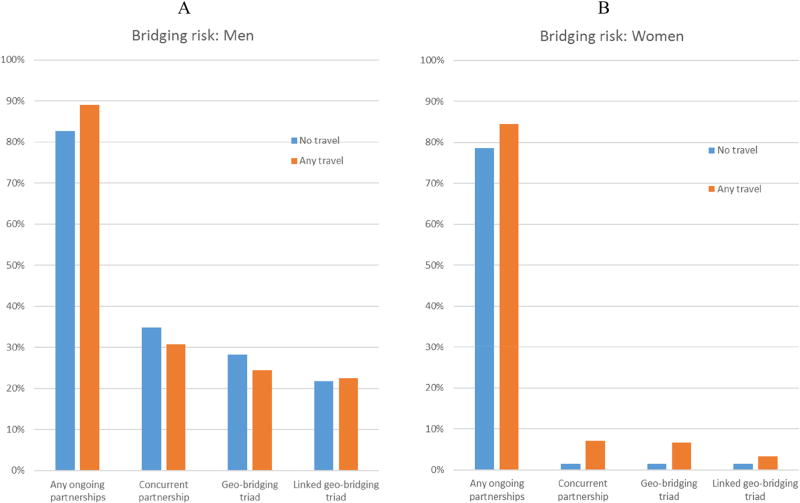
Short-term mobility can significantly influence the spread of infectious disease. In order for mobile individuals to geographically spread sexually transmitted infections (STIs), individuals must engage in sexual acts with different partners in two places within a short time. In this study, we considered the potential of mobile individuals as bridge populations - individuals who link otherwise disconnected sexual networks and contributed to ongoing STI transmission. Using monthly retrospective panel data, we examined associations between short-term mobility and sexual partner concurrency in Agbogbloshie, Ghana. We also examined bridging by the location of sex acts and the location of sexual partners in concurrent triads, and whether mobile individuals from our sample were more likely to be members of geographic bridging triads. Although reported rates of sexual partnership concurrency were much higher for men compared to women, mobility was only associated with increased concurrency for women. Additionally, this association held for middle-distance mobility and short-duration trips for women. Taking into account the location of sex acts and the location of sexual partners, about 22% of men (21.7% and 22.4% for mobile and non-mobile men, respectively) and only 3% of women (1.4% and 3.3% for mobile and non-mobile women, respectively) were potential bridges for STIs over the last year. Our results highlight the gendered nature of mobility and sexual risk behavior, reflecting the normative social context that encourages women to conceal certain types of sexual behavior.
Keywords: Circular migration; HIV; Partner concurrency; STI; Sexual network.
Copyright © 2017 Elsevier Ltd. All rights reserved.
Figures
References
-
- Ackah C, Medvedev D. Internal migration in Ghana: determinants and welfare impacts. Int. J. Soc. Econ. 2012;39(10):764–784.
-
- Agyei-Mensah S. Twelve years of HIV/AIDS in Ghana: puzzles of interpretation. Can. J. A. fr. Stud. 2001;35(3):441–472. - PubMed
-
- Anarfi JK. Sexuality, migration and AIDS in Ghana-A socio-behavioural study. Health Transit. Rev. 1993;3:1–22. (ment)
-
- Anarfi JK. Migration and livelihoods in the era of AIDS: a west African focus with emphasis on Ghana. Res. Rev. Inst. Afr. Stud. 2001;17(1):17–24.
Publication types
MeSH terms
Grants and funding
LinkOut - more resources
Full Text Sources
Other Literature Sources
Medical
