Review
. 2017 May 8:10:23.
doi: 10.1186/s13072-017-0130-8. eCollection 2017.

DNA methylation and DNA methyltransferases

Affiliations
Review

DNA methylation and DNA methyltransferases

John R Edwards et al. Epigenetics Chromatin. .

Abstract

The prevailing views as to the form, function, and regulation of genomic methylation patterns have their origin many years in the past, at a time when the structure of the mammalian genome was only dimly perceived, when the number of protein-encoding mammalian genes was believed to be at least five times greater than the actual number, and when it was not understood that only ~10% of the genome is under selective pressure and likely to have biological function. We use more recent findings from genome biology and whole-genome methylation profiling to provide a reappraisal of the shape of genomic methylation patterns and the nature of the changes that they undergo during gametogenesis and early development. We observe that the sequences that undergo deep changes in methylation status during early development are largely sequences without regulatory function. We also discuss recent findings that begin to explain the remarkable fidelity of maintenance methylation. Rather than a general overview of DNA methylation in mammals (which has been the subject of many reviews), we present a new analysis of the distribution of methylated CpG dinucleotides across the multiple sequence compartments that make up the mammalian genome, and we offer an updated interpretation of the nature of the changes in methylation patterns that occur in germ cells and early embryos. We discuss the cues that might designate specific sequences for demethylation or de novo methylation during development, and we summarize recent findings on mechanisms that maintain methylation patterns in mammalian genomes. We also describe the several human disorders, each very different from the other, that are caused by mutations in DNA methyltransferase genes.

Keywords: DNA cytosine methylation; Epigenetics; Mammalian DNA methyltransferases; Methylation dynamics; Methylation-related human diseases.


Figures
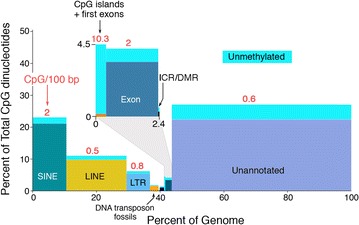
Fig. 1
Fig. 1
Distribution of DNA methylation across sequence compartments in the human genome. Vertical axis indicates percentage of total CpG dinucleotides in each indicated compartment; horizontal axis indicates percentage of total genome in each compartment; light blue at the top of each compartment indicates unmethylated fraction. Numerals in red denote CpG dinucleotides per 100 bp. The genome-wide CpG density expected on the basis of G + C content is 4.2 per 100 bp. Note that the only sequence compartment that exists in the largely unmethylated state is the CpG island/first exon compartment; this compartment occupies <0.5% of the genome. The ICR/DMR compartment (differentially methylated regions of imprinting control regions) represents ~0.001% of the genome and ~0.01% of total CpG dinucleotides. Introns are included in the unannotated compartment, as are putative enhancers. The methylation data are from Bisulfite-Seq data for hippocampus (Roadmap Epigenome Project sample E071 [5]), but other differentiated adult tissues show very similar trends
Fig. 2
Fig. 2
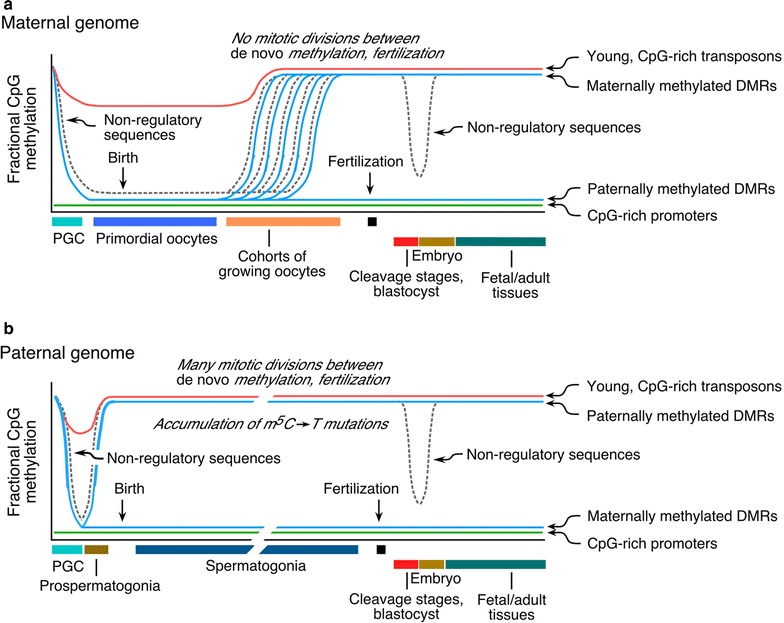
Dynamics of demethylation and de novo methylation in the maternal (a) and paternal (b) genomes during mammalian development. The standard depictions of developmental changes in genomic methylation patterns often assume a monolithic genome; in fact, different sequence compartments display marked differences in timing of methylation and demethylation. CpG-rich (CpG island) promoters are unmethylated at all stages, except for the small number of CpG islands associated with imprinting control regions and CpG islands on the inactive X chromosome in somatic cells of females. Young, CpG-rich transposons largely escape both waves of demethylation. Most of the dynamic methylation and demethylation that occurs in primordial germ cells (PGCs) and the early embryo affects sequences that are evolving at the neutral rate and whose methylation status is without known biological effect. The methylation status of these sequences, which represent the bulk of the genome and are composed of satellite DNA, old and inactive transposons, introns, and unannotated sequences evolving at the neutral rate, is shown by broken lines
Fig. 3
Fig. 3
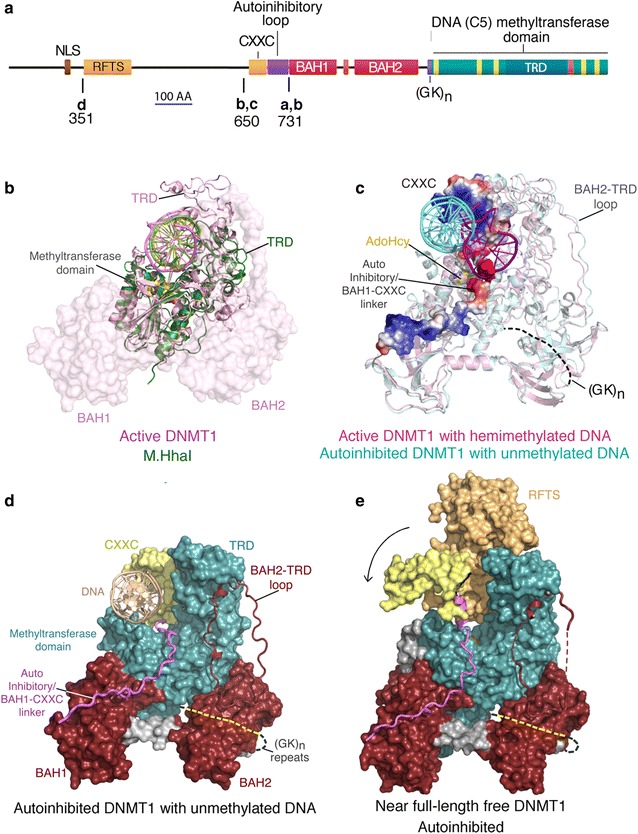
Structure and regulation of DNMT1. a Functional domains in DNMT1. A nuclear localization sequence (NLS) and replication focus targeting sequence (RFTS) are closest to the N-terminus. A CXXC domain binds selectively to unmethylated CpG dinucleotides; this binding event interposes an acidic autoinhibitory loop between the active site and unmethylated DNA to inhibit de novo methylation [30]. The bromo-adjacent homology (BAH) domains 1 and 2 are of unknown function but are related in structure to BAH domains in other proteins that bind to specific modified histones (reviewed in [39]). A run of alternating lysine and glycine residues joins the multidomain N-terminal domain to the large C-terminal methyltransferase domain, which is related in sequence and structure to all other DNA (cytosine-5) methyltransferases (reviewed in [35]). Letters below the diagram indicate the position of N-terminal truncations in the crystal structures shown in be. b Superposition of the structures of active DNMT1 [30] and M.HhaI, a bacterial restriction methyltransferase [40]. The methyltransferase domain of DNMT1 shows strong isostery with full-length M.HhaI. c Superposition of autoinhibited DNMT1 in complex with unmethylated DNA and active DNMT1 deleted for the CXXC and autoinhibitory loop domains in complex with hemimethylated DNA [41]. DNA can be seen to have accessed the catalytic pocket of DNMT1 in the active complex and to be very close to the S-adenosyl-l-homocysteine present in both complexes. d, e Impingement of the RFTS on the CXXC domain displaces the latter (curved arrow) into a conformation that inhibits binding of DNA [42]. It is proposed that the interaction of UHRF1 bound to hemimethylated DNA causes a retraction of the RFTS domain to allow access of hemimethylated DNA to the active site of DNMT1 [42]
Fig. 4
Fig. 4
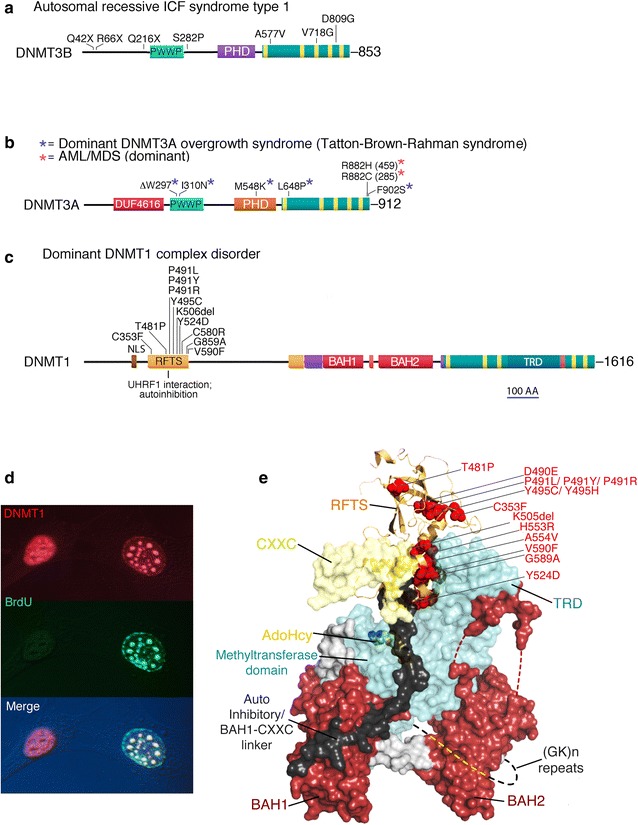
Each of the three DNMT genes is mutated in specific and diverse human syndromes. a DNMT3B bears recessive loss-of-function mutations in ICF syndrome type 1. b DNMT3A is mutated in dominant DNMT3A overgrowth syndrome and in subset of cases of acute myeloid leukemia and myelodysplastic syndrome. While most AML/MDS mutations affect codon 882, mutations at other positions also occur. c The RFTS domain of DNMT1 is subject to many different dominant mutations in a variable adult-onset cerebellar ataxia, deafness, dementia, and narcolepsy syndrome. The RFTS mediates interactions with replication foci during S phase (d) and with UHRF1. The positions of the amino acid substitutions within the structure of DNMT1 are shown in e. Only a subset of reported disease-associated mutations are shown for any of the three genes

References

    1. Edwards JR, et al. Chromatin and sequence features that define the fine and gross structure of genomic methylation patterns. Genome Res. 2010;7:972–980. doi: 10.1101/gr.101535.109. - DOI - PMC - PubMed
    1. Bestor TH, Edwards JR, Boulard M. Notes on the role of dynamic DNA methylation in mammalian development. Proc Natl Acad Sci USA. 2015;112:6796–67999. doi: 10.1073/pnas.1415301111. - DOI - PMC - PubMed
    1. Lister R, et al. Human DNA methylomes at base resolution show widespread epigenomic differences. Nature. 2009;462:315–322. doi: 10.1038/nature08514. - DOI - PMC - PubMed
    1. Ioshikhes IP, Zhang MQ. Large-scale human promoter mapping using CpG islands. Nat Genet. 2000;26:61–63. doi: 10.1038/79189. - DOI - PubMed
    1. Roadmap Epigenomics Consortium. Kundaje A, Meuleman W, Ernst J, Bilenky M, Yen A, Heravi-Moussavi A, Kheradpour P, Zhang Z, Wang J, et al. Integrative analysis of 111 reference human epigenomes. Nature. 2015;518:317–330. doi: 10.1038/nature14248. - DOI - PMC - PubMed

Publication types

Substances