


Racial differences in the pain management of children recovering from anesthesia
- PMID: 28504322
- PMCID: PMC5474946
- DOI: 10.1111/pan.13163
Racial differences in the pain management of children recovering from anesthesia
Abstract
Background: When pain management has been studied in settings such as pediatric emergency departments, racial disparities have been clearly identified. To our knowledge, this has not been studied in the pediatric perioperative setting. We sought to determine whether there are differences based on race in the administration of analgesia to children suffering from pain in the postanesthesia care unit.
Methods: This is a prospective, observational, study of 771 children aged 4-17 years who underwent elective outpatient surgery. Racial differences in probability of receiving analgesia for pain in the recovery room were assessed using bivariable and multivariable logistic regression analyses.
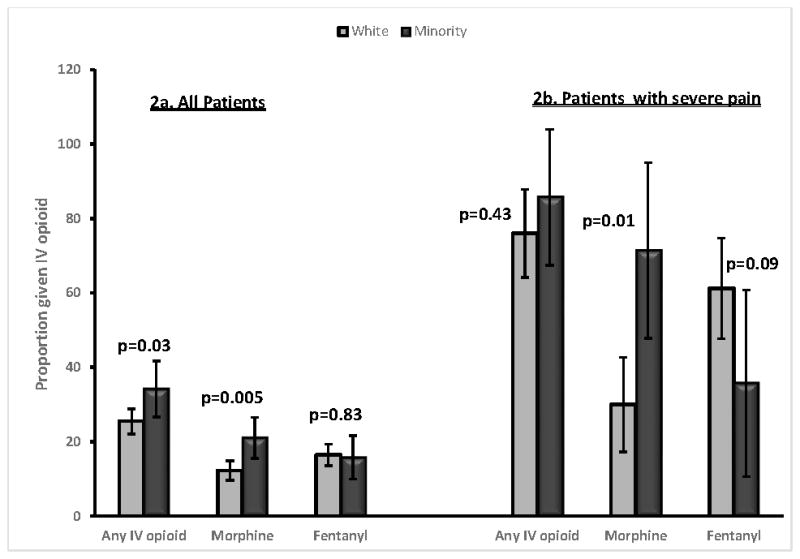
Results: A total of 294 children (38.2%) received at least one class of analgesia (opioid or nonopioid); while 210 (27.2%) received intravenous (i.v.) opioid analgesia in the recovery room. Overall postanesthesia care unit analgesia utilization was similar between white and minority children (white children 36.8% vs minority children 43.4%, OR 1.3; 95% CI=0.92-1.89; P=.134). We found no significant difference by racial/ethnic group in the likelihood of a child receiving i.v. opioid for severe postoperative pain (white children 76.0% vs 85.7%, OR 1.89; 95% CI=0.37-9.67; P=.437). However, minority children were more likely to receive i.v. opioid analgesia than their white peers (white children 24.5% vs minority children 34.2%, OR 1.5; 95% CI=1.04-2.2; P=.03). On multivariable analysis, minority children had a 63% higher adjusted odds of receiving i.v. opioids in the recovery room (OR=1.63; 95% CI, 1.05-2.62; P=.03).
Conclusions: Receipt of analgesia for acute postoperative pain was not significantly associated with a child's race. Minority children were more likely to receive i.v. opioids for the management of mild pain.
Keywords: ethnic minority; pain management; pediatric ambulatory surgery; postanesthesia care unit; racial disparity.
© 2017 John Wiley & Sons Ltd.
Conflict of interest statement
Figures
References
-
- Institute of Medicine. Unequal Treatment: Confronting Racial and Ethnic Disparities in Health Care. Washington, DC: National Academies Press; 2003. - PubMed
-
- Kirby JB, Taliaferro G, Zuvekas SH. Explaining racial and ethnic disparities in health care. Med Care. 2006;44:I64–I72. - PubMed
-
- Todd KH, Samaroo N, Hoffman JR. Ethnicity as a risk factor for inadequate emergency department analgesia. JAMA. 1993;269(12):1537–9. - PubMed
-
- Fiscella K, Franks P, Gold MR, Clancy CM. Inequality in quality: addressing socioeconomic, racial, and ethnic disparities in health care. JAMA. 2000;283(19):2579–2584. - PubMed
-
- Green CR, Baker TA, Smith EM, Sato Y. The effect of race in older adults presenting for chronic pain management: A comparative study of African and Caucasian Americans. J Pain. 2003;4:82–90. - PubMed
Publication types
MeSH terms
Substances
Grants and funding
LinkOut - more resources
Full Text Sources
Other Literature Sources
Medical
