


Carotid angioplasty-assisted mechanical thrombectomy without urgent stenting may be a better option in acute tandem occlusions
- PMID: 28504557
- PMCID: PMC5684897
- DOI: 10.1177/1591019917701113
Carotid angioplasty-assisted mechanical thrombectomy without urgent stenting may be a better option in acute tandem occlusions
Abstract
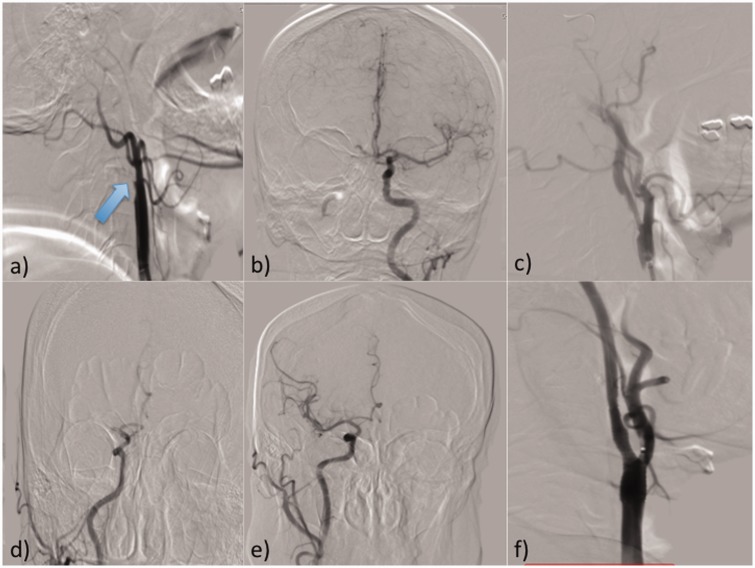
Background The aim of the study was to assess the efficacy of balloon angioplasty-assisted mechanical thrombectomy without urgent stenting in the carotid artery as another approach for endovascular treatment of tandem occlusions. Methods Fifteen consecutive cases of tandem occlusions treated with the endovascular approach between January 2014 and May 2016 were reviewed. The study cohort included patients with an etiology of large vessel atherosclerosis. Extracranial carotid stenting was performed in another session if post-thrombectomy mRS modified Rankin Score (mRS) was 0-2. Good clinical outcome was determined by follow-up at 7-10, 30 and 90 days according to the mRS. Results Most patients (80%) were male. Eight (53.4%) patients received intravenous thrombolysis before angiography. Proximal revascularization was successful in 100% of cases with balloon angioplasty internal carotid artery (ICA) origin. Successful recanalization (modified thrombolysis in cerebral infarction (mTICI) 2b-3) (mTICI 2 b-3) occurred in 12 cases (80%) and good clinical outcomes were achieved in 10 patients (66.7%). Cervical ICA stent placement was performed in 10 patients with good clinical outcomes. No symptomatic intracranial hemorrhage occurred after delayed ICA stenting Conclusions This is the first reported case series to evaluate this approach for endovascular treatment of tandem occlusions. Carotid angioplasty-assisted mechanical thrombectomy without urgent stenting seems to be a safer approach.
Keywords: Acute stroke; angioplasty-assisted mechanical thrombectomy; carotid angioplasty; interventional neurology; tandem occlusion.
Figures
References
-
- Rubiera M, Ribo M, Delgado-Mederos R, et al. Tandem internal carotid artery/middle cerebral artery occlusion: An independent predictor of poor outcome after systemic thrombolysis. Stroke 2006; 37: 2301–2305. - PubMed
-
- Grigoryan M, Haussen DC, Hassan AE, et al. Endovascular treatment of acute ischemic stroke due to tandem occlusions: Large multicenter series and systematic review. Cerebrovasc Dis 2016; 41: 306–312. - PubMed
-
- Saver JL, Goyal M, Bonafe A, et al. Stent-retriever thrombectomy after intravenous t-PA vs. t-PA alone in stroke. N Engl J Med 2015; 372: 2285–2295. - PubMed
-
- Miyamoto N, Naito I, Takatama S, et al. Urgent stenting for patients with acute stroke due to atherosclerotic occlusive lesions of the cervical internal carotid artery. Neurol Med Chir 2008; 48: 49–55. - PubMed
-
- Roth C, Papanagiotou P, Behnke S, et al. Stent-assisted mechanical recanalization for treatment of acute intracerebral artery occlusions. Stroke 2010; 41: 2559–2567. - PubMed
MeSH terms
LinkOut - more resources
Full Text Sources
Other Literature Sources
Miscellaneous
