


Health literacy and primary health care use of ethnic minorities in the Netherlands
- PMID: 28506230
- PMCID: PMC5432986
- DOI: 10.1186/s12913-017-2276-2
Health literacy and primary health care use of ethnic minorities in the Netherlands
Abstract
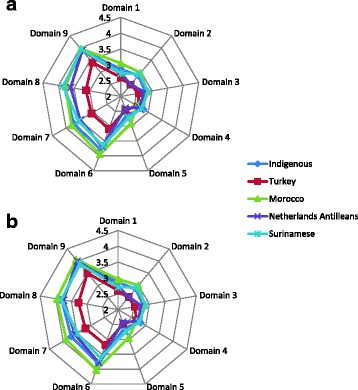
Background: In the Netherlands, ethnic minority populations visit their general practitioner (GP) more often than the indigenous population. An explanation for this association is lacking. Recently, health literacy is suggested as a possible explaining mechanism. Internationally, associations between health literacy and health care use, and between ethnicity and health literacy have been studied separately, but, so far, have not been linked to each other. In the Netherlands, some expectations have been expressed with regard to supposed low health literacy of ethnic minority groups, however, no empirical study has been done so far. The objectives of this study are therefore to acquire insight into the level of health literacy of ethnic minorities in the Netherlands and to examine whether the relationship between ethnicity and health care use can be (partly) explained by health literacy.
Methods: A questionnaire was sent to a sample of 2.116 members of the Dutch Health Care Consumer Panel (response rate 46%, 89 respondents of non-western origin). Health literacy was measured with the Health Literacy Questionnaire (HLQ) which covers nine different domains. The health literacy levels of ethnic minority groups were compared to the indigenous population. A negative binomial regression model was used to estimate the association between ethnicity and GP visits. To examine whether health literacy is an explaining factor in this association, health literacy and interaction terms of health literacy and ethnicity were added into the model.
Results: Differences in levels of health literacy were only found between the Turkish population and the indigenous Dutch population. This study also found an association between ethnicity and GP visits. Ethnic minorities visit their GP 33% more often than the indigenous population. Three domains of the HLQ (the ability to navigate the health care system, the ability to find information and to read and understand health information) partly explained the association between ethnicity and GP visits.
Conclusions: In general, there are no differences in health literacy between most of the ethnic minority groups in the Netherlands and the indigenous Dutch population. Only the Turkish population scored significantly lower on several health literacy domains. Some domains of health literacy do explain the association between ethnicity and higher frequency of GP visits. Further research is recommended to understand the pathways through which health literacy impacts health care use.
Keywords: Ethnic minorities; General practitioner; Health literacy; Primary care.
Figures
References
-
- Beauchamp A, Buchbinder R, Dodson S, Batterham RW, Elsworth, GR, McPhee C, Osborne RH. Distribution of health literacy strengths and weaknesses across socio-demographic groups: a cross-sectional survey using the Health Literacy Questionnaire (HLQ). BMC Public Health. 2015;15: 678. doi:10.1186/s12889-015-2056-z. - PMC - PubMed
MeSH terms
LinkOut - more resources
Full Text Sources
Other Literature Sources
Medical
