


Trends in racial/ethnic disparities of new AIDS diagnoses in the United States, 1984-2013
- PMID: 28506566
- PMCID: PMC5931787
- DOI: 10.1016/j.annepidem.2017.04.002
Trends in racial/ethnic disparities of new AIDS diagnoses in the United States, 1984-2013
Abstract
Purpose: In the United States, human immunodeficiency virus (HIV)/acquired immune deficiency syndrome (AIDS) disproportionately impacts racial/ethnic minorities. We describe and evaluate trends in the Black-White and Hispanic-White disparities of new AIDS diagnoses from 1984 to 2013 in the United States.
Methods: AIDS diagnosis rates by race/ethnicity for people ≥13 years were calculated using national HIV surveillance and Census data. Black-White and Hispanic-White disparities were measured as rate ratios. Joinpoint Regression was used to identify time periods across which to estimate rate-ratio trends. We calculated the estimated annual percent change in disparities for each time period using log-normal linear regression modeling.
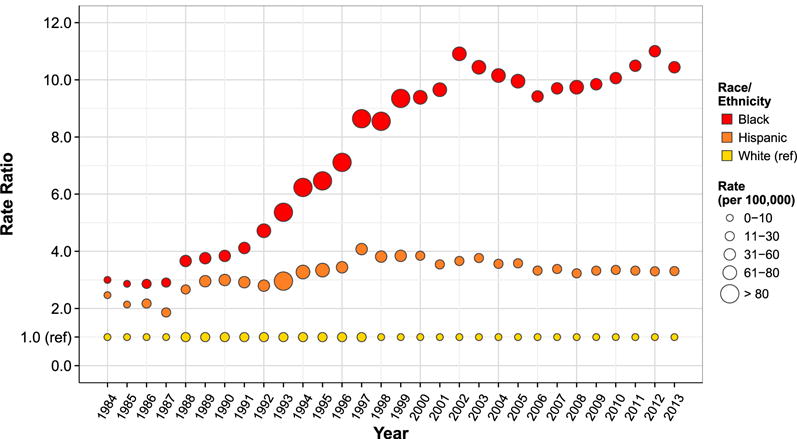
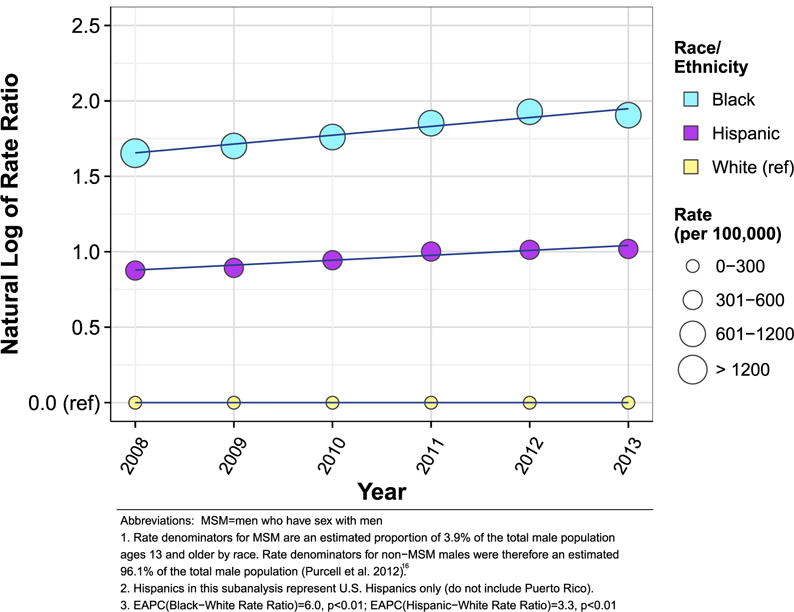
Results: Black-White disparity increased from 1984 to 1990, followed by a large increase from 1991 to 1996, and a smaller increase from 1997 to 2001. Black-White disparity moderated from 2002 to 2005 and rose again from 2006 to 2013. Hispanic-White disparity increased from 1984 to 1997 but declined after 1998. Black-White and Hispanic-White disparities increased for men who have sex with men during 2008 to 2013.
Conclusions: Recent increases in racial/ethnic disparities of AIDS diagnoses were observed and may be due in part to care continuum inequalities. We suggest assessing disparities in AIDS diagnoses as a high-level measure to capture changes at multiple stages of the care continuum collectively. Future research should examine determinants of racial/ethnic differences at each step of the continuum to better identify characteristics driving disparities.
Keywords: AIDS; Care; Disparities; HIV; Racial/ethnic; Trends.
Copyright © 2017 Elsevier Inc. All rights reserved.
Conflict of interest statement
The authors have no conflicts of interests to disclose.
Figures

References
-
- Centers for Disease Control and Prevention. Monitoring selected national HIV prevention and care objectives by using HIV surveillance data—United States and 6 dependent areas—2012. HIV Surveill Suppl Rep. 2014;19(3):8–28. Available at: http://www.cdc.gov/hiv/pdf/surveillance_report_vol_19_no_3.pdf.
-
- Centers for Disease Control and Prevention. CDC Fact Sheet: HIV among Gay and Bisexual Men. 2015 Available at: http://www.cdc.gov/nchhstp/newsroom/docs/factsheets/cdc-msm-508.pdf.
-
- Centers for Disease Control and Prevention. Estimated incidence of AIDS and deaths of persons with AIDS. HIV/AIDS Surveill Rep. 1997;9:7. Available at: http://www.cdc.gov/hiv/library/reports/surveillance/pastIssues.html#panel0.
-
- Centers for Disease Control and Prevention. HIV in the United States: At A Glance. 2014 Available at: http://www.cdc.gov/hiv/pdf/statistics_basics_ataglance_factsheet.pdf.
-
- The White House Office of National AIDS Policy. National HIV/AIDS Strategy for the United States. 2010 Available at: http://www.whitehouse.gov/sites/default/files/uploads/NHAS.pdf.
MeSH terms
Grants and funding
LinkOut - more resources
Full Text Sources
Other Literature Sources
Medical
