Review
. 2018 Jan 2;10(1):a029314.
doi: 10.1101/cshperspect.a029314.

Cell Biology of Tight Junction Barrier Regulation and Mucosal Disease

Affiliations
Review

Cell Biology of Tight Junction Barrier Regulation and Mucosal Disease

Aaron Buckley et al. Cold Spring Harb Perspect Biol. .

Abstract

Mucosal surfaces are lined by epithelial cells. In the intestine, the epithelium establishes a selectively permeable barrier that supports nutrient absorption and waste secretion while preventing intrusion by luminal materials. Intestinal epithelia therefore play a central role in regulating interactions between the mucosal immune system and luminal contents, which include dietary antigens, a diverse intestinal microbiome, and pathogens. The paracellular space is sealed by the tight junction, which is maintained by a complex network of protein interactions. Tight junction dysfunction has been linked to a variety of local and systemic diseases. Two molecularly and biophysically distinct pathways across the intestinal tight junction are selectively and differentially regulated by inflammatory stimuli. This review discusses the mechanisms underlying these events, their impact on disease, and the potential of using these as paradigms for development of tight junction-targeted therapeutic interventions.


Figures

Figure 1.
Figure 1.
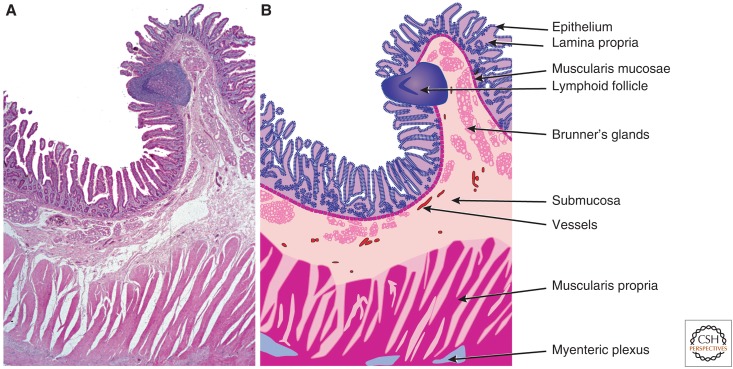
Small intestinal mucosal architecture. (A) Low magnification image of hematoxylin and eosin-stained section of normal human duodenum. Many of the structural features that are common throughout the gastrointestinal tract and other mucosal surfaces can be appreciated. (B) Line diagram indicating specific structures that comprise the intestinal wall. The open spaces between fibers of the muscularis propria represent artefactual separation that occurred during tissue processing. (From Podolsky et al. 2015; reprinted, with permission from John Wiley & Sons ©2015.)
Figure 2.
Figure 2.
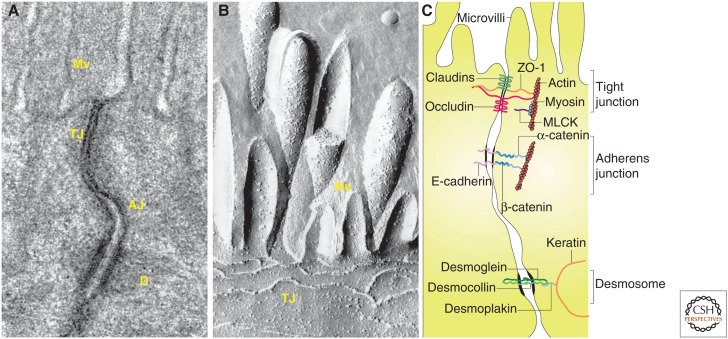
The apical junctional complex. (A) Transmission electron micrograph showing junctional complexes between two villous enterocytes. The tight junction (TJ) is just below the microvilli (Mv), followed by the adherens junction (AJ). The desmosomes (D) are located basolaterally. (B) Freeze-fracture electron micrograph showing apical microvilli (Mv) and tight junction strands (TJ) in a cultured intestinal epithelial cell. (C) Line drawing of the apical junctional complex of an intestinal epithelial cell. Tight junction proteins include claudins, zonula occludens-1 (ZO-1), and occludin, whereas E-cadherin, α-catenin, and β-catenin interact to form the adherens junction. Myosin light chain kinase (MLCK) is associated with the perijunctional actomyosin ring. Desmosomes are formed by interactions between desmoglein, desmocollin, desmoplakin and keratin filaments. (Parts A and C, from Turner 2009; reprinted, with permission; part B, from Shen et al. 2011; reprinted, with permission from Annual Reviews ©2011.)
Figure 3.
Figure 3.
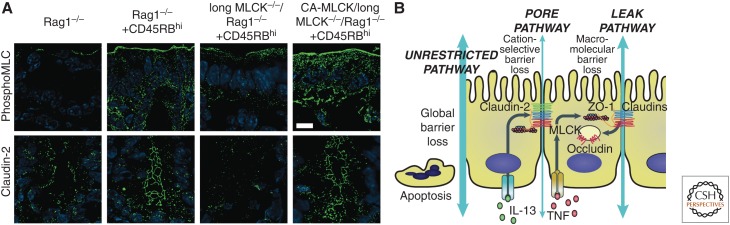
Tight junction flux pathways in disease. Transgenic, intestinal epithelial-restricted expression of constitutively active-MLCK restores sensitivity of long MLCK−/− mice to CD4+CD45RBhi-adoptive transfer colitis, an immune-mediated experimental inflammatory bowel disease (IBD). (A) Long myosin light chain kinase (MLCK) is essential for myosin II regulatory light chain (MLC) phosphorylation and claudin-2 upregulation during immune-mediated experimental IBD. Long MLCK−/− mice are protected from disease-associated MLC phosphorylation and claudin-2 upregulation. Tissue specific, intestinal epithelial expression of a constitutively active MLCK catalytic domain (CA-MLCK) restores disease-associated MLC phosphorylation and claudin-2 upregulation. Serine-19-phosphorylated MLC (phosphoMLC) or claudin-2 (green) and nuclei (blue) are shown. Bar = 10 um. (B) Diagram of intestinal permeability pathways in disease. Pore and leak pathways are regulated by claudin-2 expression and MLCK-dependent occludin endocytosis, respectively. The unrestricted pathway is a tight junction-independent pathway at sites of epithelial damage (e.g., apoptosis) that is present in advanced disease. (From Su et al. 2013; adapted, with permission, from Elsevier ©2013.)
Figure 4.
Figure 4.
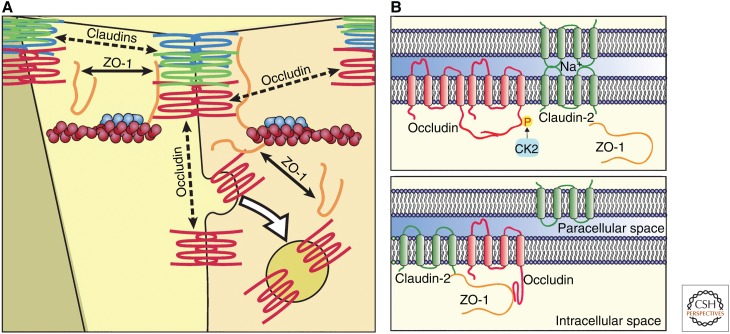
Molecular mechanisms of leak and pore pathway regulation. (A) Tight junction complex remodeling at steady-state and in response to tumor necrosis factor (TNF). Dashed black lines indicate energy-independent diffusion of claudins (green, blue) and occludin (red) within the membrane; the mobile fractions of occludin and claudin are both increased by TNF. Solid black lines indicate energy-dependent zonula occludens-1 (ZO-1) (orange) exchange between tight junction and cytosolic pools. Occludin endocytosis (white arrow) is driven by TNF-induced myosin light chain kinase (MLCK) activation and requires both caveolin-1 and ZO-1. (B) Phosphorylation regulates interactions between tight junction proteins and can be exploited to modify claudin-2 channel activity. Diagram shows interactions and dynamic behavior of proteins involved in tight junction regulation by casein kinase 2 (CK2). Upper panel. CK2-mediated phosphorylation of occludin S408 facilitates dimerization and diffusion within the membrane, thereby limiting occludin binding to ZO-1 and claudin-2 and allowing flux across claudin-2 pores. Lower panel. CK2 inhibition and occludin dephosphorylation promotes formation of occludin:ZO-1:claudin-2 complexes that reduce claudin-2 anchoring and pore function at the tight junction. (Part B, from Raleigh et al. 2011; reprinted, with permission from The Rockefeller University Press © 2011.)

References

    1. Al-Sadi R, Khatib K, Guo S, Ye D, Youssef M, Ma T. 2011. Occludin regulates macromolecule flux across the intestinal epithelial tight junction barrier. Am J Physiol Gastrointest Liver Physiol 300: G1054–1064. - PMC - PubMed
    1. Amasheh S, Meiri N, Gitter AH, Schoneberg T, Mankertz J, Schulzke JD, Fromm M. 2002. Claudin-2 expression induces cation-selective channels in tight junctions of epithelial cells. J Cell Sci 115: 4969–4976. - PubMed
    1. Amasheh S, Fromm M, Gunzel D. 2011. Claudins of intestine and nephron—a correlation of molecular tight junction structure and barrier function. Acta Physiol (Oxf) 201: 133–140. - PubMed
    1. Anderson JM, Van Itallie CM. 2009. Physiology and function of the tight junction. Cold Spring Harb Perspect Biol 1: a002584. - PMC - PubMed
    1. Angelow S, Schneeberger EE, Yu AS. 2007. Claudin-8 expression in renal epithelial cells augments the paracellular barrier by replacing endogenous claudin-2. J Membr Biol 215: 147–159. - PubMed

Publication types

LinkOut - more resources