Changes in Kinetic Parameters of Gait in Patients with Supratentorial Unilateral Stroke in Chronic Period
- PMID: 28507629
- PMCID: PMC5420775
- DOI: 10.3889/oamjms.2017.053
Changes in Kinetic Parameters of Gait in Patients with Supratentorial Unilateral Stroke in Chronic Period
Abstract
Aim: The aim of the study is to evaluate the changes of the kinetic parameters of gait in patients with supratentorial unilateral stroke in the chronic period (SUSChP).
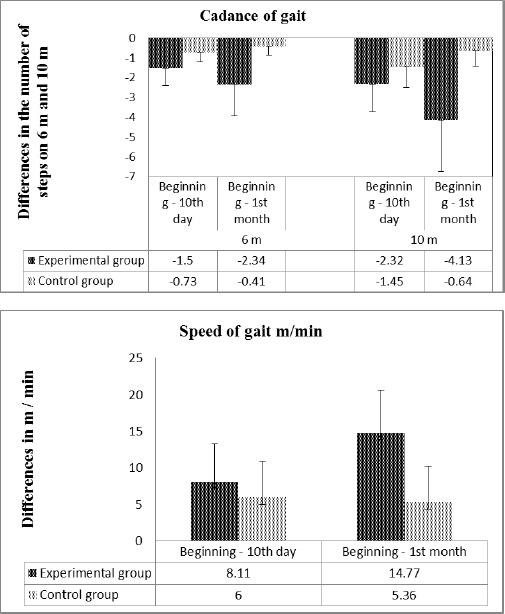
Material and methods: The study was conducted with 67 patients with SUSChP (56 patients included in the experimental group - 32 men and 24 women, with duration of disease 7.8 ± 2.0 months, and 11 patients in the control group - 9 men and 2 women, with duration of disease 7.3 ± 1.5 months). To evaluate the changes in the gait were followed cadence of 6 m and 10 m and the speed of movement which are the most informative kinetic parameters. Patients in the experimental group were treated with a specialised 10-day KT, which later continued to be performed as an adapted exercise program at home for one month.
Results: After applying specialised kinesitherapeutic methodology (SKTM), the highest trend towards improvement in the kinetic parameters of gait was established after the 1st month with a level of significance during treatment p < 0.001.
Conclusion: The enclosed SKTM in the experimental group continued later as an adapted exercise program at home, significantly improving the kinetic parameters of gait in patients with SUSChP, compared with the usual kinesi-therapeutic methodology applied in the control group.
Keywords: Chronic period; Gait; Kinetic parameters; Supratentorial unilateral stroke.
Figures
References
-
- Duysens J, Verheyden G, Massaad F, Meyns P, Smits-Engelsman B, Jonkers U. Rehabilitation of gait and balance after CNS injury. In: Dietz V, Ward N, editors. Oxford Textbook of Neurorehabilitation. Oxford University Press; 2015. pp. 211–227.
-
- Brandstater M, de Bruin H, Gowland C, Clark B. Hemiplegic gait: analysis of temporal variables. Arch Phys Med Rehabil. 1983;64:583–587. PMid:6661021. - PubMed
-
- Kerrigan D, Deming L, Holden M. Knee recurvatum in gait: a study of associated knee biomechanics. Arch Phys Med Rehabil. 1996;77:645–650. https://doi.org/10.1016/S0003-9993(96)90002-7 . - PubMed
-
- Kerrigan D, Schaufele M, Wen M. Gait analysis. In: Delisa J, Gans B, editors. Rehabilitation medicine principles and practice. 3rd ed. Philadelphia: Lippincott-Raven; 1998. pp. 167–187.
-
- Pis V, Bouer B, Kadian V. The gait in humans. In: Physical Medicine and Rehabilitation - Principles and Practice. Vol. 1. Skopje: Delisa J. Tabernakul; 2012. pp. 155–168.
LinkOut - more resources
Full Text Sources
Other Literature Sources