


Fecal immunochemical test-based colorectal cancer screening: The gender dilemma
- PMID: 28507758
- PMCID: PMC5415207
- DOI: 10.1177/2050640616659998
Fecal immunochemical test-based colorectal cancer screening: The gender dilemma
Abstract
Background: Despite differences between men and women in incidence of colorectal cancer (CRC) and its precursors, screening programs consistently use the same strategy for both genders.
Objective: The objective of this article is to illustrate the effects of gender-tailored screening, including the effects on miss rates of advanced neoplasia (AN).
Methods: Participants (age 50-75 years) in a colonoscopy screening program were asked to complete a fecal immunochemical test (FIT) before colonoscopy. Positivity rates, sensitivity and specificity for detection of AN at multiple cut-offs were determined. Absolute numbers of detected and missed AN per 1000 screenees were calculated.
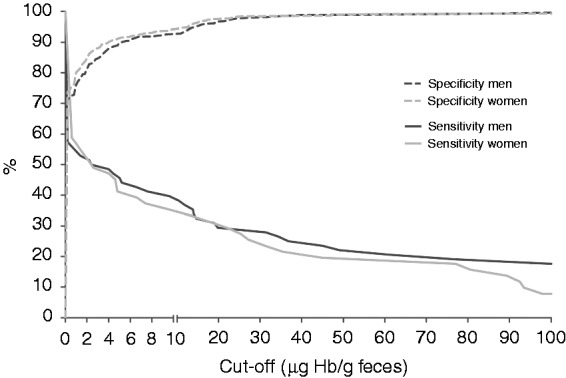
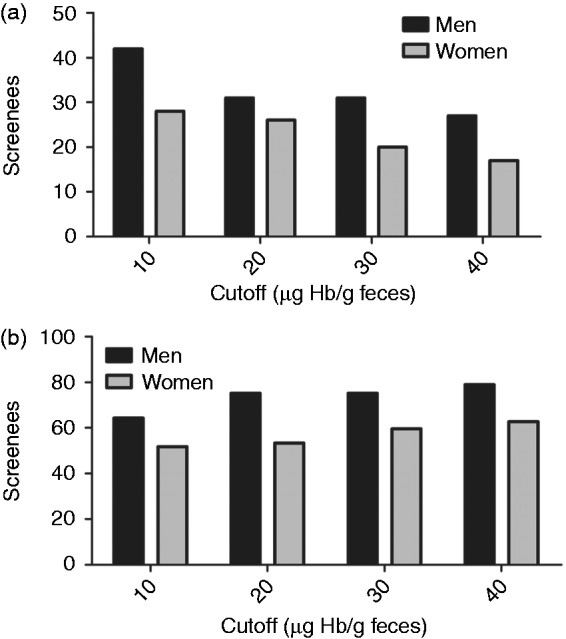
Results: In total 1,256 individuals underwent FIT and colonoscopy, 51% male (median age 61 years; IQR 56-66) and 49% female (median age 60 years; IQR 55-65). At all cut-offs men had higher positivity rates than women, ranging from 3.8% to 10.8% versus 3.2% to 4.8%. Sensitivity for AN was higher in men than women; 40%-25% and 35%-22%, respectively. More AN were found and missed in absolute numbers in men at all cut-offs.
Conclusion: More AN were both detected and missed in men compared to women at all cut-offs. Gender-tailored cut-offs could either level sensitivity in men and women (i.e., lower cut-off in women) or level the amount of missed lesions (i.e., lower cut-off in men).
Keywords: Colorectal cancer; fecal immunochemical test; gender; miss rates; screening.
Figures
References
LinkOut - more resources
Full Text Sources
Other Literature Sources
