. 2017:1602:59-81.
doi: 10.1007/978-1-4939-6964-7_5.

Efficient Reverse Genetic Systems for Rapid Genetic Manipulation of Emergent and Preemergent Infectious Coronaviruses

Affiliations

Efficient Reverse Genetic Systems for Rapid Genetic Manipulation of Emergent and Preemergent Infectious Coronaviruses

Adam S Cockrell et al. Methods Mol Biol. 2017.

Abstract

Emergent and preemergent coronaviruses (CoVs) pose a global threat that requires immediate intervention. Rapid intervention necessitates the capacity to generate, grow, and genetically manipulate infectious CoVs in order to rapidly evaluate pathogenic mechanisms, host and tissue permissibility, and candidate antiviral therapeutic efficacy. CoVs encode the largest viral RNA genomes at about 28-32,000 nucleotides in length, and thereby complicate efficient engineering of the genome. Deconstructing the genome into manageable fragments affords the plasticity necessary to rapidly introduce targeted genetic changes in parallel and assort mutated fragments while maximizing genome stability over time. In this protocol we describe a well-developed reverse genetic platform strategy for CoVs that is comprised of partitioning the viral genome into 5-7 independent DNA fragments (depending on the CoV genome), each subcloned into a plasmid for increased stability and ease of genetic manipulation and amplification. Coronavirus genomes are conveniently partitioned by introducing type IIS or IIG restriction enzyme recognition sites that confer directional cloning. Since each restriction site leaves a unique overhang between adjoining fragments, reconstruction of the full-length genome can be achieved through a standard DNA ligation comprised of equal molar ratios of each fragment. Using this method, recombinant CoVs can be rapidly generated and used to investigate host range, gene function, pathogenesis, and candidate therapeutics for emerging and preemergent CoVs both in vitro and in vivo.

Keywords: Bat coronavirus; Coronavirus (CoV); Emerging; Middle East respiratory syndrome coronavirus (MERS-CoV); Porcine epidemic diarrhea virus (PEDV); Preemergent; Reverse genetics; Severe acute respiratory syndrome coronavirus (SARS-CoV).


Figures
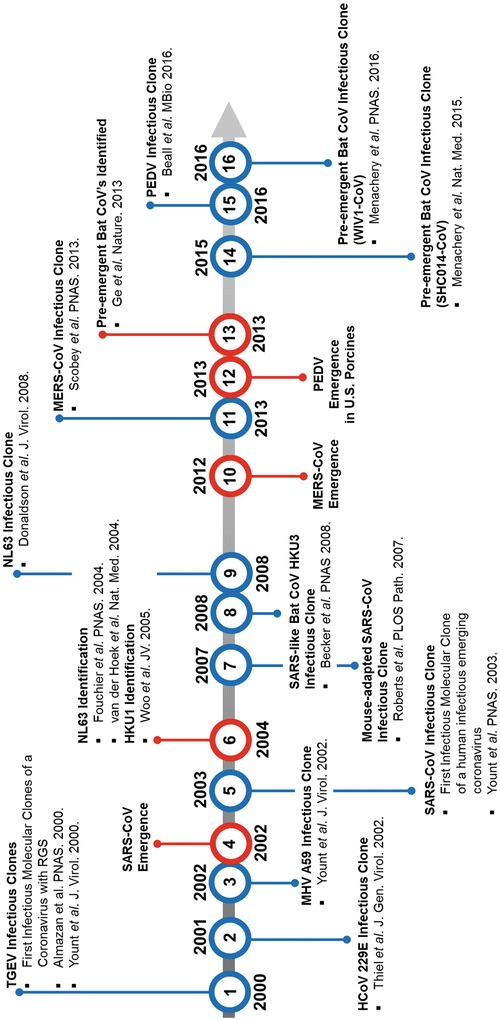
Fig. 1
Fig. 1
Timeline of emerging coronavirus events and infectious clones generated using reverse genetics systems (RGS). RGS timeline spans from the first RGS clones, TGEV , in 2000 through the most recently generated RGS clone, preemergent bat coronavirus infectious clone (WIV1-CoV), in 2016. Red indicates outbreak and viral identification events. Blue indicates the publication of RGS clones. Transmissible gastroenteritis virus (TGEV ), mouse hepatitis virus (MHV), severe acute respiratory syndrome coronavirus ( SARS-CoV) , Hong Kong University (HKU), Middle East respiratory syndrome coronavirus (MERS-CoV ) , porcine epidemic diarrhea virus (PEDV )
Fig. 2
Fig. 2
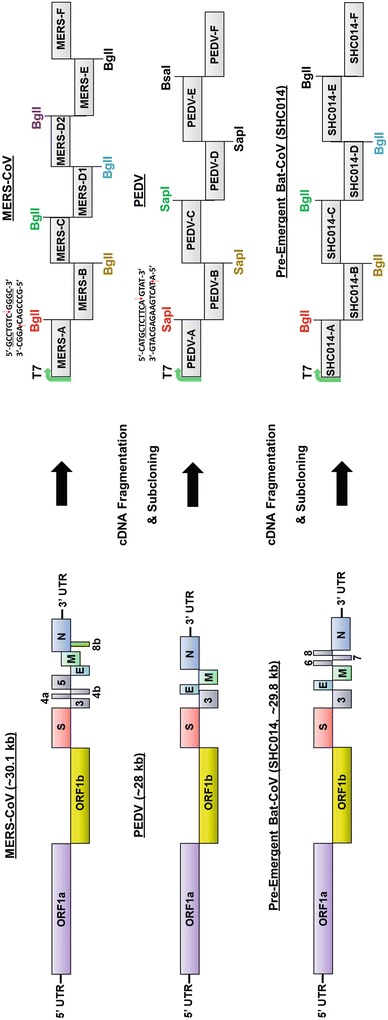
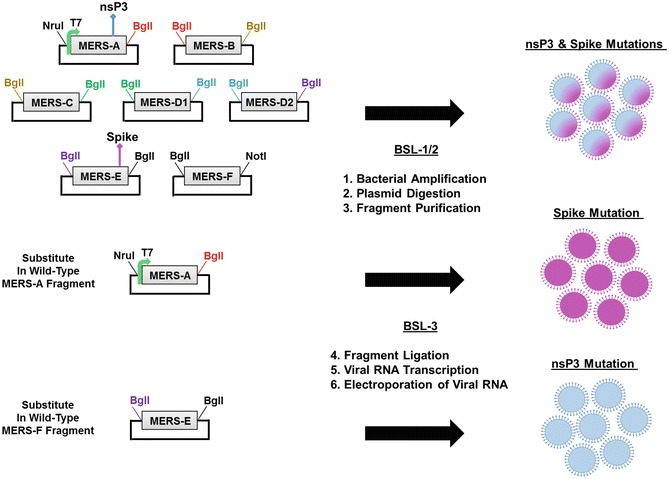
Organization of coronavirus genomes and infections clones used to generate recombinant coronavirus. (a) Left: Genome organization of MERS-CoV , PEDV , and SHC014. Right: Organization of coronavirus cDNA fragments used in subcloning in order to generate a genome-length cDNA template prior to transcription. Color-coded restriction sites denote distinct type IIS ( SapI) or type IIG ( BglI) restriction sites. An example of each is shown for the first junction encoded in the MERS-CoV and PEDV genomes. (b) A benefit of the RGS infectious clone system is the ease of directed genome mutation. By swapping fragments between wild-type and mutant MERS-CoV , or even between various coronavirus species, useful CoV variants such as wild-type spike or open reading frame mutants can be rapidly generated in order to understand the role of specific mutations or viral genes. Multiple infectious clones with different genetic mutations can be generated in parallel provided that the mutations are on different fragments. Example: Three different viruses are generated from mutations in the nsP3 gene (fragment A, blue) and the spike gene (fragment E, purple)
Fig. 2
Fig. 2
Organization of coronavirus genomes and infections clones used to generate recombinant coronavirus. (a) Left: Genome organization of MERS-CoV , PEDV , and SHC014. Right: Organization of coronavirus cDNA fragments used in subcloning in order to generate a genome-length cDNA template prior to transcription. Color-coded restriction sites denote distinct type IIS ( SapI) or type IIG ( BglI) restriction sites. An example of each is shown for the first junction encoded in the MERS-CoV and PEDV genomes. (b) A benefit of the RGS infectious clone system is the ease of directed genome mutation. By swapping fragments between wild-type and mutant MERS-CoV , or even between various coronavirus species, useful CoV variants such as wild-type spike or open reading frame mutants can be rapidly generated in order to understand the role of specific mutations or viral genes. Multiple infectious clones with different genetic mutations can be generated in parallel provided that the mutations are on different fragments. Example: Three different viruses are generated from mutations in the nsP3 gene (fragment A, blue) and the spike gene (fragment E, purple)
Fig. 3
Fig. 3
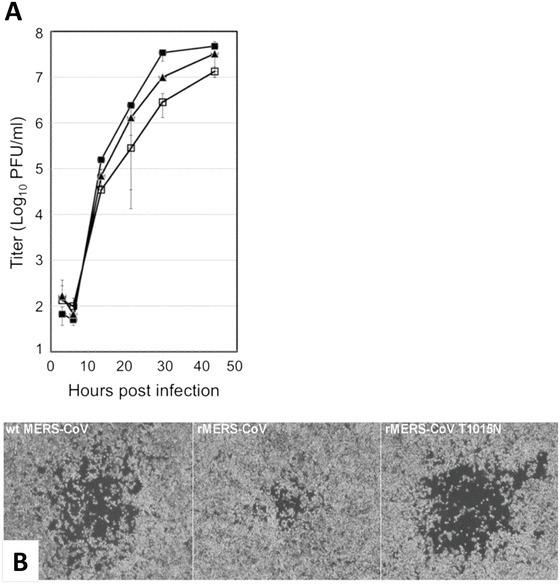
Confirmation of MERS-CoV production and growth characteristics. (a) A comparison of growth curves in wild-type (filled square, MERS-CoV ), recombinant MERS-CoV (open square, rMERS-CoV) and a recombinant MERS-CoV containing a tissue culture-adapted mutation in the spike gene (filled triangle, rMERS-CoV-T1015N). (b) A comparison of plaque formation in wild-type MERS-CoV , rMERS-CoV, and rMERS-CoV-T1015N. The recombinant MERS-CoV with the tissue culture adaptation cloned back in using RGS exhibits plaque sizes similar to wild-type MERS-CoV . All images reprinted from [25]
Fig. 4
Fig. 4
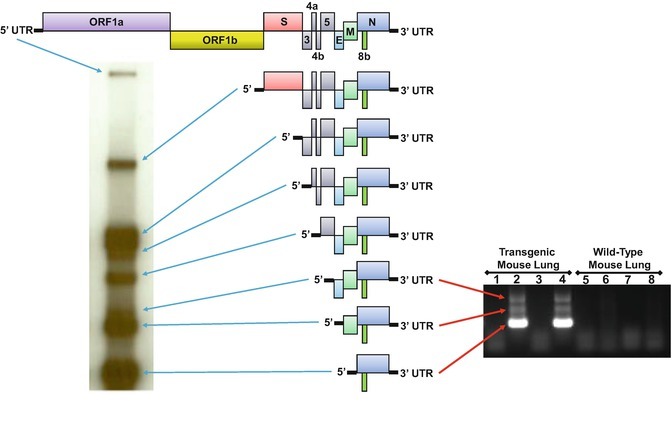
MERS-CoV subgenomic RNA (sgRNA). sgRNA is generated during active coronavirus replication and can be visualized by northern blot (left) and PCR (right). Using a biotinylated or radioactive probe against the CoV N-gene, all sgRNA species can be visualized by running RNA isolated from CoV-infected cells on a northern gel (left). Northern blot image is reprinted from [25]. Alternately, PCR primers contained within the leader sequence and N-gene can be used to generate PCR products from viral cDNA in order to visualize sgRNA, signifying productive CoV replication (right). Here, PCR products confirm productive replication of MERS-CoV in the lungs of a mouse permissive to MERS-CoV infection (transgenic mouse lung), but not in a nonpermissive, wild-type mouse lung. Both of these methods can be used to confirm productive CoV replication following RGS clone generation
Fig. 5
Fig. 5
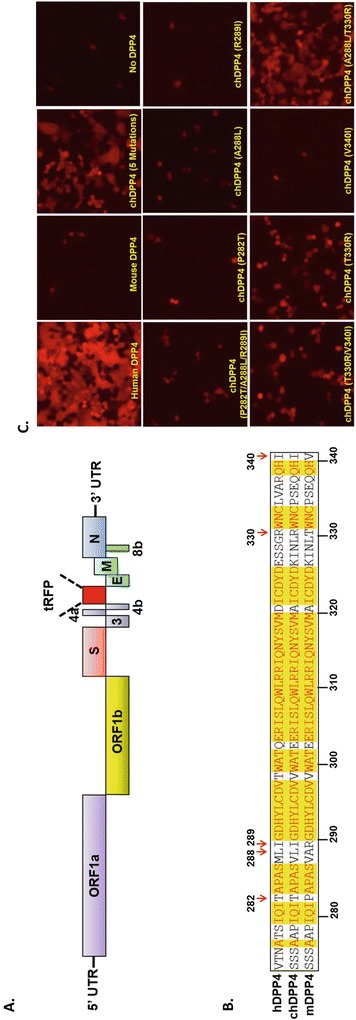
Application for an infectious clone of MERS-CoV expressing tRFP. (a) Genomic representation of an infectious clone of MERS-CoV containing the tomato red fluorescent protein (tRFP) substituted for the orf 5 gene (icMERS-CoV-tRFP). (b) Protein sequence alignment of human, mouse, and chimeric dipeptidyl peptidase 4 ( DPP4) MERS-CoV host receptor sequence with five specific amino acid changes indicated by red arrows. Figure reprinted from [40]. (c) The indicated chimeric DPP4 receptor constructs were overexpressed in 293T cells and subsequently infected with the icMERS-CoV-tRFP virus to map the minimal number of amino acids required to facilitate MERS-CoV infection. Two amino acid changes (A288L and T330R) were sufficient to support infection and replication of MERS-CoV . Figure reprinted from [40]

References

    1. McIntosh K. Coronaviruses in the limelight. J Infect Dis. 2005;191(4):489–491. doi: 10.1086/428510. - DOI - PMC - PubMed
    1. Peiris JS, Guan Y, Yuen KY. Severe acute respiratory syndrome. Nat Med. 2004;10(12 Suppl):S88–S97. doi: 10.1038/nm1143. - DOI - PMC - PubMed
    1. Graham RL, Donaldson EF, Baric RS. A decade after SARS: strategies for controlling emerging coronaviruses. Nat Rev Microbiol. 2013;11(12):836–848. doi: 10.1038/nrmicro3143. - DOI - PMC - PubMed
    1. Gralinski LE, Baric RS. Molecular pathology of emerging coronavirus infections. J Pathol. 2015;235(2):185–195. doi: 10.1002/path.4454. - DOI - PMC - PubMed
    1. Channappanavar R, Zhao J, Perlman S. T cell-mediated immune response to respiratory coronaviruses. Immunol Res. 2014;59(1–3):118–128. doi: 10.1007/s12026-014-8534-z. - DOI - PMC - PubMed

LinkOut - more resources