Review
. 2016 Dec;8(4):331-345.
doi: 10.1007/s12551-016-0231-9. Epub 2016 Nov 7.

Aspects of protein-DNA interactions: a review of quantitative thermodynamic theory for modelling synthetic circuits utilising LacI and CI repressors, IPTG and the reporter gene lacZ

Affiliations
Review

Aspects of protein-DNA interactions: a review of quantitative thermodynamic theory for modelling synthetic circuits utilising LacI and CI repressors, IPTG and the reporter gene lacZ

Peter D Munro et al. Biophys Rev. 2016 Dec.

Abstract

Protein-DNA interactions are central to the control of gene expression across all forms of life. The development of approaches to rigorously model such interactions has often been hindered both by a lack of quantitative binding data and by the difficulty in accounting for parameters relevant to the intracellular situation, such as DNA looping and thermodynamic non-ideality. Here, we review these considerations by developing a thermodynamically based mathematical model that attempts to simulate the functioning of an Escherichia coli expression system incorporating two of the best characterised prokaryotic DNA binding proteins, Lac repressor and lambda CI repressor. The key aim was to reproduce experimentally observed reporter gene activities arising from the expression of either wild-type CI repressor or one of three positive-control CI mutants. The model considers the role of several potentially important, but sometimes neglected, biochemical features, including DNA looping, macromolecular crowding and non-specific binding, and allowed us to obtain association constants for the binding of CI and its variants to a specific operator sequence.

Keywords: Escherichia coli expression system; Lambda CI repressor; Mathematical model; Synthetic biology; lac repressor.


Conflict of interest statement

Conflict of interest

Peter D. Munro declares that he has no conflict of interest. Gary K. Ackers declares that he has no conflict of interest. Keith E. Shearwin declares that he has no conflict of interest.

Ethical approval

This article does not contain any studies with human participants or animals performed by any of the authors.

Figures
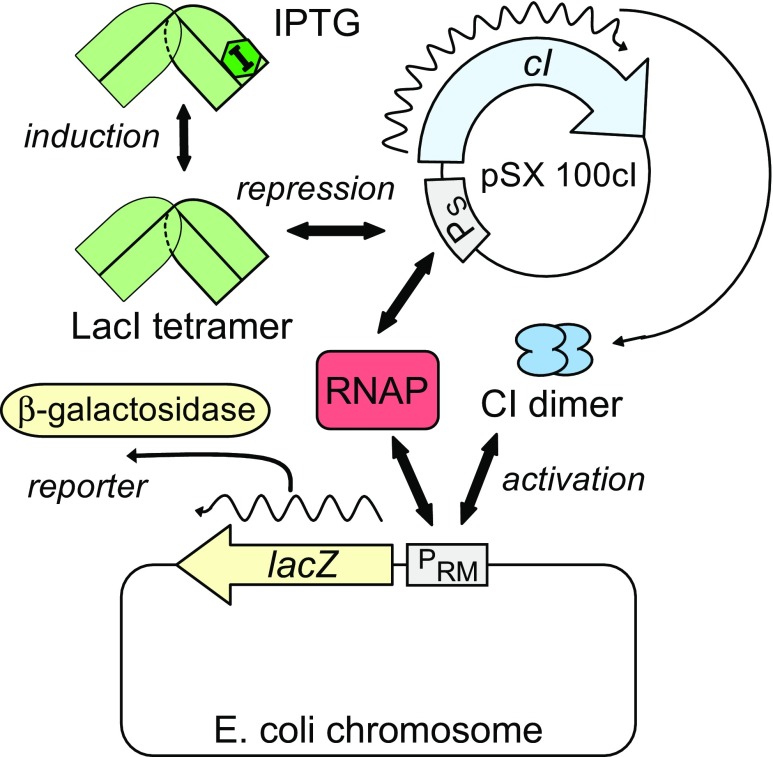
Fig. 1
Fig. 1
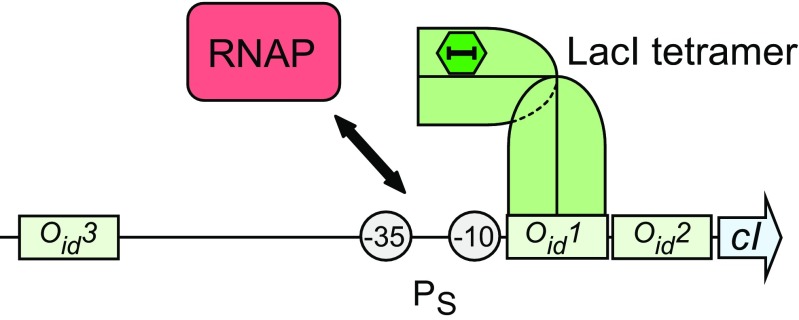
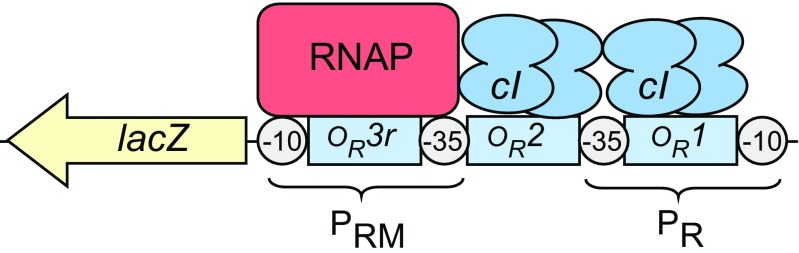
The Escherichia coli expression/reporter system constructed by Kolkhof and Müller-Hill (1994). Expression of the cI gene on plasmid pSX 100cI occurs upon binding by RNA polymerase (RNAP) to promoter PS. LacI represses expression of the cI gene by binding to operators adjacent to PS; isopropyl β-D-1-thiogalactopyranoside (IPTG) induces cI expression by binding to LacI, greatly reducing LacI’s affinity for its operators (see Fig. 3). Expression of lacZ, the gene for the reporter enzyme β-galactosidase, occurs upon binding by RNAP to promoter PRM on the E. coli chromosome. CI activates expression of lacZ when bound immediately adjacent to PRM-bound RNAP (see Fig. 4)
Fig. 2
Fig. 2
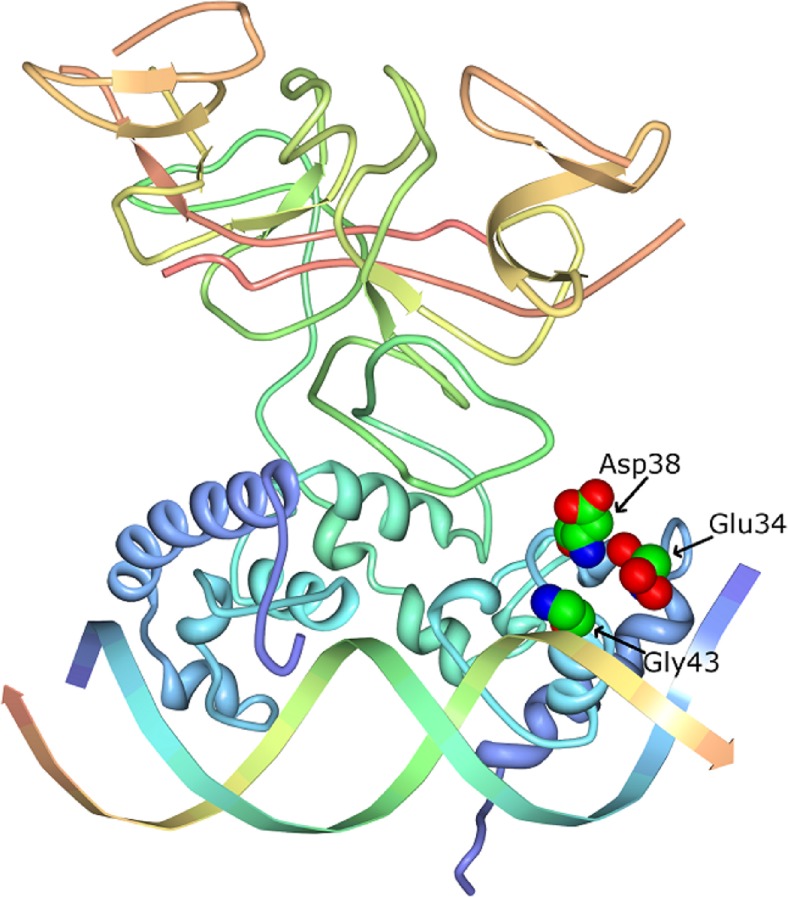
CI wild-type dimer bound to operator DNA [PDB ID: 3bdn (Stayrook et al. 2008)]. The positive-control (pc) mutants in the Kolkhof and Müller-Hill study (1994) arise from separate changes in three residues in the helix–turn–helix region of CI, namely: pc-1: G43R, pc-2: D38N and pc-3: E34K. Image of PDB ID: 3bdn (Stayrook et al. 2008) created with Protein Workshop (Moreland et al. 2005), http://www.pdb.org
Fig. 3
Fig. 3
LacI repression of transcription from synthetic promoter PS. Our modelling was based on the following proposed operation of the PS control region: LacI, bound to operator Oid1 by its IPTG-free dimeric-half, sterically hinders RNAP from binding to PS, and vice versa. LacI, bound to Oid2, reduces the initiation rate constant of RNAP by destabilising the elongating RNAP. LacI can form looped complexes by simultaneously binding to Oid3 and either Oid1 or Oid2, inhibiting RNAP from binding to the promoter. IPTG induces CI expression by binding LacI and effecting an allosteric transition that greatly reduces the ability of LacI to bind its operators. The midpoint of Oid3 is 83 base pairs upstream of the midpoint of Oid1, while Oid1 and Oid2 are separated by 24 bp, centre to centre
Fig. 4
Fig. 4
CI control of transcription from promoter PRM. Our modelling was based on the standard alternate pairwise mechanism of CI binding to the PRM control region (Shea and Ackers ; Ptashne 2004), where CI dimers are bound cooperatively at operators OR1 and OR2, and a CI dimer bound at OR2 activates transcription from PRM. CI bound to OR3 excludes RNAP from PRM and vice versa. Note that, in the Kolkhof and Muller-Hill system, the LacZ reporter gene has been placed downstream of PRM and that OR3 (here named OR3r) has two mutated base pairs (r3r1) which reduce CI binding (Kolkhof and Müller-Hill 1994)
Fig. 5
Fig. 5
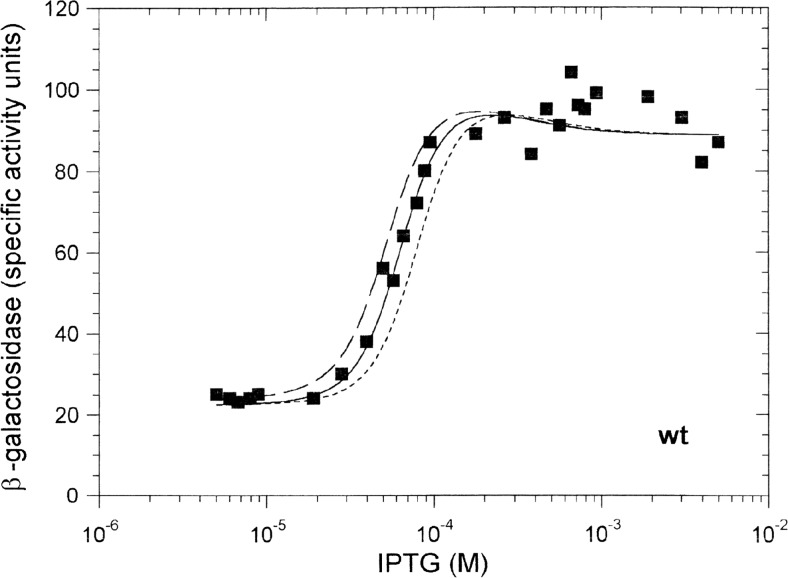
Fit of the effect of increasing amounts of wild-type CI on PRM-lacZ activity. The solid line was obtained by setting K IL = 0.48 μM−1, and K 3r = 5.0 μM−1, equal to K 3. The dashed line was obtained by setting K IL = 0.48 μM−1 and K 3r = 1.0 μM−1. Other parameters were as given in Table 1. The data points here and in subsequent figures are taken from Kolkhof and Müller-Hill (1994)
Fig. 6
Fig. 6
Parameter sensitivity in fitting of wild-type CI data. The long dashed line shows the effect of halving K PR (i.e. reduced from 0.65 to 0.325 nM−1). The short dashed line shows the effect of reduction in K IL from 0.48 to 0.38 μM−1. The solid line is the original simulation, shown as coincident with the combined effect of halving K PR and reducing K IL from 0.48 to 0.38 μM−1. Other parameters were as given in Table 1
Fig. 7
Fig. 7
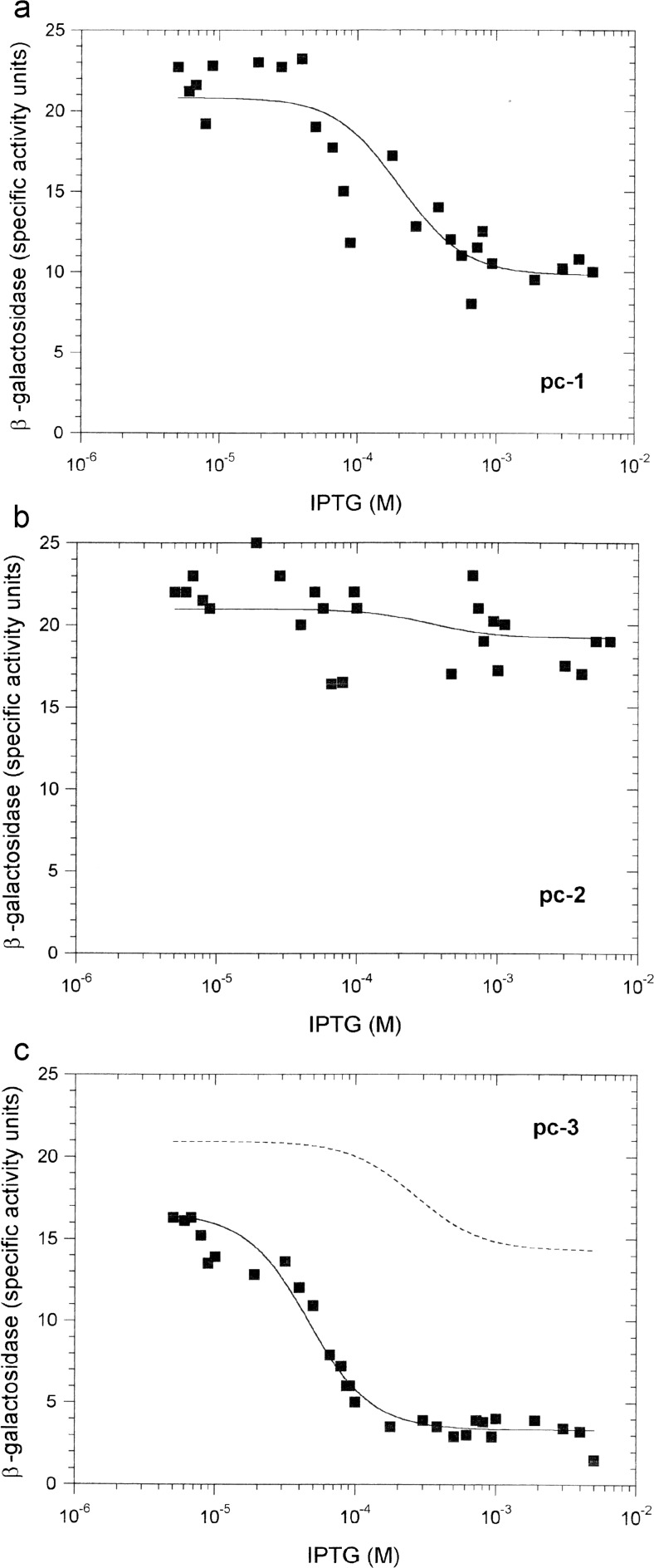
Fit of the effect of increasing amounts of the CI pc mutants on PRM-lacZ activity. Note the change in scale of the ordinate axis here compared to Figs. 5 and 6. a CI pc-1. The solid line was obtained by setting αCI = 1 and K 3r = 75 μM−1. b CI pc-2. The solid line was obtained by setting αCI = 1 and K 3r = 5.0 μM−1. c CI pc-3. The solid line was obtained by setting αCI = 1 and K 3r = 2.5 nM−1. The dashed line illustrates the effect of also increasing K ns, the CI-non-specific DNA binding constant, 100-fold. In ac, other parameters were as given in Table 1

Similar articles

Cited by

References

    1. Bremer H, Dennis PP (1996) Modulation of chemical composition and other parameters of the cell by growth rate. In: Neidhardt FC, Curtiss R, Ingraham JL et al (eds) Escherichia coli and Salmonella: cellular and molecular biology. ASM Press, Washington, DC, pp 1553–1569
    1. Cayley S, Lewis BA, Guttman HJ, Record MT. Characterization of the cytoplasm of Escherichia coli K-12 as a function of external osmolarity: implications for protein–DNA interactions in vivo. J Mol Biol. 1991;222:281–300. doi: 10.1016/0022-2836(91)90212-O. - DOI - PubMed
    1. Chen J, Alberti S, Matthews KS. Wild-type operator binding and altered cooperativity for inducer binding of lac repressor dimer mutant R3. J Biol Chem. 1994;269:12482–12487. - PubMed
    1. Chen Y-J, Johnson S, Mulligan P, Spakowitz AJ, Phillips R. Modulation of DNA loop lifetimes by the free energy of loop formation. Proc Natl Acad Sci U S A. 2014;111:17396–17401. doi: 10.1073/pnas.1415685111. - DOI - PMC - PubMed
    1. Craven GR, Steers E, Anfinsen CB. Purification, composition, and molecular weight of the beta-galactosidase of Escherichia Coli K12. J Biol Chem. 1965;240:2468–2477. - PubMed

LinkOut - more resources