


A review of multi-domain and flexible molecular chaperones studies by small-angle X-ray scattering
- PMID: 28510050
- PMCID: PMC5425780
- DOI: 10.1007/s12551-016-0194-x
A review of multi-domain and flexible molecular chaperones studies by small-angle X-ray scattering
Abstract
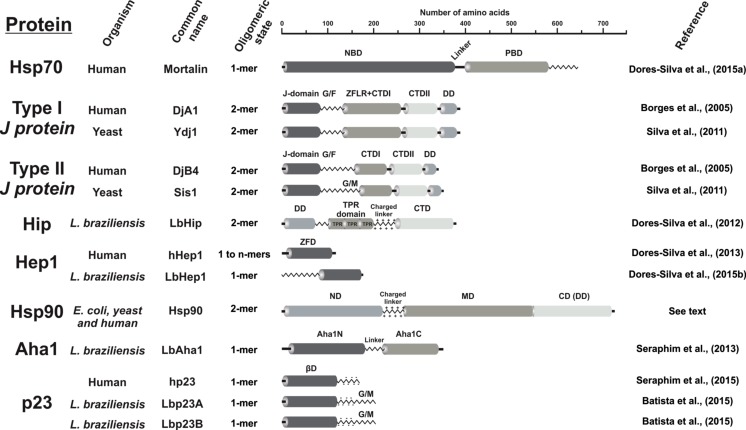
Intrinsic flexibility is closely related to protein function, and a plethora of important regulatory proteins have been found to be flexible, multi-domain or even intrinsically disordered. On the one hand, understanding such systems depends on how these proteins behave in solution. On the other, small-angle X-ray scattering (SAXS) is a technique that fulfills the requirements to study protein structure and dynamics relatively quickly with few experimental limitations. Molecular chaperones from Hsp70 and Hsp90 families are multi-domain proteins containing flexible and/or disordered regions that play central roles in cellular proteostasis. Here, we review the structure and function of these proteins by SAXS. Our general approach includes the use of SAXS data to determine size and shape parameters, as well as protein shape reconstruction and their validation by using accessory biophysical tools. Some remarkable examples are presented that exemplify the potential of the SAXS technique. Protein structure can be determined in solution even at limiting protein concentrations (for example, human mortalin, a mitochondrial Hsp70 chaperone). The protein organization, flexibility and function (for example, the J-protein co-chaperones), oligomeric status, domain organization, and flexibility (for the Hsp90 chaperone and the Hip and Hep1 co-chaperones) may also be determined. Lastly, the shape, structural conservation, and protein dynamics (for the Hsp90 chaperone and both p23 and Aha1 co-chaperones) may be studied by SAXS. We believe this review will enhance the application of the SAXS technique to the study of the molecular chaperones.
Keywords: Molecular chaperones; Mortalin Hsp70; Multi-domain proteins; Protein dynamics; SAXS.
Conflict of interest statement
Conflict of interest
Júlio C. Borges declares that he has no conflict of interest.
Thiago V. Seraphim declares that he has no conflict of interest.
Paulo R. Dores-Silva declares that he has no conflict of interest.
Leandro R. S. Barbosa declares that he has no conflict of interest.
Ethical approval
This article does not contain any studies with human participants or animals performed by any of the authors.
Figures
References
-
- Avila CL, Torres-Bugeau CM, Barbosa LR, Sales EM, Ouidja MO, Socías SB, Celej MS, Raisman-Vozari R, Papy-Garcia D, Itri R, Chehín RN. Structural characterization of heparin-induced glyceraldehyde-3-phosphate dehydrogenase protofibrils preventing alpha-synuclein oligomeric species toxicity. J Biol Chem. 2014;289:13838–13850. doi: 10.1074/jbc.M113.544288. - DOI - PMC - PubMed
-
- Barbosa LRS, Spinozzi F, Mariani P, Itri R (2013) Small-angle X-ray scattering applied to proteins in solution. In: Ruso JM, Piñeiro Á (eds) Proteins in solution and at interfaces: methods and applications in biotechnology and materials science. Wiley, New York, pp 49–72
Publication types
LinkOut - more resources
Full Text Sources
Other Literature Sources
