


BAG-1 as a biomarker in early breast cancer prognosis: a systematic review with meta-analyses
- PMID: 28510570
- PMCID: PMC5518859
- DOI: 10.1038/bjc.2017.130
BAG-1 as a biomarker in early breast cancer prognosis: a systematic review with meta-analyses
Abstract
Background: The co-chaperone protein Bcl-2-associated athanogene-1 (BAG-1) is overexpressed in breast cancer and has been incorporated in the oncotype DX and PAM50 breast cancer prognostic assays. Bcl-2-associated athanogene-1 exists as multiple protein isoforms that interact with diverse partners, including chaperones Hsc70/Hsp70, Ser/Thr kinase Raf-1 and Bcl-2, to promote cancer cell survival. The BAG-1L isoform specifically binds to and increases the transcriptional activity of oestrogen receptor in cells, and in some, but not all studies, BAG-1 expression is predictive of clinical outcome in breast cancer.
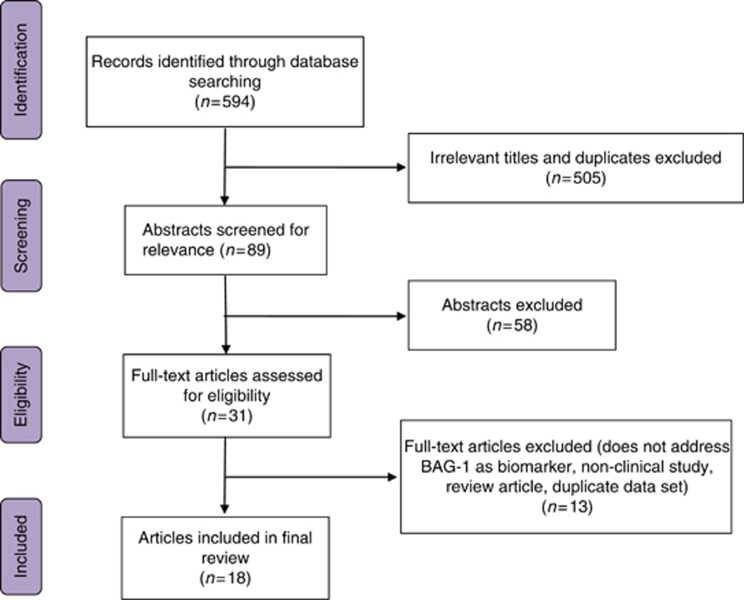
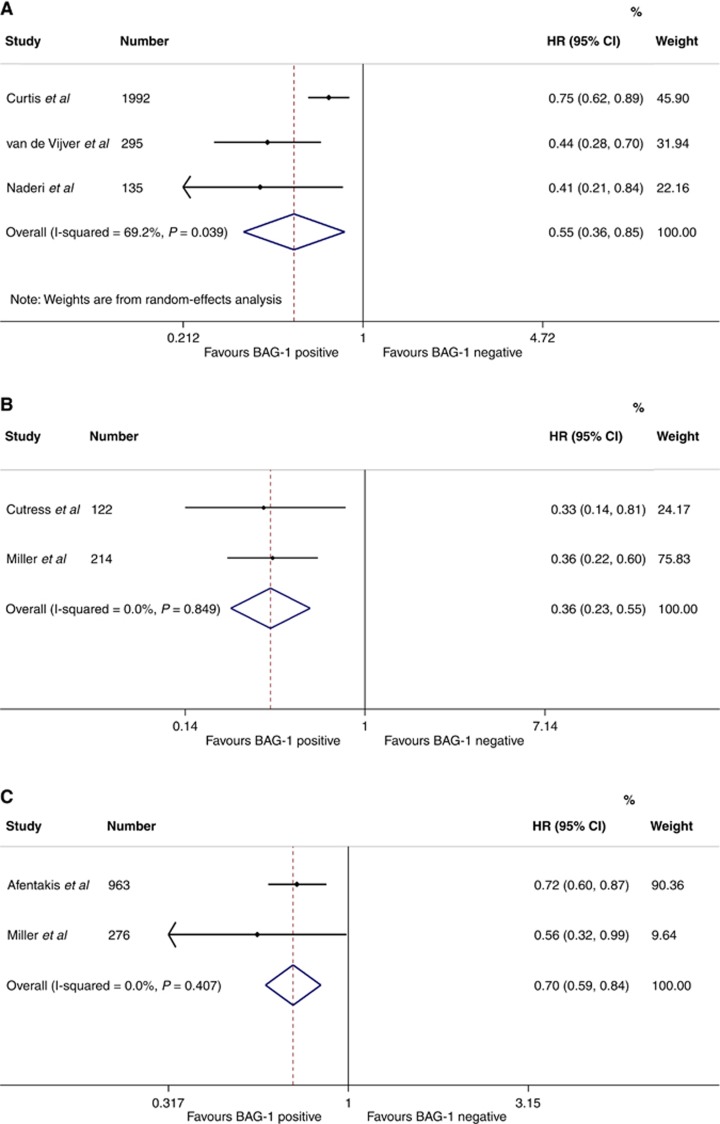
Methods: A systematic review of published studies reporting BAG-1 (mRNA and/or protein) expression and clinical outcome in early breast cancer. The REporting Recommendations for Tumour MARKer and Prognostic Studies (REMARK) criteria were used as a template against which data were assessed. Meta-analyses were performed for studies that provided a hazard ratio and 95% confidence intervals for clinical outcomes including disease-free survival or breast cancer-specific survival from univariate analysis.
Results: Eighteen studies used differing methodologies and reported on differing outcomes. Meta-analyses were only possible on results from a subset of reported studies. Meta-analyses suggested improved outcome with high BAG-1 mRNA and high BAG-1 nuclear expression by immunohistochemisty.
Conclusions: Increased levels of BAG-1 are associated with better breast cancer outcomes.
Conflict of interest statement
The authors declare no conflict of interest.
Figures
Comment in
-
Reply to 'Comment on 'BAG-1 as a biomarker in early breast cancer prognosis: a systematic review with meta-analyses''.Br J Cancer. 2018 Apr;118(8):1154. doi: 10.1038/s41416-018-0032-y. Epub 2018 Mar 15. Br J Cancer. 2018. PMID: 29540772 Free PMC article. No abstract available.
-
Comment on 'BAG-1 as a biomarker in early breast cancer prognosis: a systematic review with meta-analyses'.Br J Cancer. 2018 Apr;118(8):1152-1153. doi: 10.1038/s41416-018-0023-z. Epub 2018 Mar 15. Br J Cancer. 2018. PMID: 29540774 Free PMC article. No abstract available.
References
-
- Afentakis M, Dowsett M, Sestak I, Salter J, Howell T, Buzdar A, Forbes J, Cuzick J (2013) Immunohistochemical BAG1 expression improves the estimation of residual risk by IHC4 in postmenopausal patients treated with anastrazole or tamoxifen: a TransATAC study. Breast Cancer Res Treat 140(2): 253–262. - PubMed
-
- Athanassiadou P, Grapsa D, Gonidi M, Athanassiadou AM, Tsipis A, Patsouris E (2009) CD24 expression has a prognostic impact in breast carcinoma. Pathol Res Pract 205(8): 524–533. - PubMed
-
- Bray F, Jemal A, Grey N, Ferlay J, Forman D (2012) Global cancer transitions according to the Human Development Index (2008–2030): a population-based study. Lancet Oncol 13(8): 790–801. - PubMed
-
- Curtis C, Shah SP, Chin SF, Turashvili G, Rueda OM, Dunning MJ, Speed D, Lynch AG, Samarajiwa S, Yuan Y, Graf S, Ha G, Haffari G, Bashashati A, Russell R, McKinney S, Langerod A, Green A, Provenzano E, Wishart G, Pinder S, Watson P, Markowetz F, Murphy L, Ellis I, Purushotham A, Borresen-Dale AL, Brenton JD, Tavare S, Caldas C, Aparicio S (2012) The genomic and transcriptomic architecture of 2000 breast tumours reveals novel subgroups. Nature 486(7403): 346–352. - PMC - PubMed
Publication types
MeSH terms
Substances
Grants and funding
LinkOut - more resources
Full Text Sources
Other Literature Sources
Medical
Research Materials
Miscellaneous
