Comparison of artemether-lumefantrine and chloroquine with and without primaquine for the treatment of Plasmodium vivax infection in Ethiopia: A randomized controlled trial
- PMID: 28510573
- PMCID: PMC5433686
- DOI: 10.1371/journal.pmed.1002299
Comparison of artemether-lumefantrine and chloroquine with and without primaquine for the treatment of Plasmodium vivax infection in Ethiopia: A randomized controlled trial
Erratum in
-
Correction: Comparison of artemether-lumefantrine and chloroquine with and without primaquine for the treatment of Plasmodium vivax infection in Ethiopia: A randomized controlled trial.PLoS Med. 2018 Oct 4;15(10):e1002677. doi: 10.1371/journal.pmed.1002677. eCollection 2018 Oct. PLoS Med. 2018. PMID: 30286081 Free PMC article.
Abstract
Background: Recent efforts in malaria control have resulted in great gains in reducing the burden of Plasmodium falciparum, but P. vivax has been more refractory. Its ability to form dormant liver stages confounds control and elimination efforts. To compare the efficacy and safety of primaquine regimens for radical cure, we undertook a randomized controlled trial in Ethiopia.
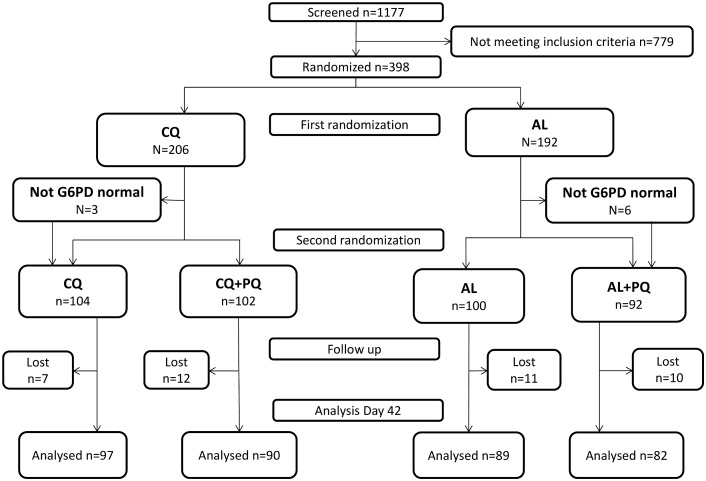
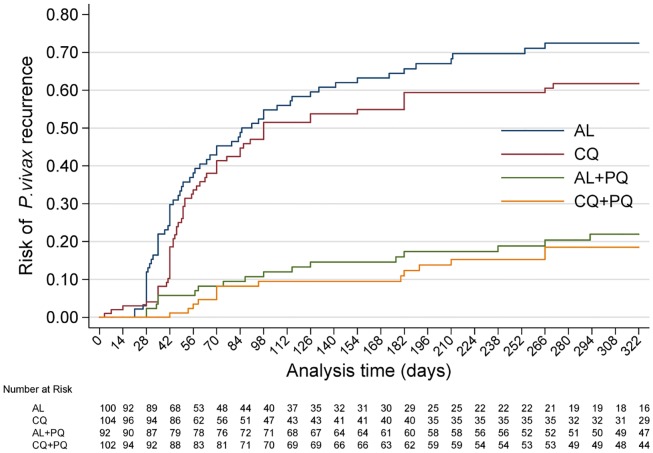
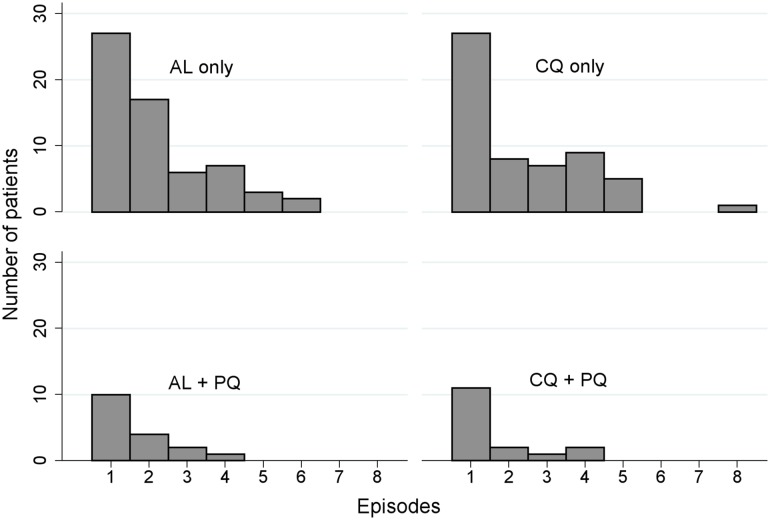
Methods and findings: Patients with normal glucose-6-phosphate dehydrogenase status with symptomatic P. vivax mono-infection were enrolled and randomly assigned to receive either chloroquine (CQ) or artemether-lumefantrine (AL), alone or in combination with 14 d of semi-supervised primaquine (PQ) (3.5 mg/kg total). A total of 398 patients (n = 104 in the CQ arm, n = 100 in the AL arm, n = 102 in the CQ+PQ arm, and n = 92 in the AL+PQ arm) were followed for 1 y, and recurrent episodes were treated with the same treatment allocated at enrolment. The primary endpoints were the risk of P. vivax recurrence at day 28 and at day 42. The risk of recurrent P. vivax infection at day 28 was 4.0% (95% CI 1.5%-10.4%) after CQ treatment and 0% (95% CI 0%-4.0%) after CQ+PQ. The corresponding risks were 12.0% (95% CI 6.8%-20.6%) following AL alone and 2.3% (95% CI 0.6%-9.0%) following AL+PQ. On day 42, the risk was 18.7% (95% CI 12.2%-28.0%) after CQ, 1.2% (95% CI 0.2%-8.0%) after CQ+PQ, 29.9% (95% CI 21.6%-40.5%) after AL, and 5.9% (95% CI 2.4%-13.5%) after AL+PQ (overall p < 0.001). In those not prescribed PQ, the risk of recurrence by day 42 appeared greater following AL treatment than CQ treatment (HR = 1.8 [95% CI 1.0-3.2]; p = 0.059). At the end of follow-up, the incidence rate of P. vivax was 2.2 episodes/person-year for patients treated with CQ compared to 0.4 for patients treated with CQ+PQ (rate ratio: 5.1 [95% CI 2.9-9.1]; p < 0.001) and 2.3 episodes/person-year for AL compared to 0.5 for AL+PQ (rate ratio: 6.4 [95% CI 3.6-11.3]; p < 0.001). There was no difference in the occurrence of adverse events between treatment arms. The main limitations of the study were the early termination of the trial and the omission of haemoglobin measurement after day 42, resulting in an inability to estimate the cumulative risk of anaemia.
Conclusions: Despite evidence of CQ-resistant P. vivax, the risk of recurrence in this study was greater following treatment with AL unless it was combined with a supervised course of PQ. PQ combined with either CQ or AL was well tolerated and reduced recurrence of vivax malaria by 5-fold at 1 y.
Trial registration: ClinicalTrials.gov NCT01680406.
Conflict of interest statement
LvS receives a stipend as a specialty consulting editor for PLOS Medicine and serves on the journal's editorial board.
Figures
References
-
- World Health Organization. World malaria report 2014. Geneva: World Health Organization; 2014.
Publication types
MeSH terms
Substances
Associated data
Grants and funding
LinkOut - more resources
Full Text Sources
Other Literature Sources
Medical