


Phylogenetic analyses of Begonia sect. Coelocentrum and allied limestone species of China shed light on the evolution of Sino-Vietnamese karst flora
- PMID: 28510906
- PMCID: PMC5432845
- DOI: 10.1186/1999-3110-55-1
Phylogenetic analyses of Begonia sect. Coelocentrum and allied limestone species of China shed light on the evolution of Sino-Vietnamese karst flora
Abstract
Background: The picturesque limestone karsts across the Sino-Vietnamese border are renowned biodiversity hotspot, distinguished for extremely high endemism of calciphilous plants restricted to caves and cave-like microhabitats that have functioned as biological refugia on the otherwise harsh habitats. To understand evolutionary mechanisms underlying the splendid limestone flora, dated phylogeny is reconstructed for Asian Begonia, a species-rich genus on limestone substrates represented by no less than 60 species in southern China, using DNA sequences of nrITS and chloroplast rpL16 intron. The sampling includes 94 Begonia species encompassing most major Asian clades with a special emphasized on Chinese species.
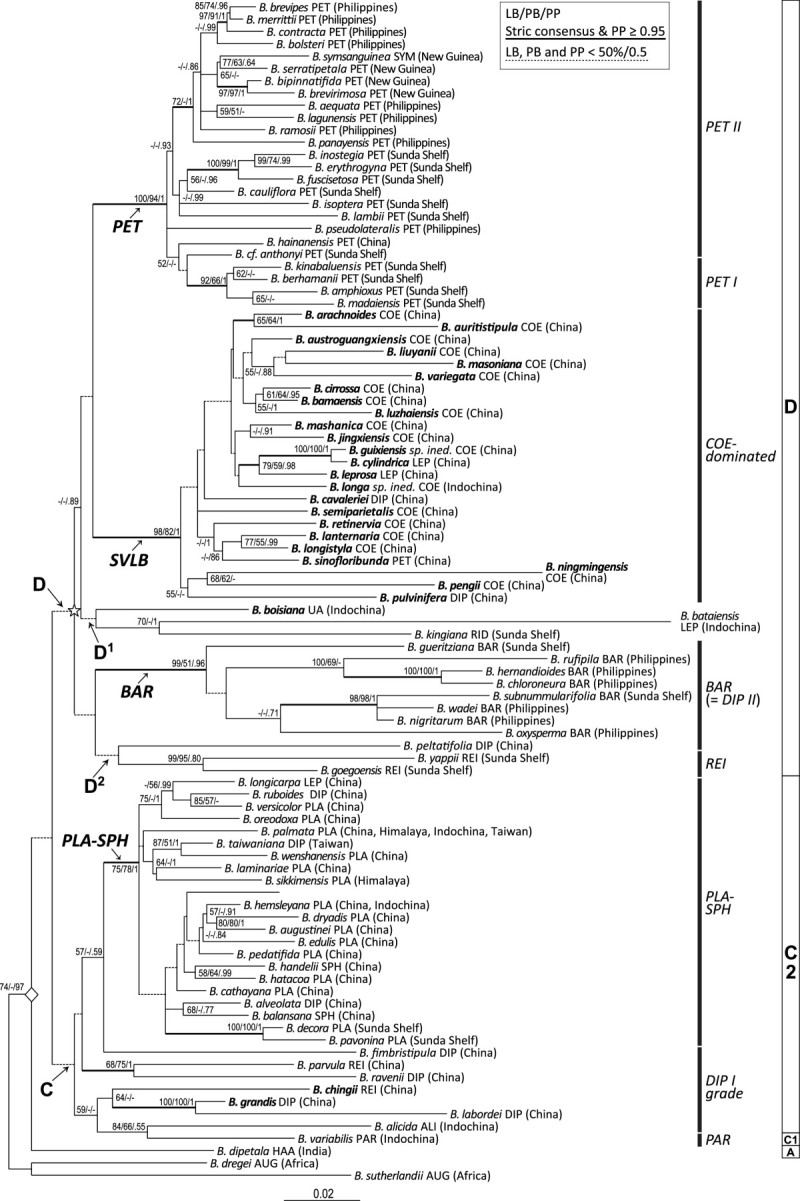
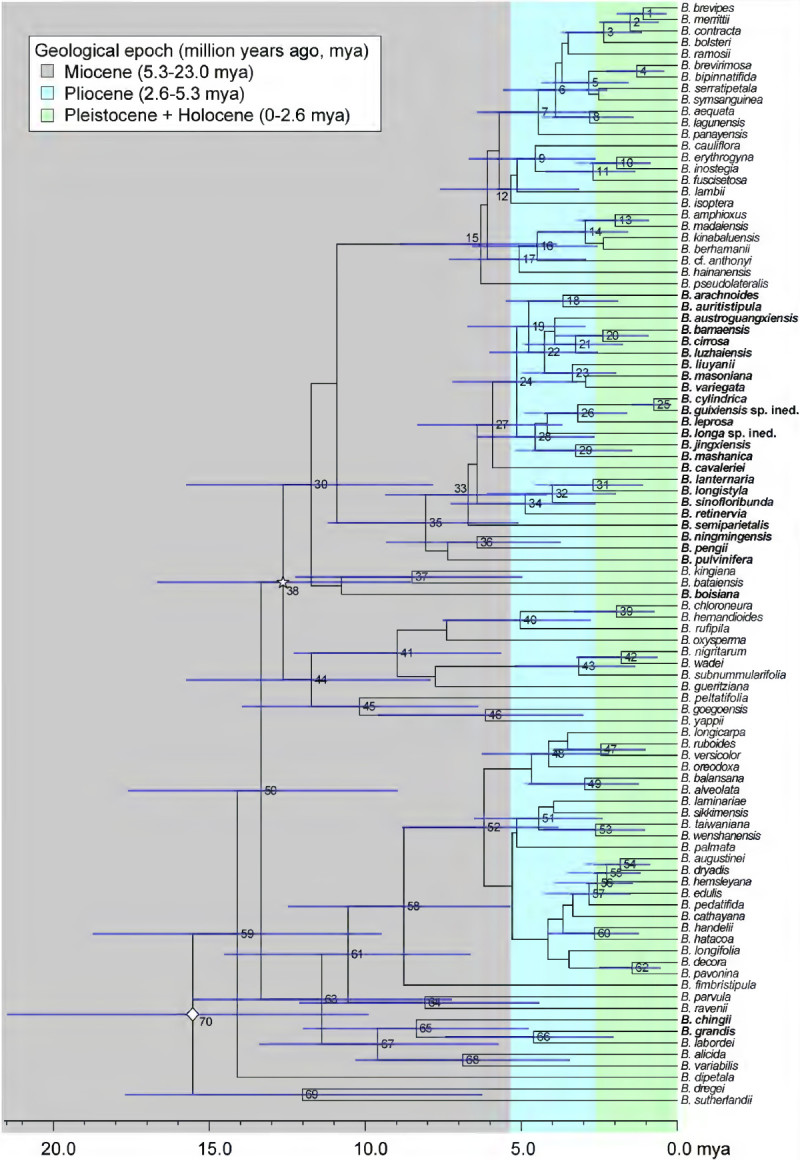
Results: Except for two tuberous deciduous species and a species with upright stems, a majority of Sino-Vietnamese limestone Begonia (SVLB), including sect. Coelocentrum (19 species sampled) and five species of sect. Diploclinium, Leprosae, and Petermannia, are rhizomatous and grouped in a strongly supported and yet internally poorly resolved clade (Clade SVLB), suggesting a single evolutionary origin of the adaptation to limestone substrates by rhizomatous species, subsequent species radiation, and a strong tendency to retain their ancestral niche. Divergence-time estimates indicate a late Miocene diversification of Clade SVLB, coinciding with the onset of the East Asian monsoon and the period of extensive karstification in the area.
Conclusions: Based on our phylogenetic study, Begonia sect. Coelocentrum is recircumscribed and expanded to include other members of the Clade SVLB (sect. Diploclinium: B. cavaleriei, B. pulvinifera, and B. wangii; sect. Leprosae: B. cylindrica and B. leprosa; sect. Petermannia: B. sinofloribunda). Because species of Clade SVLB have strong niche conservatism to retain in their ancestral habitats in cave-like microhabitats and Begonia are generally poor dispersers prone to diversify allopatrically, we propose that extensive and continuous karstification of the Sino-Vietnamese limestone region facilitated by the onset of East Asian monsoon since the late Miocene has been the major driving force for species accumulation via geographic isolation in Clade SVLB. Morphologically species of Clade SVLB differ mainly in vegetative traits without apparent adaptive value, suggesting that limestone Begonia radiation is better characterized as non-adaptive, an underappreciated speciation mode crucial for rapid species accumulations in organisms of low vagility and strong niche conservatism.
Keywords: Biological refugia; Cave plants; East Asian monsoon; Non-adaptive radiation; Phylogenetic niche conservatism; Sect. Diploclinium; Sect. Leprosae; Sect. Petermannia; Uplift of Tibetan Plateau.
Figures
References
-
- An Z-S. The history and variability of the East Asian paleomonsoon climate. Quaternary Sci Rev. 2000;19:171–187. doi: 10.1016/S0277-3791(99)00060-8. - DOI
-
- Averyanov LV, Nguyen HQ. Eleven new species of Begonia L. (Begoniaceae) from Laos and Vietnam. Turczaninowia. 2012;15:5–32.
-
- Barkley FA, Baranov AI. The sections of Begoniaceae. Buxtonia. 1972;1(supplement):1–8.
LinkOut - more resources
Full Text Sources
Other Literature Sources
Molecular Biology Databases
