


Impact of a workplace 'sit less, move more' program on efficiency-related outcomes of office employees
- PMID: 28511642
- PMCID: PMC5434625
- DOI: 10.1186/s12889-017-4367-8
Impact of a workplace 'sit less, move more' program on efficiency-related outcomes of office employees
Abstract
Background: Few studies have examined the impact of 'sit less, move more' interventions on workplace performance. This study assessed the short and mid-term impacts of and patterns of change within, a 19-week workplace web-based intervention (Walk@WorkSpain; W@WS; 2010-11) on employees´ presenteeism, mental well-being and lost work performance.
Methods: A site randomised control trial recruited employees at six Spanish university campuses (n = 264; 42 ± 10 years; 171 female), assigned by worksite and campus to an Intervention (IG; used W@WS; n = 129; 87 female) or an active Comparison group (A-CG; pedometer, paper diary and self-reported sitting time; n = 135; 84 female). A linear mixed model assessed changes between the baseline, ramping (8 weeks), maintenance (11 weeks) and follow-up (two months) phases for the IG versus A-CG on (i) % of lost work productivity (Work Limitations Questionnaire; WLQ); (ii) three scales for presenteeism (WLQ) assessing difficulty meeting scheduling demands (Time), performing cognitive and inter-personal tasks (Mental-Interpersonal) and decrements in meeting the quantity, quality and timeliness of completed work (Output); and (iii) mental well-being (Warwick-Edinburgh Mental Well-being Scale). T-tests assessed differences between groups for changes on the main outcomes. In the IG, a multivariate logistic regression model identified patterns of response according to baseline socio-demographic variables, physical activity and sitting time.
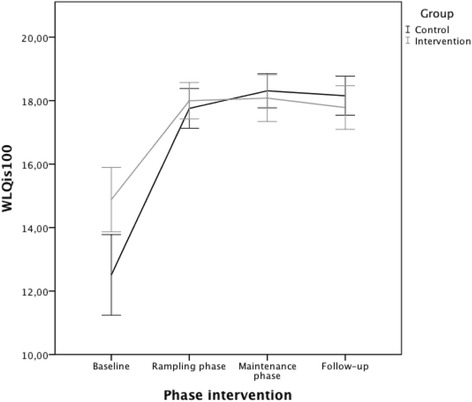
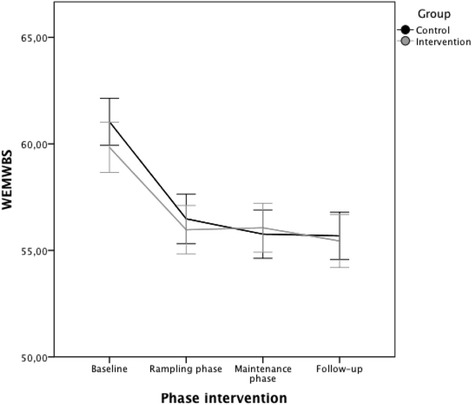
Results: There was a significant 2 (group) × 2 (program time points) interaction for the Time (F [3]=8.69, p = 0.005), Mental-Interpersonal (F [3]=10.01, p = 0.0185), Output scales for presenteeism (F [3]=8.56, p = 0.0357), and for % of lost work performance (F [3]=10.31, p = 0.0161). Presenteeism and lost performance rose significantly in both groups across all study time points; after baseline performance was consistently better in the IG than in the A-CG. Better performance was linked to employees being more active (Time, p = 0.041) and younger (Mental-interpersonal, p = 0.057; Output, p = 0.017). Higher total sitting time during nonworking days (Mental-interpersonal, p = 0.019) and lower sitting time during workdays (WLQ Index, p = 0.013) also improved performance.
Conclusion: Versus an active comparison condition, a 'sit less, move more` workplace intervention effectively reduced an array of markers of lost workday productivity.
Trial registration: NCT02960750 ; Date of registration: 07/11/2016.
Keywords: Physical activity; Presenteeism; Sitting time; Well-being; Workplace.
Figures
References
-
- Thorp AA, Healy GN, Winkler E, Clark BK, Gardiner PA, Owen N. Prolonged sedentary time and physical activity in workplace and non-work contexts: a cross-sectional study of office, customer service and call center employees. Int J Behav Nutr Phys Act. 2012;26:128. doi: 10.1186/1479-5868-9-128. - DOI - PMC - PubMed
-
- Ekblom-Bak E, Ekblom Ö, Bergström G, Börjesson M. Isotemporal substitution of sedentary time by physical activity of different intensities and bout lengths, and its associations with metabolic risk. Eur J Prev Cardiol. 2015; pii: 2047487315619734. [Epub ahead of print]. - PubMed
-
- Buman MP, Winkler EA, Kurka JM, Hekler EB, Baldwin CM, Owen N, Ainsworth BE, Healy GN, Gardiner PA. Reallocating time to sleep, sedentary behaviors, or active behaviors: associations with cardiovascular disease risk biomarkers, NHANES 2005-2006. Am J Epidemiol. 2014;179:323–334. doi: 10.1093/aje/kwt292. - DOI - PubMed
MeSH terms
Associated data
LinkOut - more resources
Full Text Sources
Other Literature Sources
Medical
