


Long-term safety and efficacy of vismodegib in patients with advanced basal cell carcinoma: final update of the pivotal ERIVANCE BCC study
- PMID: 28511673
- PMCID: PMC5433030
- DOI: 10.1186/s12885-017-3286-5
Long-term safety and efficacy of vismodegib in patients with advanced basal cell carcinoma: final update of the pivotal ERIVANCE BCC study
Erratum in
-
Correction to: Long-term safety and efficacy of vismodegib in patients with advanced basal cell carcinoma: final update of the pivotal ERIVANCE BCC study.BMC Cancer. 2019 Apr 18;19(1):366. doi: 10.1186/s12885-019-5568-6. BMC Cancer. 2019. PMID: 30999949 Free PMC article.
Abstract
Background: In the primary analysis of the ERIVANCE BCC trial, vismodegib, the first US Food and Drug Administration-approved Hedgehog pathway inhibitor, showed objective response rates (ORRs) by independent review facility (IRF) of 30% and 43% in metastatic basal cell carcinoma (mBCC) and locally advanced BCC (laBCC), respectively. ORRs by investigator review were 45% (mBCC) and 60% (laBCC). Herein, we present long-term safety and final investigator-assessed efficacy results in patients with mBCC or laBCC.
Methods: One hundred four patients with measurable advanced BCC received oral vismodegib 150 mg once daily until disease progression or intolerable toxicity. The primary end point was IRF-assessed ORR. Secondary end points included ORR, duration of response (DOR), progression-free survival, overall survival (OS), and safety.
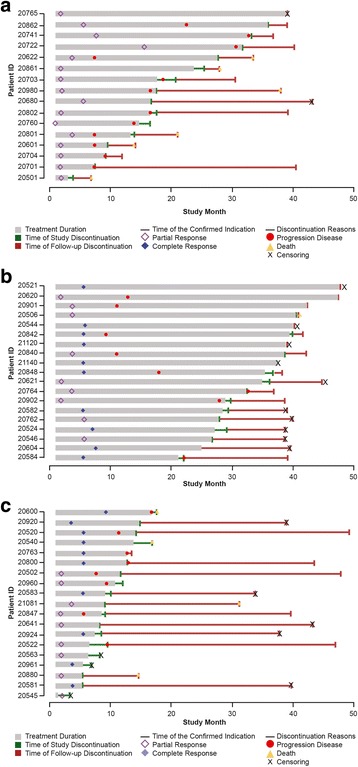
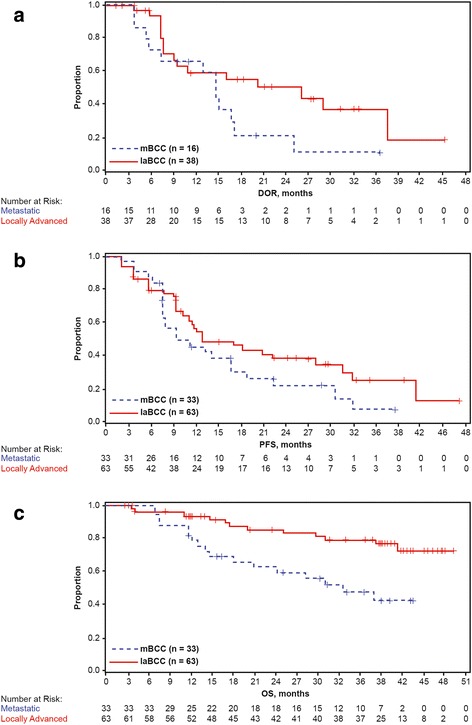
Results: At data cutoff (39 months after completion of accrual), 8 patients were receiving the study drug (69 patients in survival follow-up). Investigator-assessed ORR was 48.5% in the mBCC group (all partial responses) and 60.3% in the laBCC group (20 patients had complete response and 18 patients had partial response). ORRs were comparable across patient subgroups, including aggressive histologic subtypes (eg, infiltrative BCC). Median DOR was 14.8 months (mBCC) and 26.2 months (laBCC). Median OS was 33.4 months in the mBCC cohort and not estimable in the laBCC cohort. Adverse events remained consistent with clinical experience. Thirty-three deaths (31.7%) were reported; none were related to vismodegib.
Conclusions: This long-term update of the ERIVANCE BCC trial demonstrated durability of response, efficacy across patient subgroups, and manageable long-term safety of vismodegib in patients with advanced BCC.
Trial registration: This study was registered prospectively with Clinicaltrials.gov , number NCT00833417 on January 30, 2009.
Keywords: Basal cell carcinoma (BCC); Efficacy; Long-term; Safety; Vismodegib.
Figures
References
-
- Lucas R, McMichael T, Smith W, Armstrong B. World Health Organization: Solar ultraviolet radiation: global burden of disease from solar ultraviolet radiation. Environmental Burden of Disease Series, No. 13. Geneva, Switzerland, World Health Organization, 2006. http://www.who.int/uv/health/solaruvradfull_180706.pdf.
-
- Sekulic A, Mangold AR, Northfelt DW, LoRusso PM. Advanced basal cell carcinoma of the skin: targeting the hedgehog pathway. Curr Opin Oncol. 2013;24:218–223. - PubMed
Publication types
MeSH terms
Substances
Associated data
LinkOut - more resources
Full Text Sources
Other Literature Sources
Medical
