. 2017 May 16;8(3):e00489-17.
doi: 10.1128/mBio.00489-17.

Population Genomic Analysis of 1,777 Extended-Spectrum Beta-Lactamase-Producing Klebsiella pneumoniae Isolates, Houston, Texas: Unexpected Abundance of Clonal Group 307

Affiliations

Population Genomic Analysis of 1,777 Extended-Spectrum Beta-Lactamase-Producing Klebsiella pneumoniae Isolates, Houston, Texas: Unexpected Abundance of Clonal Group 307

S Wesley Long et al. mBio. .

Abstract

Klebsiella pneumoniae is a major human pathogen responsible for high morbidity and mortality rates. The emergence and spread of strains resistant to multiple antimicrobial agents and documented large nosocomial outbreaks are especially concerning. To develop new therapeutic strategies for K. pneumoniae, it is imperative to understand the population genomic structure of strains causing human infections. To address this knowledge gap, we sequenced the genomes of 1,777 extended-spectrum beta-lactamase-producing K. pneumoniae strains cultured from patients in the 2,000-bed Houston Methodist Hospital system between September 2011 and May 2015, representing a comprehensive, population-based strain sample. Strains of largely uncharacterized clonal group 307 (CG307) caused more infections than those of well-studied epidemic CG258. Strains varied markedly in gene content and had an extensive array of small and very large plasmids, often containing antimicrobial resistance genes. Some patients with multiple strains cultured over time were infected with genetically distinct clones. We identified 15 strains expressing the New Delhi metallo-beta-lactamase 1 (NDM-1) enzyme that confers broad resistance to nearly all beta-lactam antibiotics. Transcriptome sequencing analysis of 10 phylogenetically diverse strains showed that the global transcriptome of each strain was unique and highly variable. Experimental mouse infection provided new information about immunological parameters of host-pathogen interaction. We exploited the large data set to develop whole-genome sequence-based classifiers that accurately predict clinical antimicrobial resistance for 12 of the 16 antibiotics tested. We conclude that analysis of large, comprehensive, population-based strain samples can assist understanding of the molecular diversity of these organisms and contribute to enhanced translational research.IMPORTANCEKlebsiella pneumoniae causes human infections that are increasingly difficult to treat because many strains are resistant to multiple antibiotics. Clonal group 258 (CG258) organisms have caused outbreaks in health care settings worldwide. Using a comprehensive population-based sample of extended-spectrum beta-lactamase (ESBL)-producing K. pneumoniae strains, we show that a relatively uncommon clonal type, CG307, caused the plurality of ESBL-producing K. pneumoniae infections in our patients. We discovered that CG307 strains have been abundant in Houston for many years. As assessed by experimental mouse infection, CG307 strains were as virulent as pandemic CG258 strains. Our results may portend the emergence of an especially successful clonal group of antibiotic-resistant K. pneumoniae.


Figures

FIG 1
FIG 1
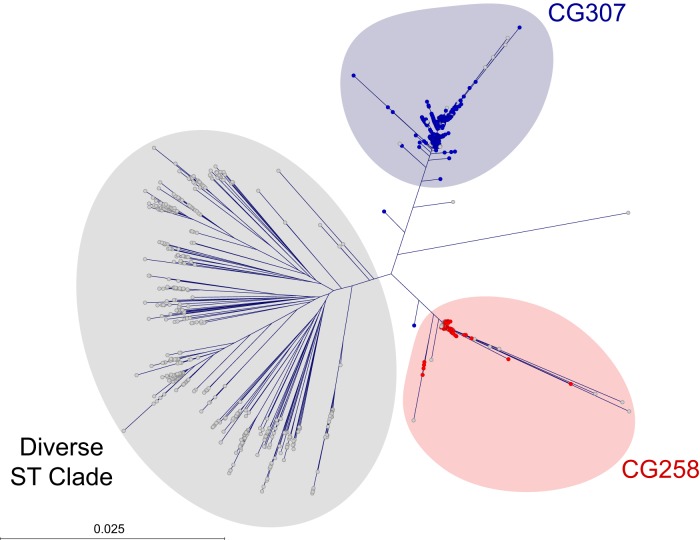
Estimates of genetic relationships among 1,777 ESBL-producing K. pneumoniae strains recovered from infected patients in a multiple-hospital system in the Houston metropolitan area. Polymorphisms were called against the genome of CG258 K. pneumoniae reference strain NJST258_2 (NCBI GenBank accession no. CP006918.1). Colors represent the major clonal groups, including CG258 (red) and CG307 (blue), and the remaining heterogeneous STs (gray). Phylogenetic relationships were defined by the neighbor-joining method in FastTreeMP with double precision. The core genome was defined as the chromosomal sequence with phage sequence regions excluded. To simplify presentation, outliers have been cropped out of frame at 3 and 9 o’clock. The outlier strains, which were identified as K. pneumoniae by matrix-assisted laser desorption ionization mass spectrometry and MLST, may be allied with the genomes of some strains referred to as K. quasipneumoniae and K. variicola.
FIG 2
FIG 2
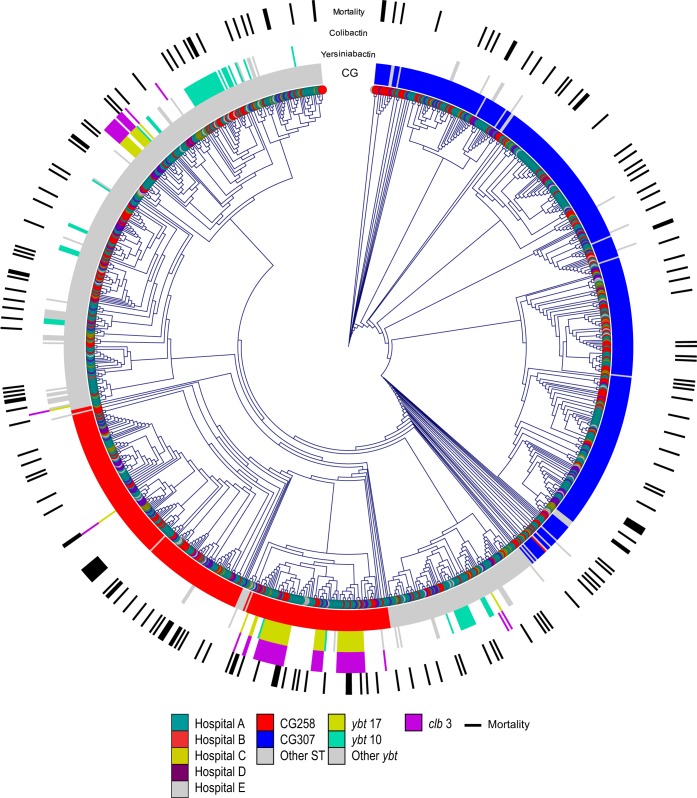
Spatial relationships of ESBL-producing K. pneumoniae strains from the multiple hospitals in the Houston Methodist system with clonal groups and associated patient deaths. This circular cladogram displays the first isolate from each patient, color coded by the five hospitals of origin (teal, yellow, red, purple, and gray). The circles surrounding the cladogram, from innermost to outermost, indicate the clonal group of the strain, yersiniabactin locus, colibactin locus, and patient death. In the innermost circle, the CG258 strains are red and the CG307 strains are blue. Other clonal types are indicated with a gray bar. The yersiniabactin circle is color coded to indicate which yersiniabactin locus is present, if any, with the two most common loci, ybt17 and ybt10, in yellow and teal, respectively; all other ybt loci are gray. The colibactin circle is purple to indicate the presence of clb3, the only colibactin synthesis locus detected in our collection. In the outermost circle, in-hospital death is indicated by a black line. For patients with multiple strains, only the first isolate from the patient is represented on the tree.
FIG 3
FIG 3
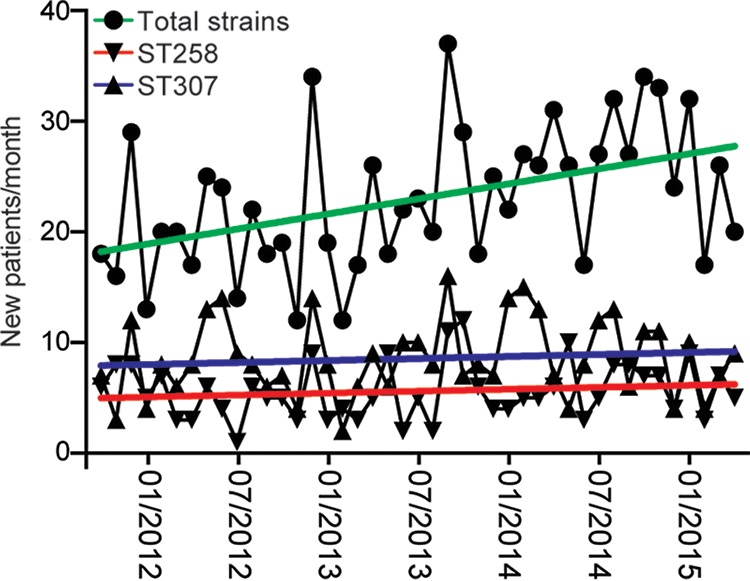
ESBL-producing K. pneumoniae strains recovered during the course of this study. The first strain recovered from each patient is graphed (circles, green linear regression). The number of strains classified as CG307 (triangles, blue linear regression) and CG258 (inverted triangles, red linear regression) are also shown. This figure demonstrates that CG258 and CG307 strains were abundant throughout the study period.
FIG 4
FIG 4
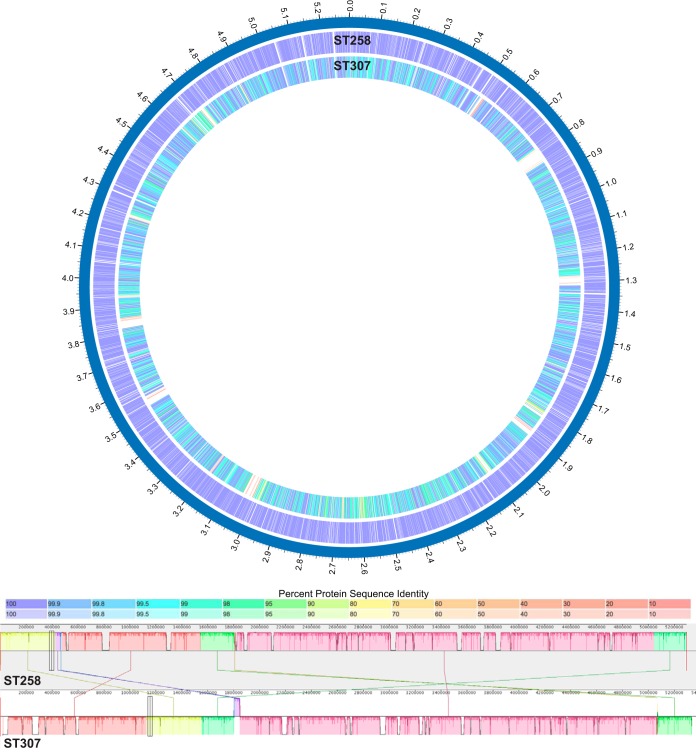
Gene content differences between the reference genomes of CG258 and CG307. CG258 is the globally abundant strain of K. pneumoniae, and CG307 is the locally abundant strain in our study. Bidirectional BLAST was performed by using the PATRIC resource to illustrate the differences in gene content between these two reference genomes. The color indicates the percent identity of the BLAST hit for each gene, with darker shading indicating a bidirectional hit and lighter shading indicating a unidirectional hit (top). A progressive Mauve alignment of the CG258 and CG307 reference genomes is shown. Local colinear blocks are organized by color (bottom). NJST258_2 is the CG258 reference genome, and KPN11 is the CG307 reference assembly.
FIG 5
FIG 5
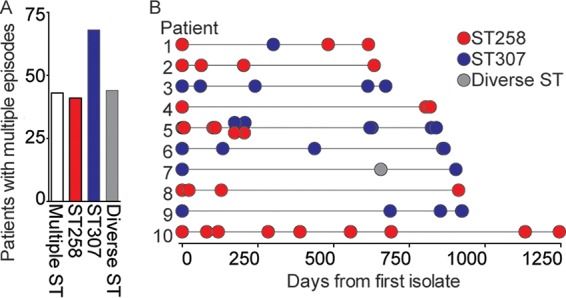
Genetic variation in ESBL-producing K. pneumoniae clinical strains in the same patient over time. (A) Clonal group of each strain recovered from 196 patients with multiple strains. (B) Clonal group of each isolate recovered from 10 patients (numbered 1 to 10) with multiple strains spanning the longest period. Each circle represents one isolate. The vertically overlapping circles shown for patient 5 indicate that two different strains were recovered from different specimens on the same day or consecutive days.
FIG 6
FIG 6
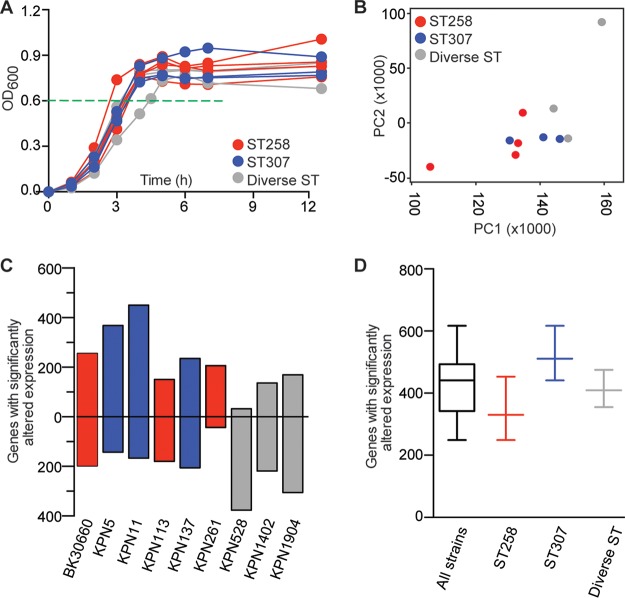
RNA-seq analysis of 10 genomically diverse ESBL-producing K. pneumoniae strains. Strains of CG258 (n = 4, red), CG307 (n = 3, blue), and other STs (n = 3, gray) were analyzed. (A) Growth curves of strains. RNA-seq analysis of duplicate cultures was done (the mean absorbance of each strain pair is shown); the growth curves of all of the strains are similar. Cells were harvested at the mid-exponential phase of growth (OD600 of 0.6; horizontal dashed green line). (B) RNA-seq transcriptome data for chromosomally located genes of each strain were compared to those of CG258 reference strain BK30684. Plotted are expression relationships among the strains based on principal component 1 (PC1) and principal component 2 (PC2), which account for the two largest unrelated variances in the data. The strains are distributed across both axes, showing transcriptome diversity within and between CGs. (C) Number of genes with significantly altered expression relative to reference strain BK30684. Plotted are the numbers of genes with significantly increased (positive y axis) and decreased (negative y axis) expression for each strain. (D) Box plot summarizing data from the 10 strains combined or within CGs.
FIG 7
FIG 7
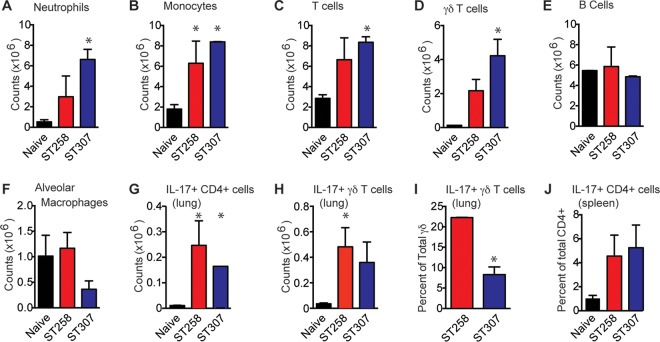
Host immune response to ESBL-producing K. pneumoniae in a mouse model of pneumonia. Flow cytometry analysis of leukocytes recovered from infected lungs, including neutrophils (A), monocytes (B), T cells (C), B cells (D), alveolar macrophages (E), CD4 T cells (F), γδ T cells (G), IL-17-producing CD4 T cells (H), and IL-17-producing γδ T cells (I). (J) IL-17-producing γδ T cells were also recovered from the spleen.
FIG 8
FIG 8
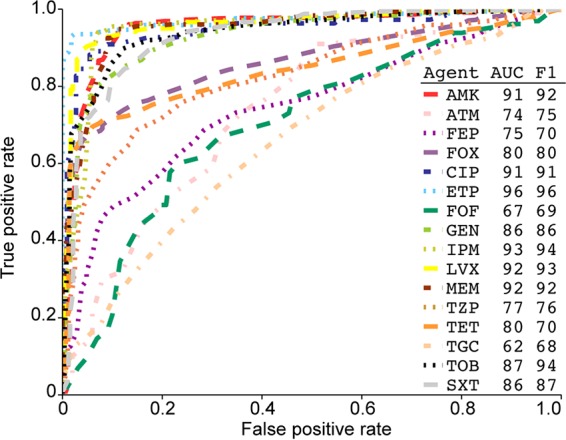
Receiver operating characteristic curves of 16 AdaBoost-based classifiers predicting antimicrobial resistance. Antibiotic agent abbreviations: AMK, amikacin; ATM, aztreonam; FEP, cefepime; FOX, cefoxitin; CIP, ciprofloxacin; ETP, ertapenem; FOF, fosfomycin; GEN, gentamicin; IPM, imipenem; LVX, levofloxacin; MEM, meropenem; TZP, piperacillin-tazobactam; TET, tetracycline; TGC, tigecycline; TOB, tobramycin; SXT, trimethoprim-sulfamethoxazole. AUC is area under the concentration-time curve. The F1 score, the harmonic mean of precision and recall, is commonly used to compare classification methods. Data are the results of a 10-fold cross validation.

References

    1. Munoz-Price LS, Poirel L, Bonomo RA, Schwaber MJ, Daikos GL, Cormican M, Cornaglia G, Garau J, Gniadkowski M, Hayden MK, Kumarasamy K, Livermore DM, Maya JJ, Nordmann P, Patel JB, Paterson DL, Pitout J, Villegas MV, Wang H, Woodford N, Quinn JP. 2013. Clinical epidemiology of the global expansion of Klebsiella pneumoniae carbapenemases. Lancet Infect Dis 13:785–796. doi:10.1016/S1473-3099(13)70190-7. - DOI - PMC - PubMed
    1. Endimiani A, Choudhary Y, Bonomo RA. 2009. In vitro activity of NXL104 in combination with beta-lactams against Klebsiella pneumoniae isolates producing KPC carbapenemases. Antimicrob Agents Chemother 53:3599–3601. doi:10.1128/AAC.00641-09. - DOI - PMC - PubMed
    1. Snitkin ES, Zelazny AM, Thomas PJ, Stock F, NISC Comparative Sequencing Program Group, Henderson DK, Palmore TN, Segre JA. 2012. Tracking a hospital outbreak of carbapenem-resistant Klebsiella pneumoniae with whole-genome sequencing. Sci Transl Med 4:148ra116. doi:10.1126/scitranslmed.3004129. - DOI - PMC - PubMed
    1. Centers for Disease Control and Prevention (CDC) 2013. Notes from the field: hospital outbreak of carbapenem-resistant Klebsiella pneumoniae producing New Delhi metallo-beta-lactamase—Denver, Colorado, 2012. MMWR Morb Mortal Wkly Rep 62:108 https://www.cdc.gov/mmwr/preview/mmwrhtml/mm6206a5.htm. - PMC - PubMed
    1. Mathers AJ, Stoesser N, Sheppard AE, Pankhurst L, Giess A, Yeh AJ, Didelot X, Turner SD, Sebra R, Kasarskis A, Peto T, Crook D, Sifri CD. 2015. Klebsiella pneumoniae carbapenemase (KPC)-producing K. pneumoniae at a single institution: insights into endemicity from whole-genome sequencing. Antimicrob Agents Chemother 59:1656–1663. doi:10.1128/AAC.04292-14. - DOI - PMC - PubMed

MeSH terms

LinkOut - more resources