. 2017 Jul;206(3):1505-1520.
doi: 10.1534/genetics.116.196832. Epub 2017 May 16.

Cap-n-Collar Promotes Tissue Regeneration by Regulating ROS and JNK Signaling in the Drosophila melanogaster Wing Imaginal Disc

Affiliations

Cap-n-Collar Promotes Tissue Regeneration by Regulating ROS and JNK Signaling in the Drosophila melanogaster Wing Imaginal Disc

Amanda R Brock et al. Genetics. 2017 Jul.

Abstract

Regeneration is a complex process that requires an organism to recognize and repair tissue damage, as well as grow and pattern new tissue. Here, we describe a genetic screen to identify novel regulators of regeneration. We ablated the Drosophila melanogaster larval wing primordium by inducing apoptosis in a spatially and temporally controlled manner and allowed the tissue to regenerate and repattern. To identify genes that regulate regeneration, we carried out a dominant-modifier screen by assessing the amount and quality of regeneration in adult wings heterozygous for isogenic deficiencies. We have identified 31 regions on the right arm of the third chromosome that modify the regenerative response. Interestingly, we observed several distinct phenotypes: mutants that regenerated poorly, mutants that regenerated faster or better than wild-type, and mutants that regenerated imperfectly and had patterning defects. We mapped one deficiency region to cap-n-collar (cnc), the Drosophila Nrf2 ortholog, which is required for regeneration. Cnc regulates reactive oxygen species levels in the regenerating epithelium, and affects c-Jun N-terminal protein kinase (JNK) signaling, growth, debris localization, and pupariation timing. Here, we present the results of our screen and propose a model wherein Cnc regulates regeneration by maintaining an optimal level of reactive oxygen species to promote JNK signaling.

Keywords: Cap-n-collar; Drosophila; Nrf2; imaginal disc; reactive oxygen species; regeneration.


Figures

Figure 1
Figure 1
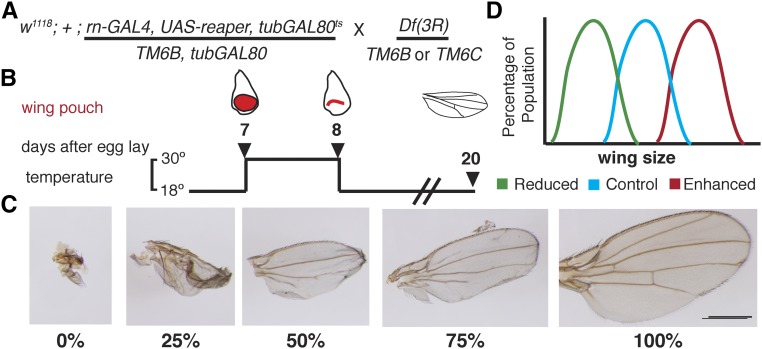
Outline of the deficiency screen. (A) The genotype of the ablation chromosome and the genetic cross used in the screen. (B) A diagram of the tissue ablation system. Briefly, at 18° GAL80TS inhibits GAL4 and UAS-reaper is not expressed. Shifting to 30° at day 7 after egg lay (AEL) relieves the inhibition and reaper expression induces apoptosis. On day 8 AEL, stocks are shifted back to 18° and regeneration occurs. Starting at approximately day 20 AEL, adult flies eclose, enabling scoring of wing size. (C) A semiquantitative scoring scale for the adult wings that resulted from regenerated wing primordia. (D) Tissue ablation was timed so that the majority of a population of control wings regenerate to 50% of normal size, so that screening could identify populations of wings that were larger or smaller than controls.
Figure 2
Figure 2
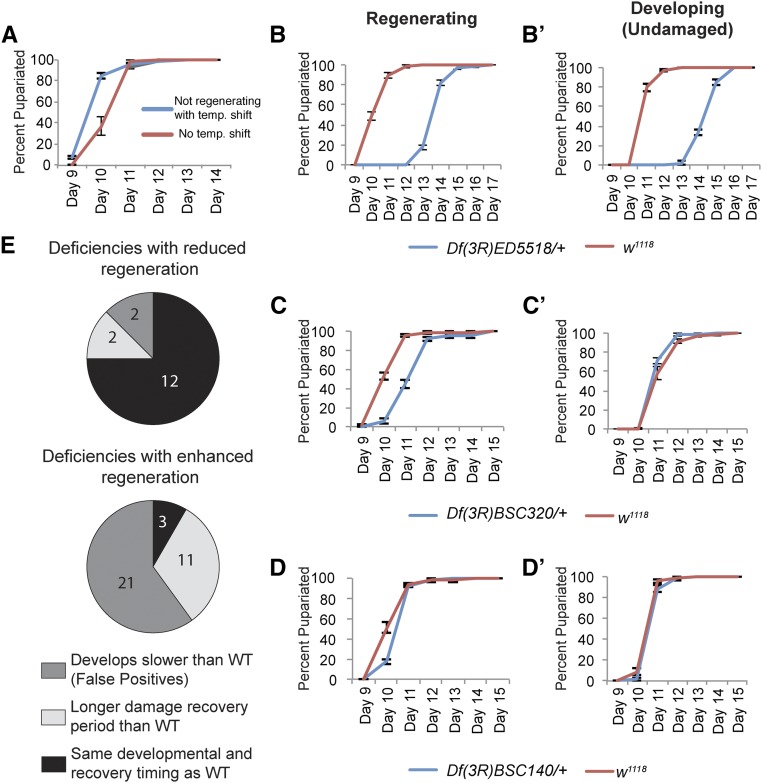
Secondary screen for defects in developmental and regeneration timing. Categorization of mutant lines according to the rates at which the mutant populations reached pupariation during normal development and after tissue damage. (A) The rate at which larvae at 18° reach pupariation compared to that of larvae experiencing the 24-hr, 30° temperature shift without ablation. (B) Df(3R)ED5518/+ pupariated 4 days later than controls following tissue damage, three independent experiments, w1118 n = 157, Df(3R)ED5518/+ n = 64.; (B’) the same line also delayed pupariation during normal development, three independent experiments, w1118 n = 184 wings, Df(3R)ED5518/+ n = 64 wings. (C) Df(3R)BSC320/+ delayed pupariation 1 day longer than controls following tissue damage, three independent experiments, w1118 n = 165, Df(3R)BSC320/+ n = 96. (C’) the same line developed at the same rate as controls when undamaged, three independent experiments, w1118 n = 173, Df(3R)BSC320/+ n = 96; (D) Df(3R)BSC140/+ pupariated at the same rate as controls following tissue damage, three independent experiments, w1118 n = 128, Df(3R)BSC140/+ n = 69; (D’) the same line also developed at the same rate as controls when undamaged, three independent experiments, w1118 n = 129, Df(3R)BSC140/+ n = 52; (E) The secondary screening results for lines that regenerated poorly compared to controls: 2 lines developed slower than controls, 2 lines developed normally but had an increased recovery period following tissue damage, and 12 lines had no discernible pupariation delay after tissue damage. Data for individual lines are in Table 1. The secondary screening results for lines that regenerated better than controls: 21 lines developed slower than controls, 11 lines developed normally but had an increased recovery time following tissue damage compared to controls, and 3 lines had enhanced regeneration with no discernible change in pupariation timing relative to controls. Data for individual lines are in Table 2. temp., temperature; WT, wild-type.
Figure 3
Figure 3
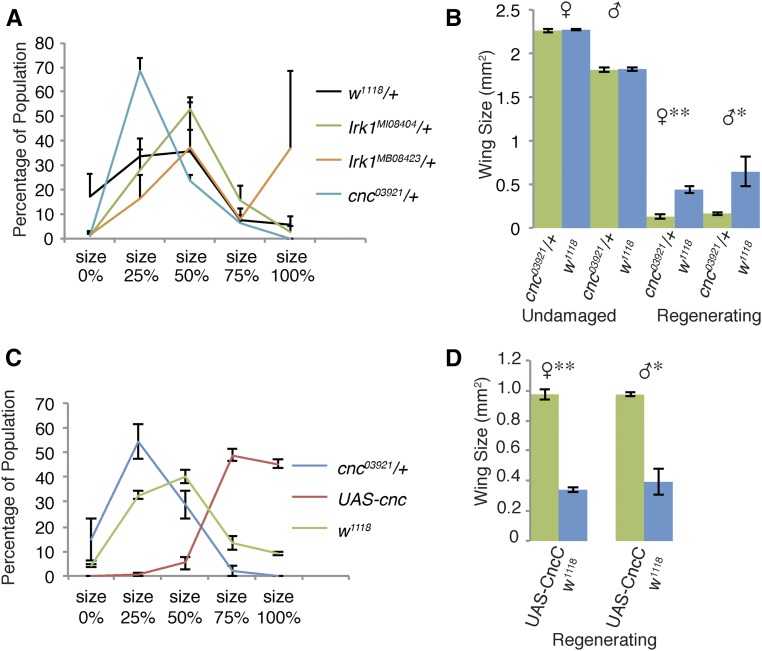
Cnc (cap-n-collar) is required for regeneration. (A) Comparison of populations of adult wings after regeneration for control (w1118), cnc03921/+, Irk1MI08404/+, and Irk1MB08423/+ animals. Error bars display SEM. Three independent experiments, w1118 n = 228 wings, cnc03921/+ n = 122 wings, Irk1MI08404/+ n = 160 wings, and Irk1MB08423/+ n = 116 wings. (B) Measurement of adult wing sizes resulting from undamaged or ablated imaginal discs, in square millimeters. cnc03921/+ (undamaged male n = 56 wings, undamaged female n = 84 wings, regenerated male n = 53 wings, and regenerated female n = 82 wings) and w1118 (undamaged male n = 103 wings, undamaged female n = 165 wings, regenerated male n = 105 wings, and regenerated female n = 154 wings). Male and female wings were separated because of sexually dimorphic adult wing size. There was no significant difference between undamaged cnc and w1118 wing sizes (P > 0.5); however, there was a significant difference in wing size following tissue damage in both males and females using the Student’s t-test. * P < 0.05 and ** P < 0.005. Error bars represent SEM. (C) Comparison of populations of adult wings after imaginal disc ablation with the genotypes w1118, cnc03921/+, and UAS-cncC. Error bars represent SEM. Three independent experiments, w1118 n = 233 wings, cnc03921/+ n = 206 wings, and UAS-cncC n = 176 wings. (D) Measurement of w1118 and UAS-cncC adult wing sizes resulting from undamaged or regenerated imaginal discs in square millimeters. w1118 male n = 70 wings, female n = 131 wings, and UAS-cncC male n = 155 wings, female n = 204 wings. Error bars represent SEM. * P < 0.05, ** P < 0.005, using the Student’s t-test.
Figure 4
Figure 4
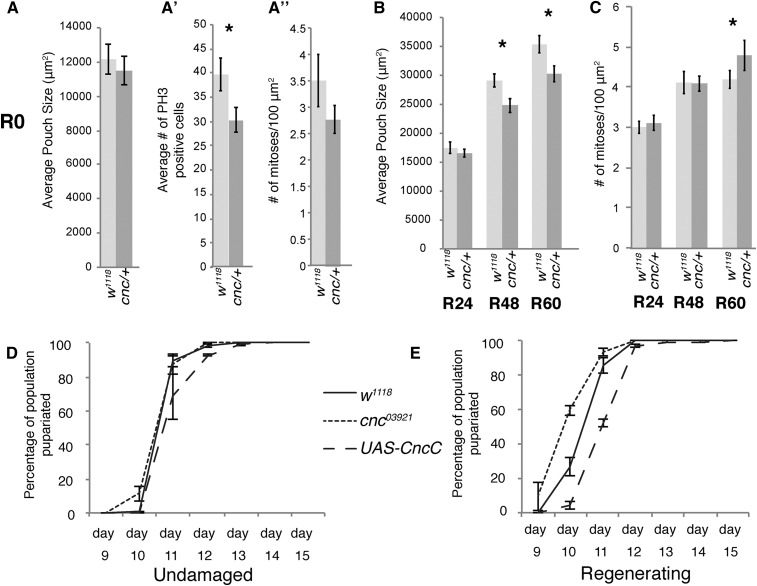
Cnc (cap-n-collar) is required for early blastema proliferation and regulates entry to metamorphosis. (A) Average wing pouch size in control and cnc03921/+ regenerating discs at R0, as marked by anti-Nubbin immunostaining. n = between 11 and 15 discs for each sample, from at least two independent experiments. * P < 0.05. (A’) Average number of mitoses, as marked by anti-phospho histone H3 (PH3), per wing pouch, as marked by anti-Nubbin, in the same discs as (A). (A’’) The average number of mitoses per 100 μm2, calculated from the same discs. Error bars represent SEM. (B) Average wing pouch size in control and cnc03921/+ regenerating discs at R24, R48, and R60, as marked by anti-Nubbin immunostaining. n = between 12 and 22 discs for each sample, from at least two independent experiments. * P < 0.05, Student’s t-test. (C) Average number of mitoses per 100 μm2, calculated from the same discs. Error bars represent SEM. (D) The percentage of normally developing animals that had formed pupae on the side of the vial each day after egg lay. These animals contained the ablation chromosome but were reared at 18° and so did not induce ablation. Three independent experiments, total n for w1118 = 205, UAS-cncC = 207, and cnc03921/+ = 103. (E) The percentage of animals with damaged imaginal discs that had formed pupae on the side of the vial each day after egg lay. The thermal shift to 30° accelerated development such that the timing in (D) cannot be compared to the timing in (E). Three independent experiments, total n for w1118 = 177, UAS-cncC = 154, and cnc03921/+ = 95. Error bars are SEM.
Figure 5
Figure 5
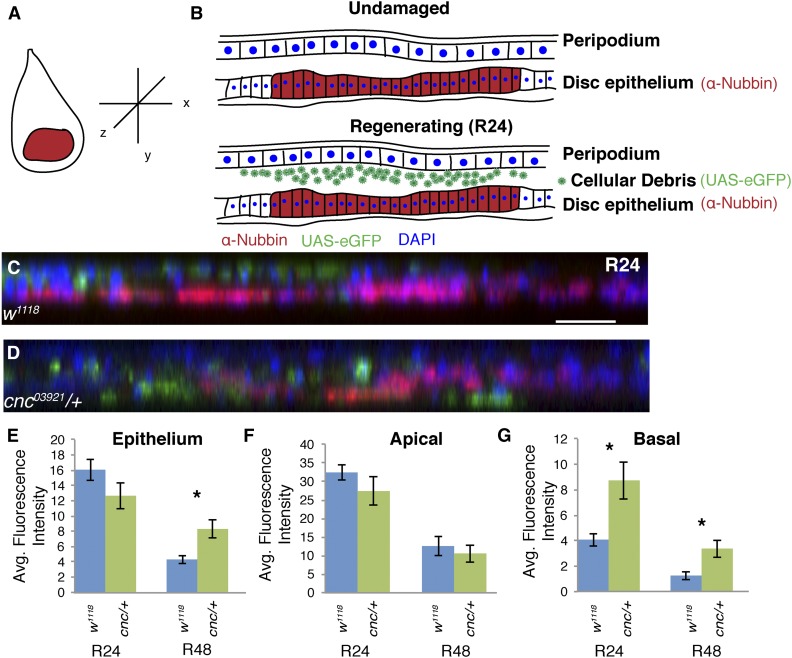
Cnc prevents persistence of basally localized cellular debris. Distribution of cellular debris marked by UAS-eGFP expression in regenerating discs. (A) Typical view of a wing imaginal disc in the XY-plane. (B) Schematic of wing discs in the YZ-plane, which is the orientation of all confocal images shown (orthogonal slices). UAS-eGFP is expressed during the 24-hr ablation period; 24 hr after ablation has ended, the visible GFP is in the debris in the lumen between the peripodium and disc epithelium. (C and D) Orthogonal slices showing the debris fields (eGFP, green) and regenerating epithelia (anti-Nubbin, red; DAPI, blue) at R24. In w1118, the debris is apical to the disc epithelium (C). In cnc03921/+ mutants, the debris is located both apical and basal to the disc epithelium (D). The bar in (C) is equal to 20 μm. (E–G) Quantification of fluorescence intensity in the epithelium (E), and regions apical (F) and basal (G) to the epithelium of the two genotypes at R24 and R48. Error bars are SEM. * P < 0.05, Student’s t-test. Avg., average; Cnc, cap-n-collar; eGFP, enhanced GFP; UAS, upstream activating sequence.
Figure 6
Figure 6
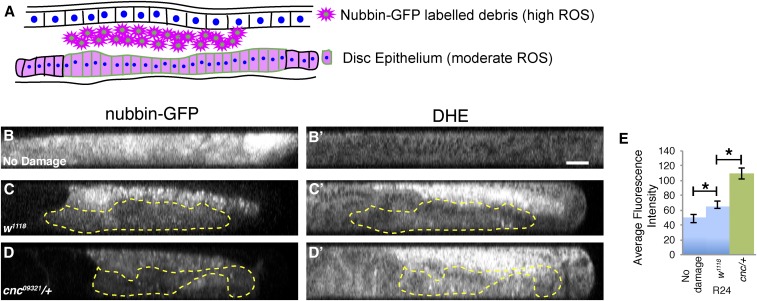
Reactive oxygen species (ROS) levels are higher in the blastema when Cnc (cap-n-collar) levels are reduced. (A) Schematic of a disc in the XY plane. A nubbin-GFP enhancer trap labels the debris and the regenerating epithelium. Dihydroethidum (DHE) fluorescence marking ROS is present in high levels in the cellular debris and lower levels in the disc epithelium. (B–D) Wing discs presented in the YZ-plane expressing a nubbin-GFP reporter to mark the wing primordium and debris (B–D) with DHE staining to indicate ROS levels (B’–D’). Discs are w1118 undamaged (B and B’), w1118 R24 (C and C’), or cnc03921/+ R24 (D and D’). Yellow dotted lines outline the diffuse nub-GFP expression in the regenerating wing pouch, and exclude the bright GFP with puncta in the debris. Bar = 20 μm. (E) DHE levels were quantified by measuring fluorescence intensity in three equal-sized boxes in the epithelial layer of each disc. Undamaged, n = 13; w1118, n = 15; and cnc03921, n = 15. Error bars are SEM. * P < 0.05, Student’s t-test.
Figure 7
Figure 7
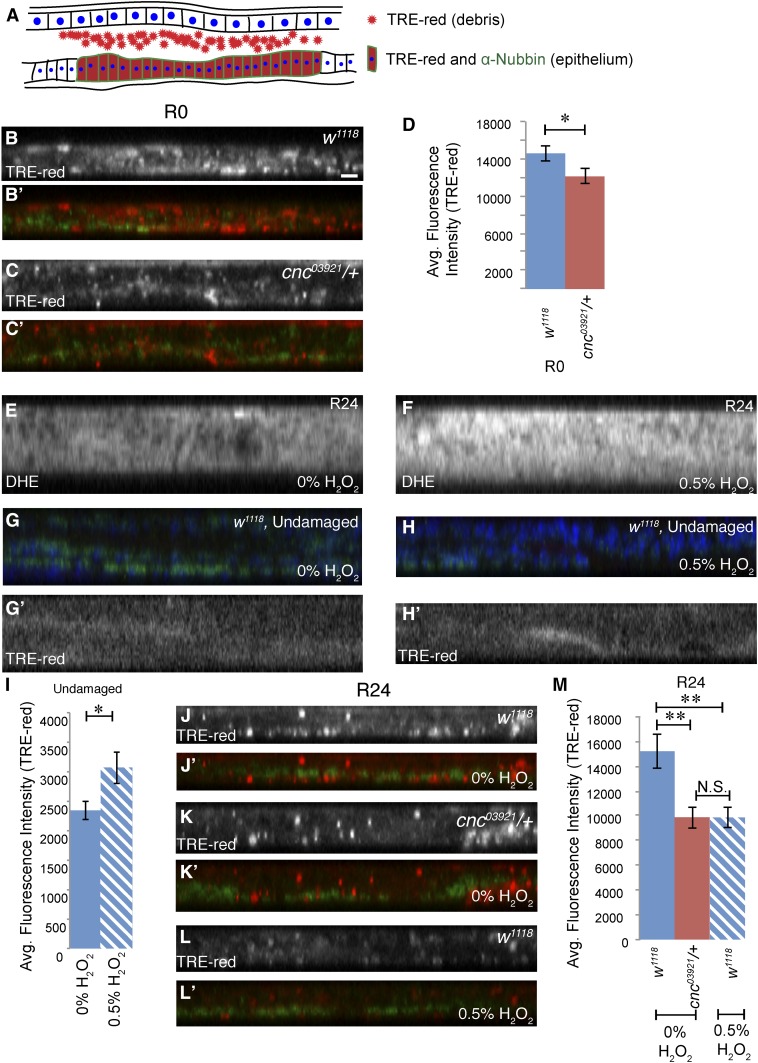
JNK signaling is reduced during regeneration by exposure to excessive ROS. (A) Schematic of a wing disc in the YZ plane. A reporter for JNK signaling, TRE-red, is present at high levels in the debris and at lower levels in the disc epithelium, which is identified by Nubbin antibody (green). (B and C) Wing discs at the end of the ablation period (R0) with TRE-red (red) and anti-Nubbin (green) of the genotypes w1118 (B) and cnc03921/+ (C). Bar in (B) = 20 μm. (D) Quantification of TRE-red fluorescence levels in the disc epithelium (w1118 n = 20 and cnc03921/+ n = 16). (E and F) DHE staining of wing imaginal discs from larvae fed 0 and 0.5% H2O2. Note that feeding 0.5% H2O2 to the larvae results in higher ROS levels in the wing discs. (G and H) Undamaged w1118 wing discs from larvae fed 0% H2O2 (G and G’), or 0.5% H2O2 (H and H’) with anti-Nubbin (green), TRE-Red (red), and DAPI (blue). (G’ and H’) The TRE-Red alone, adjusted for brightness and contrast to enhance visibility. (I) Quantification of TRE-Red performed on unadjusted images (see Materials and Methods): 0% H2O2, w1118 n = 14 and 0.5% H2O2, w1118 n = 20. (J–M) TRE-Red (red) and anti-Nubbin (green) in wing discs after 24 hr of regeneration. (J and J’) w1118, fed 0% H2O2; (K and K’) cnc03921/+, fed 0% H2O2; and (L and L’) w1118, fed 0.5% H2O2. (M) Quantification of (J–L). (0% H2O2, w1118 n = 31, cnc03921/+ n = 25; R24 0.5% H2O2, w1118 n = 30). Note that TRE-Red levels in cnc03921/+ discs are equal to those in w1118 discs with ectopic 0.5% H2O2. Error bars are SEM. * P < 0.05, ** P < 0.005, Student’s t-test. Avg., average; DHE, dihydroethidum; JNK, c-Jun N-terminal protein kinase; N.S., not significant; ROS, reactive oxygen species.
Figure 8
Figure 8
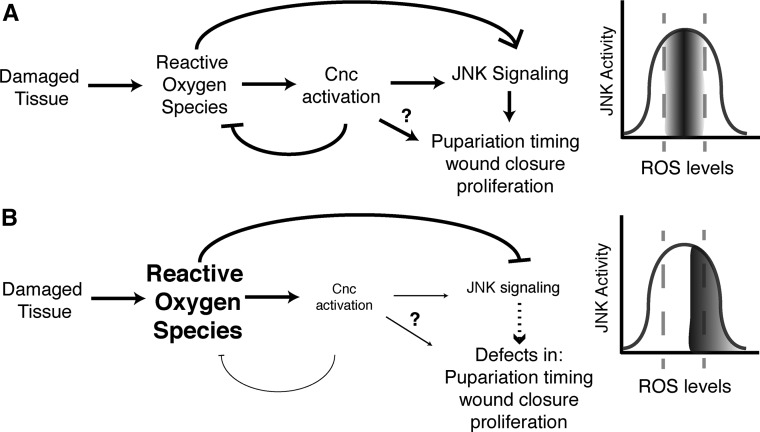
Model for Cnc activity during regeneration. (A) Proposed relationship between ROS levels, Cnc, JNK signaling, and regenerative capacity. Injury induces ROS, which in turn activate JNK and Cnc activity. Cnc transcriptional targets constrain ROS levels and may also regulate JNK activity. Thus, there is an ideal range of ROS levels at which regeneration is most efficient. (B) Model where Cnc levels are reduced. Injury induces ROS, which in turn activate JNK and Cnc. Less Cnc activity results in high ROS levels and low JNK activation, due to an inhibitory effect of high ROS and possibly due to reduction of other important Cnc targets. Cnc, cap-n-collar; c-Jun N-terminal protein kinase; ROS, reactive oxygen species.

References

    1. Bando T., Mito T., Maeda Y., Nakamura T., Ito F., et al. , 2009. Regulation of leg size and shape by the Dachsous/Fat signalling pathway during regeneration. Development 136: 2235–2245. - PubMed
    1. Barone M. C., Sykiotis G. P., Bohmann D., 2011. Genetic activation of Nrf2 signaling is sufficient to ameliorate neurodegenerative phenotypes in a Drosophila model of Parkinson’s disease. Dis. Model. Mech. 4: 701–707. - PMC - PubMed
    1. Behrens A., Sibilia M., David J. P., Möhle-Steinlein U., Tronche F., et al. , 2002. Impaired postnatal hepatocyte proliferation and liver regeneration in mice lacking c-jun in the liver. EMBO J. 21: 1782–1790. - PMC - PubMed
    1. Bellen H. J., Levis R. W., Liao G., He Y., Carlson J. W., et al. , 2004. The BDGP gene disruption project: single transposon insertions associated with 40% of Drosophila genes. Genetics 167: 761–781. - PMC - PubMed
    1. Bergantiños C., Corominas M., Serras F., 2010. Cell death-induced regeneration in wing imaginal discs requires JNK signalling. Development 137: 1169–1179. - PubMed

MeSH terms

LinkOut - more resources