. 2017 May 16;7(1):1979.
doi: 10.1038/s41598-017-02139-8.

Microalgal diversity fosters stable biomass productivity in open ponds treating wastewater

Affiliations

Microalgal diversity fosters stable biomass productivity in open ponds treating wastewater

Dae-Hyun Cho et al. Sci Rep. .

Abstract

It is established that biodiversity determines productivity of natural ecosystems globally. We have proved that abiotic factors influenced biomass productivity in engineered ecosystems i.e. high rate algal ponds (HRAPs), previously. This study demonstrates that biotic factors, particularly microalgal diversity, play an essential role in maintaining stable biomass productivity in HRAP treating municipal wastewater by mutualistic adaptation to environmental factors. The current study examined data from the second year of a two-year study on HRAP treating municipal wastewater. Microalgal diversity, wastewater characteristics, treatment efficiency and several environmental and meteorological factors were documented. Multivariate statistical analyses reveal that microalgae in uncontrolled HRAPs adapt to adverse environmental conditions by fostering diversity. Subsequently, five dominant microalgal strains by biovolume were isolated, enriched, and optimum conditions for high biomass productivity were ascertained. These laboratory experiments revealed that different microalgal strains dominate in different conditions and a consortium of these diverse taxa help in sustaining the algae community from environmental and predatory pressures. Diversity, niche or seasonal partitioning and mutualistic growth are pertinent in microalgal cultivation or wastewater treatment. Therefore, enrichment of selective species would deprive the collective adaptive ability of the consortium and encourage system vulnerability especially in wastewater treatment.


Conflict of interest statement

The authors declare that they have no competing interests.

Figures
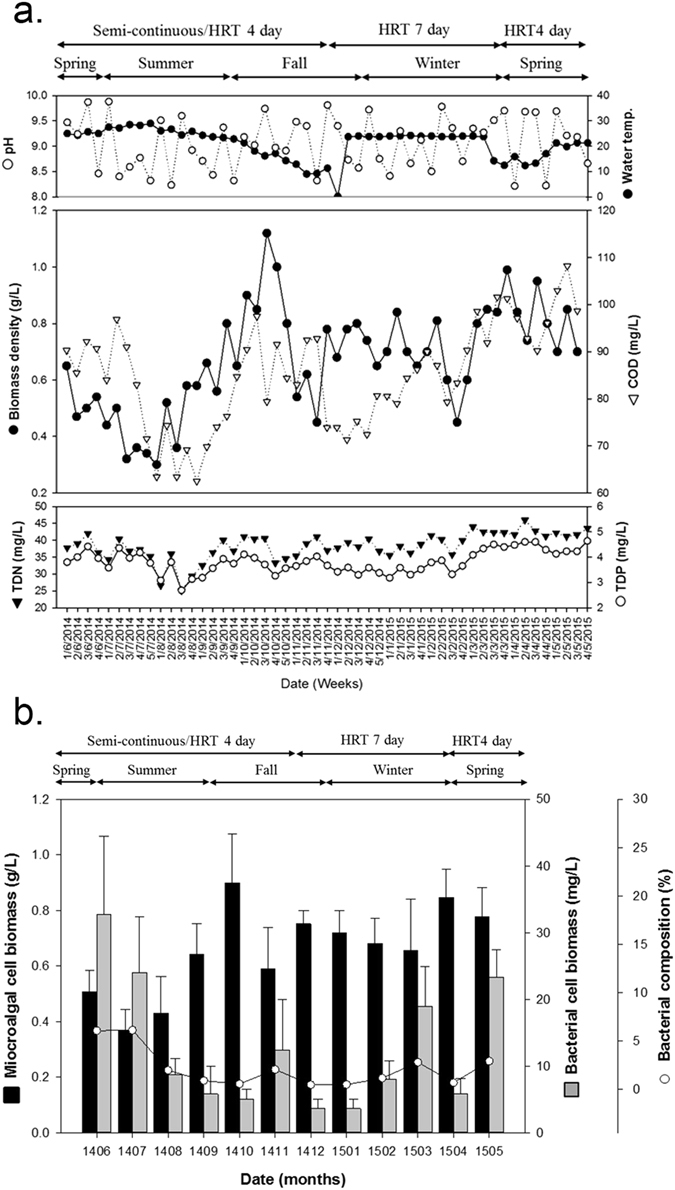
Figure 1
Figure 1
(a) Characteristics of influent wastewater in the HRAP for the year 2014–15, featuring all four seasons. (b) Microalgal and bacterial biomass in HRAP for one year.
Figure 2
Figure 2
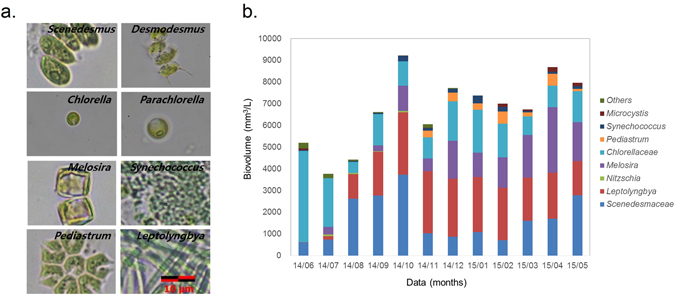
(a) Photomicrographs of dominant microalgal and cyanobacterial taxa found in HRAP. (b) Microalgal diversity in the HRAP based on biovolume calculations. Biovolume was calculated from cell numbers and volumetric data based on image analysis.
Figure 3
Figure 3
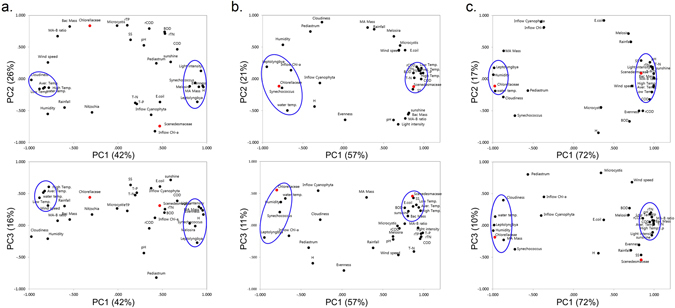
A 36-component 2D-PCA scatter plot based on correlation coefficients of all factors before (a), after (b) and during (c) temperature control experiments in HRAP. High correlation coefficient cluster is represented by bold blue line circle whereas dominant microalgal groups can be seen as red spots. The PCs were selected based on Scree plot and without rotation.
Figure 4
Figure 4
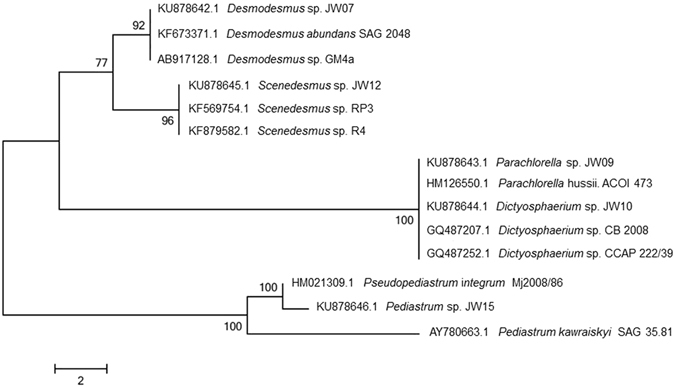
Phylogenetic tree of the isolated strains – JW07, JW09, JW10, JW12 and JW15 performed by neighbour-joining algorithm in the MEGA 5 software with bootstrap values based on 1000 replications.
Figure 5
Figure 5
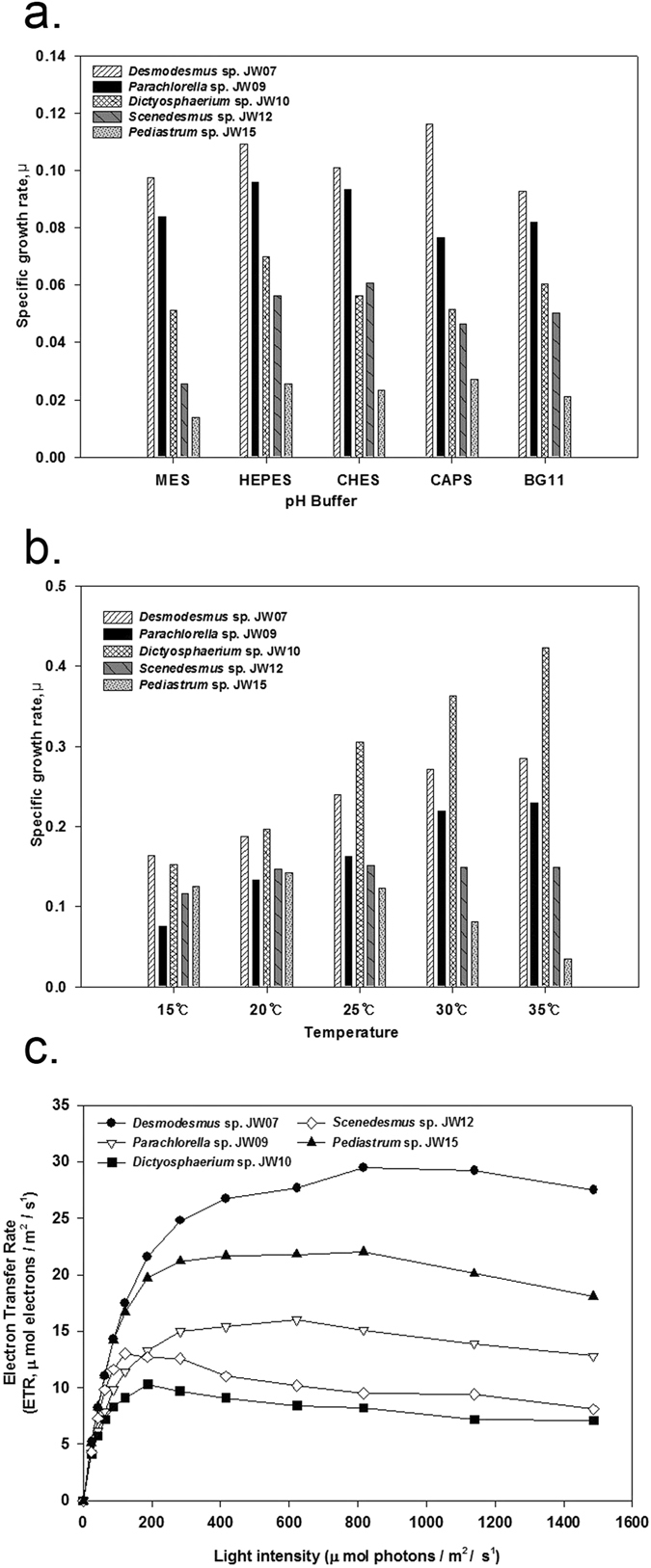
Specific growth rate and electron transfer rate of different microalgal strains under various pH and temperature profiles (a,b), and different light intensities (c), respectively.
Figure 6
Figure 6
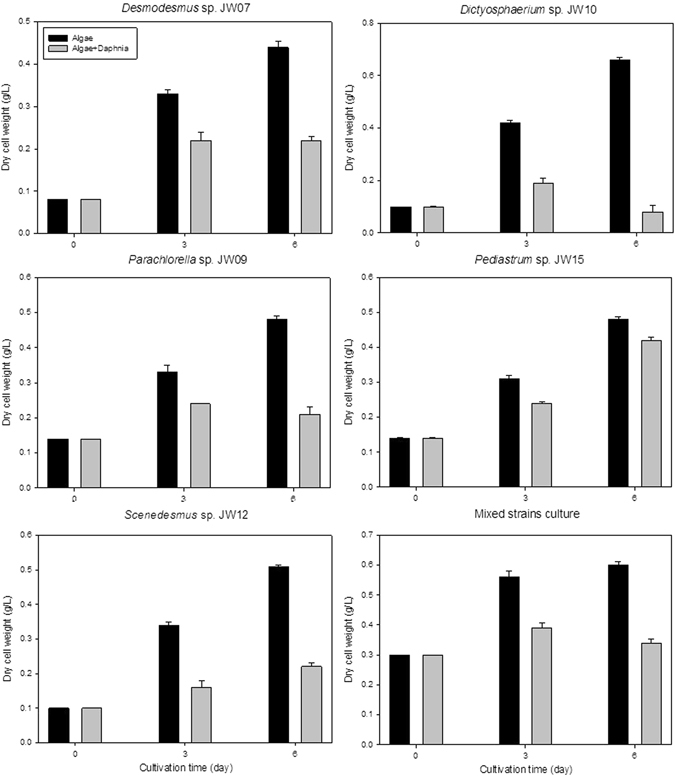
Co-cultivation study of isolated, indigenous microalgal strains with Daphnia isolated from the HRAP.

References

    1. Duffy JE, et al. Biodiversity mediates top–down control in eelgrass ecosystems: a global comparative-experimental approach. Ecol. Lett. 2015;18:696–705. doi: 10.1111/ele.12448. - DOI - PubMed
    1. Cardinale BJ. Biodiversity improves water quality through niche partitioning. Nature. 2011;472:86–89. doi: 10.1038/nature09904. - DOI - PubMed
    1. Beyter D, et al. Diversity, Productivity and Stability of an Industrial Microbial Ecosystem. Appl. Environ. Microbiol. 2016 - PMC - PubMed
    1. Weis JJ, Madrigal DS, Cardinale BJ. Effects of Algal Diversity on the Production of Biomass in Homogeneous and Heterogeneous Nutrient Environments: A Microcosm Experiment. PLoS ONE. 2008;3:e2825. doi: 10.1371/journal.pone.0002825. - DOI - PMC - PubMed
    1. Christenson L, Sims R. Production and harvesting of microalgae for wastewater treatment, biofuels, and bioproducts. Biotechnol. Adv. 2011;29:686–702. doi: 10.1016/j.biotechadv.2011.05.015. - DOI - PubMed

Publication types

LinkOut - more resources