


doi: 10.1155/2017/2960502.
Epub 2017 Apr 23.
Association of PECAM-1 Gene Polymorphisms with Kawasaki Disease in Chinese Children
Affiliations
- PMID: 28512385
- PMCID: PMC5420431
- DOI: 10.1155/2017/2960502
Item in Clipboard
Association of PECAM-1 Gene Polymorphisms with Kawasaki Disease in Chinese Children
Dis Markers.
2017.
Abstract
Kawasaki disease (KD) is an acute systemic vasculitis complicated by development of coronary artery lesions. PECAM-1 is a kind of cell adhesion molecule, which plays an important role in coronary artery disease. The relationship between PECAM-1 gene polymorphisms and their susceptibility to Kawasaki diseases (KD) is still unclear. In our study, we examined the PECAM-1 gene polymorphisms in 44 KD patients and 59 healthy children and revealed the correlation of PECAM-1 gene polymorphisms in KD children with and without coronary artery lesions (CAL).
Figures
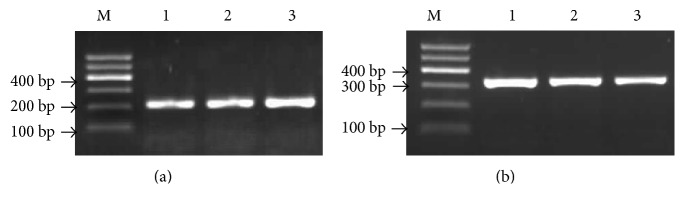
Representative results of the two PECAM-1 polymorphism sites in two groups. Lane M, DNA size marker. Lane 1, KD without CAL; Lane 2, KD with CAL; Lane 3, control's sample. (a) PECAM-1 +373 C/G gene. (b) PECAM-1 +1688 A/G gene.
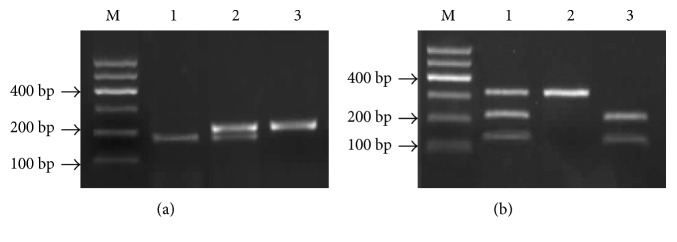
PCR-RFLP assay for PECAM-1 gene (+1688 A/G) and (+373 C/G) polymorphism. Representative electrophoresis of PCR products cleaved with restriction endonuclease Pvu II and Nhe I was shown. Lane M: DNA molecular weight marker. (a) PECAM-1 (+373 C/G) gene. Lane 1: 373CC homozygous genotype, 188 bp; Lane 2: 373CG heterozygous genotype, 255 bp and 188 bp; Lane 3: 373GG homozygous genotype, 255 bp. The 37 bp in 373 CC and 373 CG genotypes was not visible in electrophoresis gel due to its too small size. (b) PECAM-1 (+1688 A/G) gene. Lane 1: 1688AG heterozygous genotype, 338 bp, 219 bp, and 119 bp; Lane 2: 168AA homozygous genotype, 338 bp; and Lane 3: 1688GG homozygous genotype, 219 bp and 119 bp. PECAM-1: platelet endothelial cell adhesion molecule-1.
References
-
- Peng Q., Deng Y., Yang X., Leng X., Yang Y., Liu H. Genetic variants of ADAM17 are implicated in the pathological process of Kawasaki disease and secondary coronary artery lesions via the TGF-β/SMAD3 signaling pathway. European Journal of Pediatrics. 2016;175(5):705–713. doi: 10.1007/s00431-016-2696-8. - DOI - PubMed
-
- Ma L., Du Z. Advances in the pathogenesis of vascular endothelial cells injury in Kawasaki disease. Zhonghua Er Ke Za Zhi. 2016;54(2):158–160. - PubMed
-
- Tian J., Lv H. T., An X. J., Ling N., Xu F. Endothelial microparticles induce vascular endothelial cell injury in children with Kawasaki disease. European Review for Medical and Pharmacological Sciences. 2016;20(9):1814–1818. - PubMed
MeSH terms
Substances
LinkOut - more resources
Full Text Sources
Other Literature Sources
Medical
Miscellaneous
