


Behavioural individuality in clonal fish arises despite near-identical rearing conditions
- PMID: 28513582
- PMCID: PMC5442312
- DOI: 10.1038/ncomms15361
Behavioural individuality in clonal fish arises despite near-identical rearing conditions
Abstract
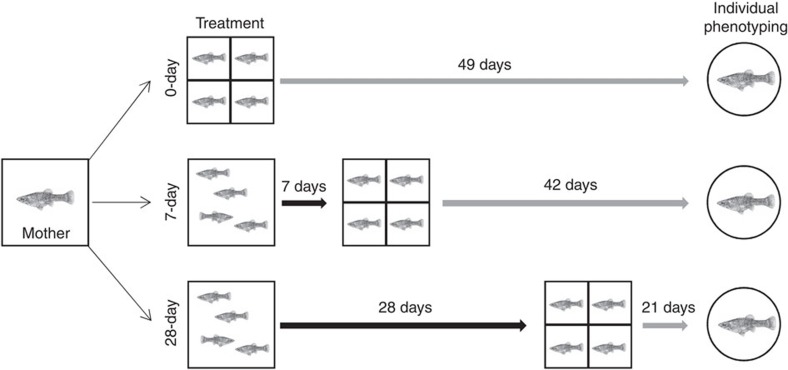
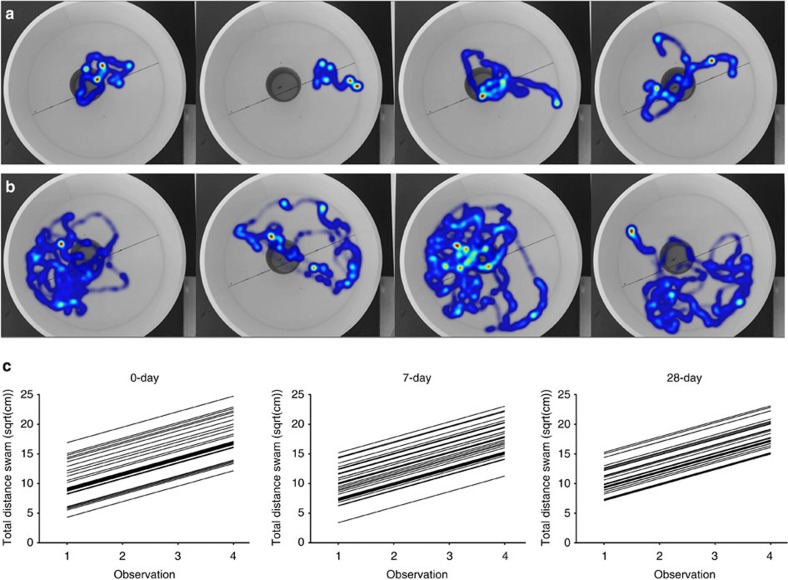
Behavioural individuality is thought to be caused by differences in genes and/or environmental conditions. Therefore, if these sources of variation are removed, individuals are predicted to develop similar phenotypes lacking repeatable individual variation. Moreover, even among genetically identical individuals, direct social interactions are predicted to be a powerful factor shaping the development of individuality. We use tightly controlled ontogenetic experiments with clonal fish, the Amazon molly (Poecilia formosa), to test whether near-identical rearing conditions and lack of social contact dampen individuality. In sharp contrast to our predictions, we find that (i) substantial individual variation in behaviour emerges among genetically identical individuals isolated directly after birth into highly standardized environments and (ii) increasing levels of social experience during ontogeny do not affect levels of individual behavioural variation. In contrast to the current research paradigm, which focuses on genes and/or environmental drivers, our findings suggest that individuality might be an inevitable and potentially unpredictable outcome of development.
Conflict of interest statement
The authors declare no competing financial interests.
Figures
References
-
- Pervin L., John O. P. eds Handbook of Personality: Theory and Research The Guilford Press (1999).
-
- Larsen R. J. & Buss D. M. Personality Psychology: Domains of Knowledge about Human Nature McGrae-Hill Education (2013).
-
- Clark A. & Ehlinger T. in Perspectives in Ethology (eds Bateson, P. & Klopfer, P.) 403–420 (Plenum, 1987).
-
- Gosling S. D. & John O. P. Personality dimensions in nonhuman animals: a cross-species review. Curr. Dir. Psychol. Sci. 8, 69–74 (1999).
-
- Sih A., Bell A. M., Johnson J. C. & Ziemba R. E. Behavioral syndromes: an integrative overview. Q. Rev. Biol. 79, 241–277 (2004). - PubMed
Publication types
MeSH terms
LinkOut - more resources
Full Text Sources
Other Literature Sources
