


HIV and the criminalisation of drug use among people who inject drugs: a systematic review
- PMID: 28515014
- PMCID: PMC6005363
- DOI: 10.1016/S2352-3018(17)30073-5
HIV and the criminalisation of drug use among people who inject drugs: a systematic review
Abstract
Background: Mounting evidence suggests that laws and policies prohibiting illegal drug use could have a central role in shaping health outcomes among people who inject drugs (PWID). To date, no systematic review has characterised the influence of laws and legal frameworks prohibiting drug use on HIV prevention and treatment.
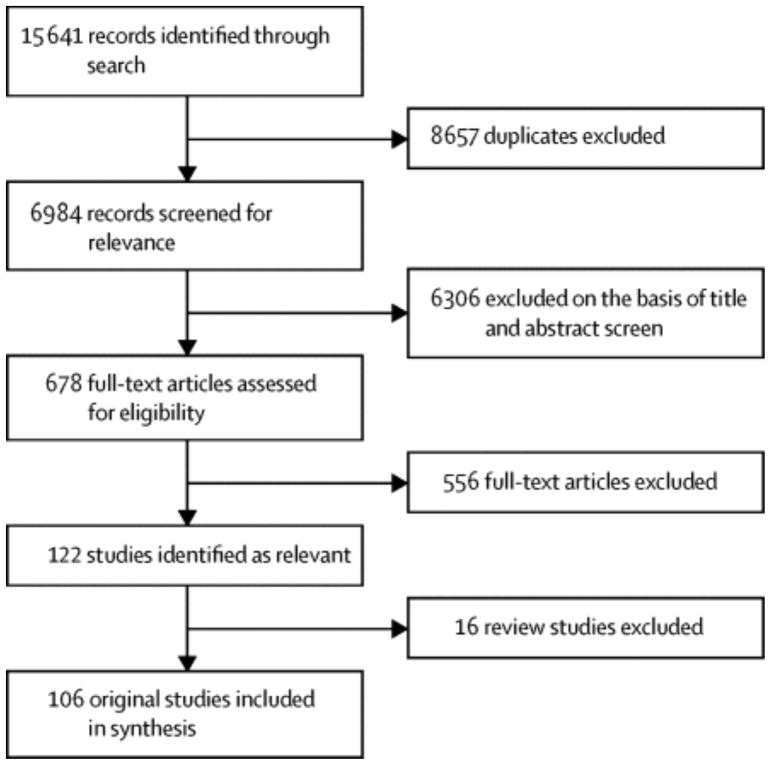
Methods: Consistent with PRISMA guidelines, we did a systematic review of peer-reviewed scientific evidence describing the association between criminalisation of drug use and HIV prevention and treatment-related outcomes among PWID. We searched MEDLINE, Embase, SCOPUS, PsycINFO, Sociological Abstracts, CINAHL, Web of Science, and other sources. To be included in our review, a study had to meet the following eligibility criteria: be published in a peer-reviewed journal or presented as a peer-reviewed abstract at a scientific conference; examine, through any study design, the association between an a-priori set of indicators related to the criminalisation of drugs and HIV prevention or treatment among PWID; provide sufficient details on the methods followed to allow critical assessment of quality; be published or presented between Jan 1, 2006, and Dec 31, 2014; and be published in the English language.
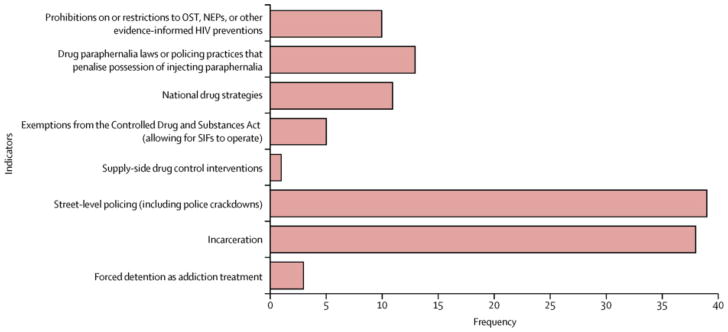
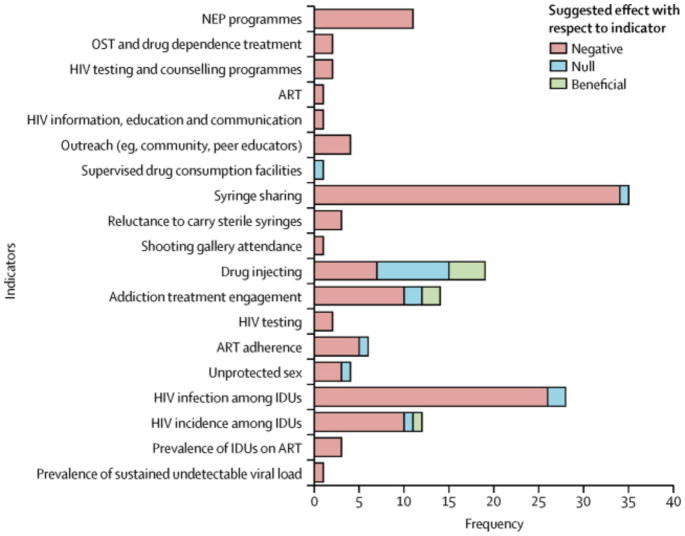
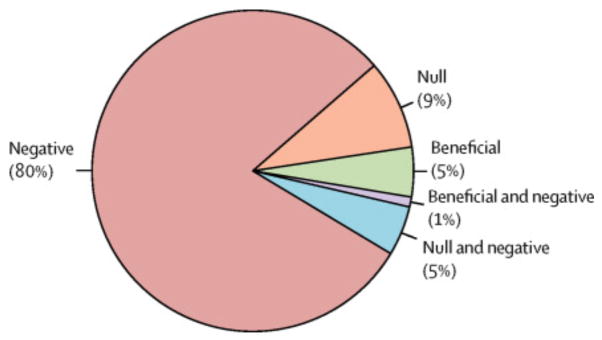
Findings: We identified 106 eligible studies comprising 29 longitudinal, 49 cross-sectional, 22 qualitative, two mixed methods, four mathematical modelling studies, and no randomised controlled trials. 120 criminalisation indicators were identified (range 1-3 per study) and 150 HIV indicators were identified (1-5 per study). The most common criminalisation indicators were incarceration (n=38) and street-level policing (n=39), while the most frequent HIV prevention and treatment indicators were syringe sharing (n=35) and prevalence of HIV infection among PWID (n=28). Among the 106 studies included in this review, 85 (80%) suggested that drug criminalisation has a negative effect on HIV prevention and treatment, 10 (9%) suggested no association, five (5%) suggested a beneficial effect, one (1%) suggested both beneficial and negative effects, and five (5%) suggested both null and negative effects.
Interpretation: These data confirm that criminalisation of drug use has a negative effect on HIV prevention and treatment. Our results provide an objective evidence base to support numerous international policy initiatives to reform legal and policy frameworks criminalising drug use.
Funding: Canadian Institutes of Health Research and US National Institutes of Health.
Copyright © 2017 Elsevier Ltd. All rights reserved.
Conflict of interest statement
JSM reports grants from the Ministry of Health of the Province of British Columbia, the US National Institute on Drug Abuse (NIDA), the US National Institutes of Health (NIH), AbbVie, Bristol-Myers Squibb, Gilead Sciences, Janssen, Merck, ViiV Healthcare, and the MAC AIDS Fund, outside the submitted work. All other authors declare no competing interests.
Figures
Comment in
-
Collateral damage and the criminalisation of drug use.Lancet HIV. 2017 Aug;4(8):e326-e327. doi: 10.1016/S2352-3018(17)30071-1. Epub 2017 May 14. Lancet HIV. 2017. PMID: 28515015 No abstract available.
References
-
- World Drug Report 2016. New York, NY: UN Office on Drugs and Crime; 2016.
-
- The gap report. Geneva: UNAIDS; Jul 16, 2014.
-
- Mathers BM, Degenhardt L, Phillips B, et al. Global epidemiology of injecting drug use and HIV among people who inject drugs: a systematic review. Lancet. 2008;372:1733–1745. - PubMed
-
- Wolfe D, Carrieri MP, Shepard D. Treatment and care for injecting drug users with HIV infection: a review of barriers and ways forward. Lancet. 2010;376:355–366. - PubMed
-
- Degenhardt L, Mathers BM, Wirtz AL, et al. What has been achieved in HIV prevention, treatment and care for people who inject drugs, 2010–2012? A review of the six highest burden countries. Int J Drug Policy. 2014;25:53–60. - PubMed
Publication types
MeSH terms
Grants and funding
LinkOut - more resources
Full Text Sources
Other Literature Sources
Medical
Molecular Biology Databases
Research Materials
