Antibiotic stability over six weeks in aqueous solution at body temperature with and without heat treatment that mimics the curing of bone cement
- PMID: 28515059
- PMCID: PMC5457644
- DOI: 10.1302/2046-3758.65.BJR-2017-0276.R1
Antibiotic stability over six weeks in aqueous solution at body temperature with and without heat treatment that mimics the curing of bone cement
Abstract
Objectives: Thermal stability is a key property in determining the suitability of an antibiotic agent for local application in the treatment of orthopaedic infections. Despite the fact that long-term therapy is a stated goal of novel local delivery carriers, data describing thermal stability over a long period are scarce, and studies that avoid interference from specific carrier materials are absent from the orthopaedic literature.
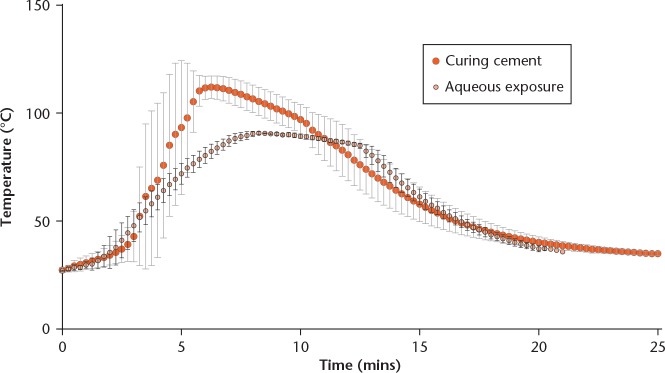
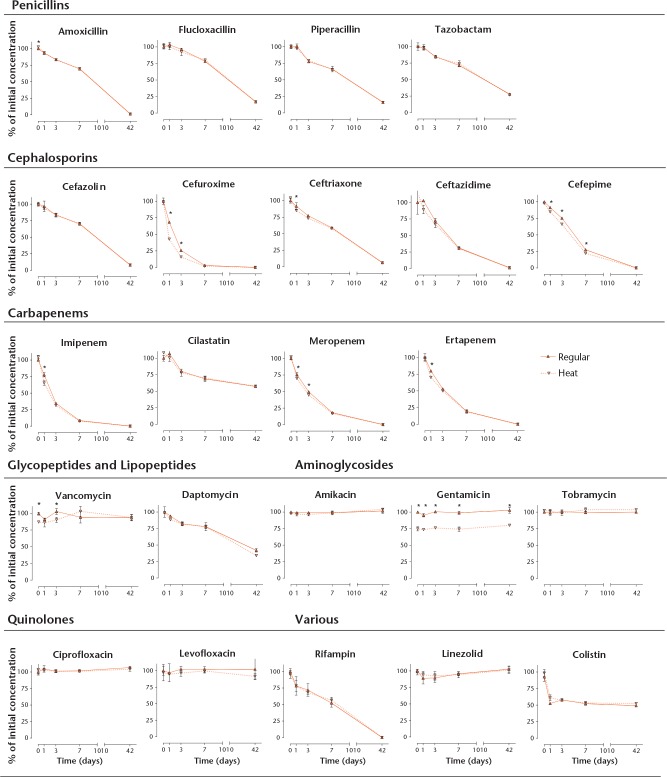
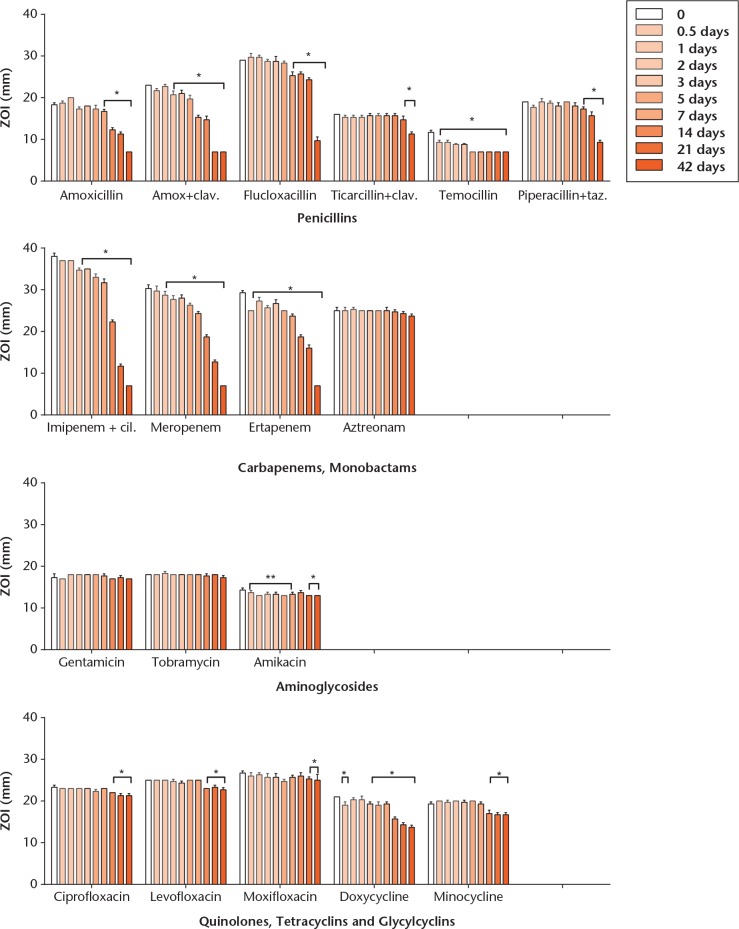
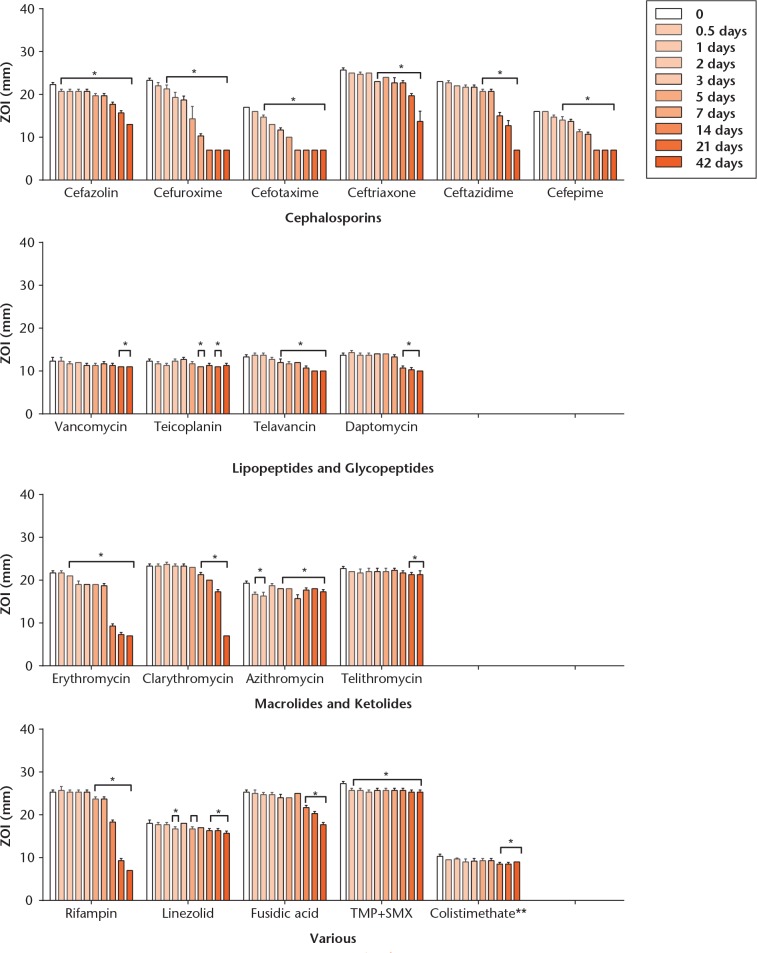
Methods: In this study, a total of 38 frequently used antibiotic agents were maintained at 37°C in saline solution, and degradation and antibacterial activity assessed over six weeks. The impact of an initial supplementary heat exposure mimicking exothermically curing bone cement was also tested as this material is commonly used as a local delivery vehicle. Antibiotic degradation was assessed by liquid chromatography coupled to mass spectrometry, or by immunoassays, as appropriate. Antibacterial activity over time was determined by the Kirby-Bauer disk diffusion assay.
Results: The heat exposure mimicking curing bone cement had minimal effect on stability for most antibiotics, except for gentamicin which experienced approximately 25% degradation as measured by immunoassay. Beta-lactam antibiotics were found to degrade quite rapidly at 37°C regardless of whether there was an initial heat exposure. Excellent long-term stability was observed for aminoglycosides, glycopeptides, tetracyclines and quinolones under both conditions.
Conclusions: This study provides a valuable dataset for orthopaedic surgeons considering local application of antibiotics, and for material scientists looking to develop next-generation controlled or extended-release antibiotic carriers.Cite this article: E. Samara, T. F. Moriarty, L. A. Decosterd, R. G. Richards, E. Gautier, P. Wahl. Antibiotic stability over six weeks in aqueous solution at body temperature with and without heat treatment that mimics the curing of bone cement. Bone Joint J 2017;6:296-306. DOI: 10.1302/2046-3758.65.BJR-2017-0276.R1.
Keywords: Bone cement; Local antibiotics; Thermal stability.
© 2017 Moriarty et al.
Conflict of interest statement
ICMJE Conflicts of Interest: None declared.
Figures
References
-
- Hanssen AD, Spangehl MJ. Practical applications of antibiotic-loaded bone cement for treatment of infected joint replacements. Clin Orthop Relat Res 2004;427:79-85. - PubMed
-
- Henry SL, Galloway KP. Local antibacterial therapy for the management of orthopaedic infections. Pharmacokinetic considerations. Clin Pharmacokinet 1995; 291:36-45. - PubMed
-
- Iarikov D, Demian H, Rubin D, Alexander J, Nambiar S. Choice and doses of antibacterial agents for cement spacers in treatment of prosthetic joint infections: review of published studies. Clin Infect Dis 2012;55:1474-1480. - PubMed
-
- Cui Q, Mihalko WM, Shields JS, Ries M, Saleh KJ. Antibiotic-impregnated cement spacers for the treatment of infection associated with total hip or knee arthroplasty. J Bone Joint Surg [Am] 2007;89-A:871-882. - PubMed
-
- Kanellakopoulou K, Giamarellos-Bourboulis EJ. Carrier systems for the local delivery of antibiotics in bone infections. Drugs 2000;59:1223-1232. - PubMed
LinkOut - more resources
Full Text Sources
Other Literature Sources