


Estimation of the linear mixed integrated Ornstein-Uhlenbeck model
- PMID: 28515536
- PMCID: PMC5407356
- DOI: 10.1080/00949655.2016.1277425
Estimation of the linear mixed integrated Ornstein-Uhlenbeck model
Abstract
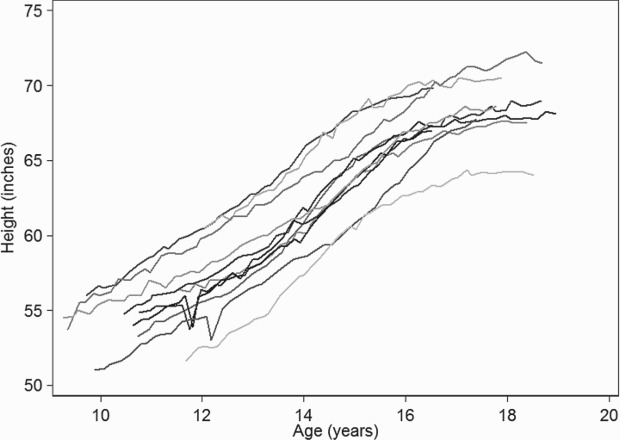
The linear mixed model with an added integrated Ornstein-Uhlenbeck (IOU) process (linear mixed IOU model) allows for serial correlation and estimation of the degree of derivative tracking. It is rarely used, partly due to the lack of available software. We implemented the linear mixed IOU model in Stata and using simulations we assessed the feasibility of fitting the model by restricted maximum likelihood when applied to balanced and unbalanced data. We compared different (1) optimization algorithms, (2) parameterizations of the IOU process, (3) data structures and (4) random-effects structures. Fitting the model was practical and feasible when applied to large and moderately sized balanced datasets (20,000 and 500 observations), and large unbalanced datasets with (non-informative) dropout and intermittent missingness. Analysis of a real dataset showed that the linear mixed IOU model was a better fit to the data than the standard linear mixed model (i.e. independent within-subject errors with constant variance).
Keywords: 62F99; 62J99; 62M10; 62P10; Fixed effects; Integrated Ornstein–Uhlenbeck process; Newton Raphson; random effects; repeated measures.
Figures
References
-
- Taylor J, Cumberland W, Sy J. A stochastic model for analysis of longitudinal AIDS data. J Am Stat Assoc. 1994;89(427):727–736. doi: 10.1080/01621459.1994.10476806 - DOI
Grants and funding
LinkOut - more resources
Full Text Sources
Other Literature Sources