


Patterns and correlates of adherence to self-monitoring in lung transplant recipients during the first 12 months after discharge from transplant
- PMID: 28517112
- PMCID: PMC5545057
- DOI: 10.1111/ctr.13014
Patterns and correlates of adherence to self-monitoring in lung transplant recipients during the first 12 months after discharge from transplant
Abstract
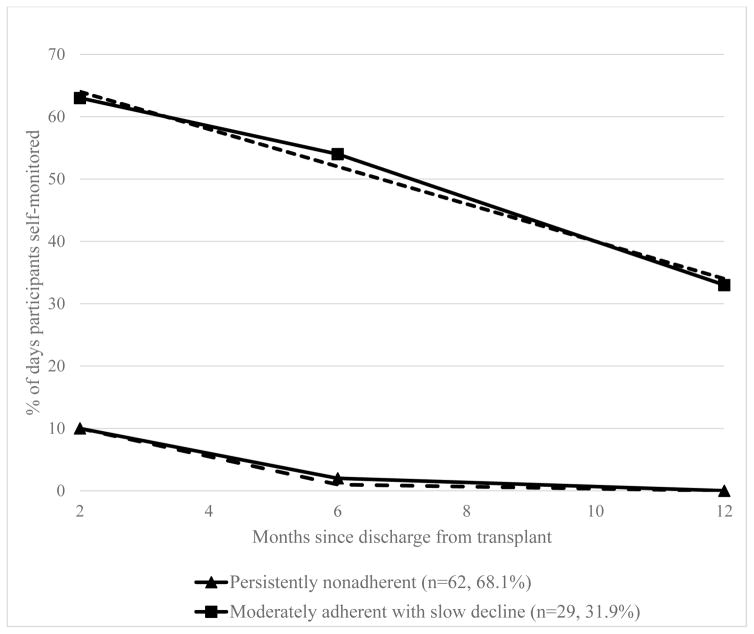
Self-monitoring of lung function, vital signs, and symptoms is crucial for lung transplant recipients (LTRs) to ensure early detection of complications and prompt intervention. This study sought to identify patterns and correlates of adherence to self-monitoring among LTRs over the first 12 months post-discharge from transplant. This study analyzed existing data from the usual care arm participants of a randomized clinical trial who tracked self-monitoring activities using paper-and-pencil logs. Adherence was calculated as the percent of days LTRs recorded any self-monitoring data per interval: hospital discharge-2 months, 3-6 months, and 7-12 months. The sample (N=91) was mostly white (87.9%), male (61.5%), with a mean age of 57.2±13.8 years. Group-based trajectory analyses revealed two groups: (i) moderately adherent with slow decline (n=29, 31.9%) and (ii) persistently nonadherent (n=62, 68.1%). Multivariate binary logistic regression revealed the following baseline factors increased the risk in the persistently nonadherent group: female (P=.035), higher anxiety (P=.008), and weaker sense of personal control over health (P=.005). Poorer physical health over 12 months were associated with increased risk in the persistently nonadherent group (P=.004). This study highlighted several modifiable factors for future interventions to target, including reducing post-transplant anxiety, and strengthening sense of personal control over health in LTRs.
Keywords: adherence; group-based trajectory modeling; lung transplant; self-management; self-monitoring.
© 2017 John Wiley & Sons A/S. Published by John Wiley & Sons Ltd.
Conflict of interest statement
Figures
References
-
- Yusen RD, Edwards LB, Dipchand AI, et al. The registry of the International Society for Heart and Lung Transplantation: Thirty-third adult lung and heart-lung transplant report-2016; focus theme: Primary diagnostic indications for transplant. J Hear Lung Transplant. 2016;35(10):1170–1184. doi: 10.1016/j.healun.2016.09.001. - DOI - PubMed
-
- DeVito Dabbs A, Hoffman LA, Iacono AT, et al. Pattern and predictors of early rejection after lung transplantation. Am J Crit Care. 2003;12(6):497–505. - PubMed
-
- Finkelstein SM, Lindgren B, Prasad B, et al. Reliability and validity of spirometry measurements in a paperless home monitoring diary program for lung transplantation. [Accessed January 5, 2015];Heart Lung. 1993 22(6):523–533. http://www.ncbi.nlm.nih.gov/pubmed/8288456. - PubMed
MeSH terms
Grants and funding
LinkOut - more resources
Full Text Sources
Other Literature Sources
Medical
