Case Reports
doi: 10.3201/eid2306.162018.
Brucella neotomae Infection in Humans, Costa Rica
- PMID: 28518028
- PMCID: PMC5443450
- DOI: 10.3201/eid2306.162018
Item in Clipboard
Case Reports
Brucella neotomae Infection in Humans, Costa Rica
Emerg Infect Dis.
2017 Jun.
Erratum in
-
Correction: Vol. 23, No. 6.Emerg Infect Dis. 2017 Aug;23(8):1435. doi: 10.3201/eid2308.C22308. Emerg Infect Dis. 2017. PMID: 31305624 Free PMC article.
Abstract
Several species of Brucella are known to be zoonotic, but B. neotomae infection has been thought to be limited to wood rats. In 2008 and 2011, however, B. neotomae was isolated from cerebrospinal fluid of 2 men with neurobrucellosis. The nonzoonotic status of B. neotomae should be reassessed.
Keywords: Brucella; Brucella neotomae; Costa Rica; bacteria; brucellosis; neurobrucellosis; neurological infections; zoonoses.
Figures
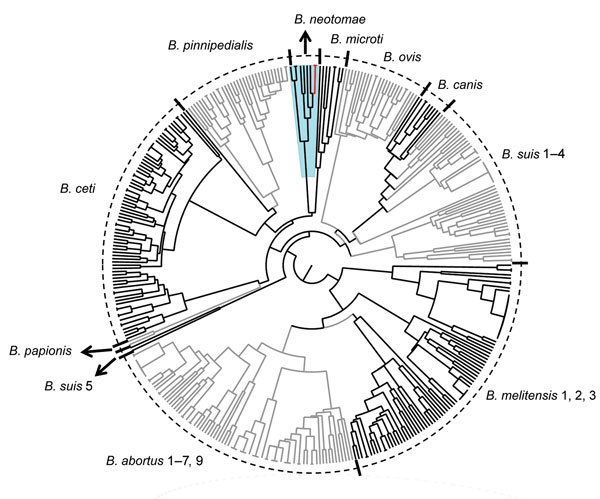
Dendrogram based on multiple locus variable number of tandem repeats–16-loci panel analysis of Brucella spp. (http://mlva.u-psud.fr/brucella/ ) and clinical isolates from human cerebrospinal fluid samples from 2 patients with brucellosis. The isolates bneohCR1 and bneohCR2 (red branches) showed a pattern consistent with previously reported profiles for Brucella neotomae (blue shading). Black, gray, and tic marks are used to differentiate between adjacent species. Arrows separate small neighboring clusters and indicate the B. neotomae cluster.
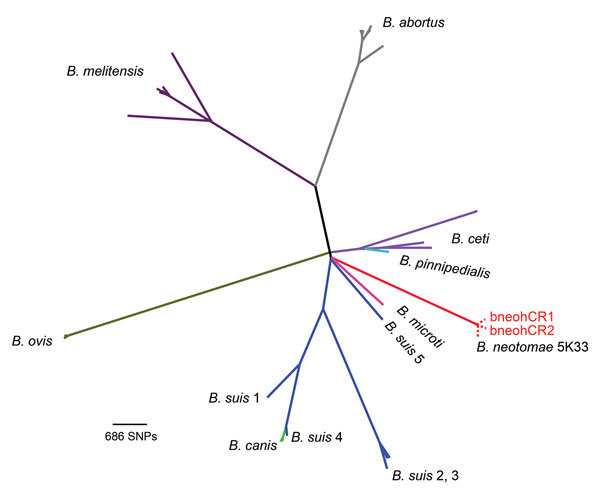
Phylogenetic tree based on 34,307 single-nucleotide polymorphisms (SNPs) found among 51 Brucella genome sequences. The clinical isolates bneohCR1 and bneohCR2 cluster with B. neotomae 5K33 and differ by 164 SNPs. A different color is used to represent each Brucella species. Dotted red lines denote the 3 B. neotomae isolates, which overlap at the tip of the branch because of the high identity among them.
References
-
- World Health Organization. The control of neglected zoonotic diseases. In: NZD4 Organising Committee, editor. WHO conference report. Geneva: WHO Press; 2014. p. 23–35.
-
- Stoenner HG, Lackman DB. A new species of Brucella isolated from the desert wood rat, Neotoma lepida Thomas. Am J Vet Res. 1957;18:947–51. - PubMed
-
- Stoenner HG. The behavior of Brucella neotomae and Brucella suis in reciprocal superinfection experiments in mice and guinea pigs. Am J Vet Res. 1963;24:376–80. - PubMed
Publication types
MeSH terms
Substances
Grants and funding
LinkOut - more resources
Full Text Sources
Other Literature Sources
Medical