


Consumption of Carbonated Soft Drinks Among Young Adolescents Aged 12 to 15 Years in 53 Low- and Middle-Income Countries
- PMID: 28520485
- PMCID: PMC5463205
- DOI: 10.2105/AJPH.2017.303762
Consumption of Carbonated Soft Drinks Among Young Adolescents Aged 12 to 15 Years in 53 Low- and Middle-Income Countries
Abstract
Objectives: To compare consumption of carbonated soft drinks among young adolescents in 53 low- and middle-income countries (LMICs).
Methods: We used 2009 to 2013 Global School-based Student Health Survey data to assess 137 449 young adolescents aged 12 to 15 years with available data (via a standardized questionnaire) on frequency of carbonated soft drink consumption.
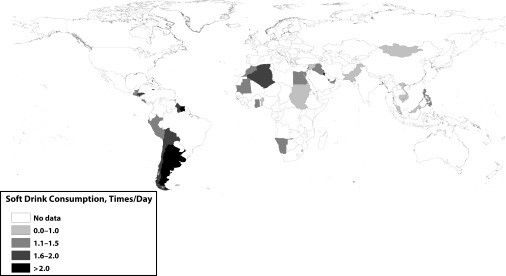
Results: Overall, young adolescents reported having consumed carbonated soft drinks 1.39 times per day (95% confidence interval [CI] = 1.26, 1.51), and 54.3% of adolescents reported consuming a carbonated soft drink at least once per day. Frequency (times per day) varied greatly across countries, ranging from 0.52 (95% CI = 0.43, 0.60) in Kiribati to 2.39 (95% CI = 2.25, 2.53) in Suriname.
Conclusions: Our data confirm that consumption of carbonated soft drinks is frequent among young adolescents in LMICs. Our findings highlight the need for interventions in these countries to reduce adolescents' carbonated soft drink consumption.
Figures
Comment in
-
Soda Consumption Among Adolescents: Implications for Low- and Middle-Income Countries.Am J Public Health. 2017 Jul;107(7):1025-1027. doi: 10.2105/AJPH.2017.303855. Am J Public Health. 2017. PMID: 28590863 Free PMC article. No abstract available.
References
MeSH terms
Substances
LinkOut - more resources
Full Text Sources
Other Literature Sources
Medical
