. 2017 Jul 7;45(12):7474-7486.
doi: 10.1093/nar/gkx434.

Translational control and Rho-dependent transcription termination are intimately linked in riboswitch regulation

Affiliations

Translational control and Rho-dependent transcription termination are intimately linked in riboswitch regulation

Laurène Bastet et al. Nucleic Acids Res. .

Abstract

Riboswitches are regulatory elements that control gene expression by altering RNA structure upon the binding of specific metabolites. Although Bacillus subtilis riboswitches have been shown to control premature transcription termination, less is known about regulatory mechanisms employed by Escherichia coli riboswitches, which are predicted to regulate mostly at the level of translation initiation. Here, we present experimental evidence suggesting that the majority of known E. coli riboswitches control transcription termination by using the Rho transcription factor. In the case of the thiamin pyrophosphate-dependent thiM riboswitch, we find that Rho-dependent transcription termination is triggered as a consequence of translation repression. Using in vitro and in vivo assays, we show that the Rho-mediated regulation relies on RNA target elements located at the beginning of thiM coding region. Gene reporter assays indicate that relocating Rho target elements to a different gene induces transcription termination, demonstrating that such elements are modular domains controlling Rho. Our work provides strong evidence that translationally regulating riboswitches also regulate mRNA levels through an indirect control mechanism ensuring tight control of gene expression.


Figures

Figure 1.
Figure 1.
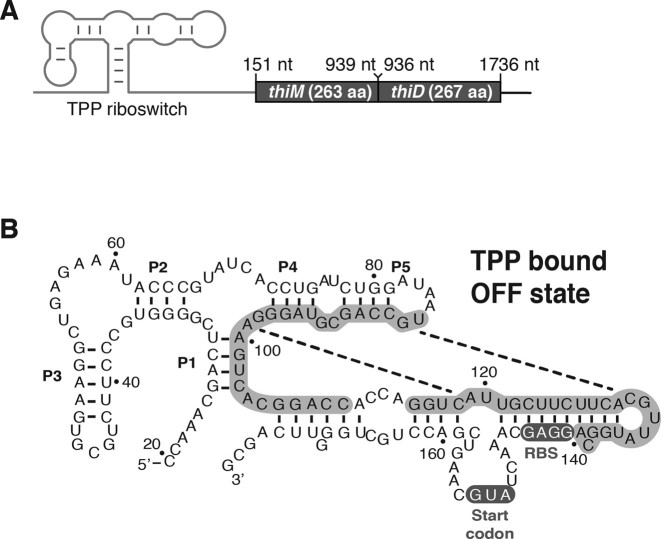
Genetic regulation of the Escherichia coli thiM riboswitch. (A) Schematic representing the thiM riboswitch and the thiMD operon. The secondary structure of the thiM riboswitch aptamer is shown upstream of the thiM and thiD genes. Genomic locations and sizes of both proteins are indicated. Note that there is an overlap of three nucleotides between thiM and thiD. (B) Predicted secondary structure of the thiM riboswitch in the presence of thiamin pyrophosphate (TPP) (OFF state). Nucleotides involved in the formation of the anti-sequestering stem (ON state) are shown in gray and indicated by dotted lines. The ribosome-binding site (RBS) and AUG start codons are highlighted. The nomenclature indicates the nucleotide positions and the paired regions (P1–P5).
Figure 2.
Figure 2.
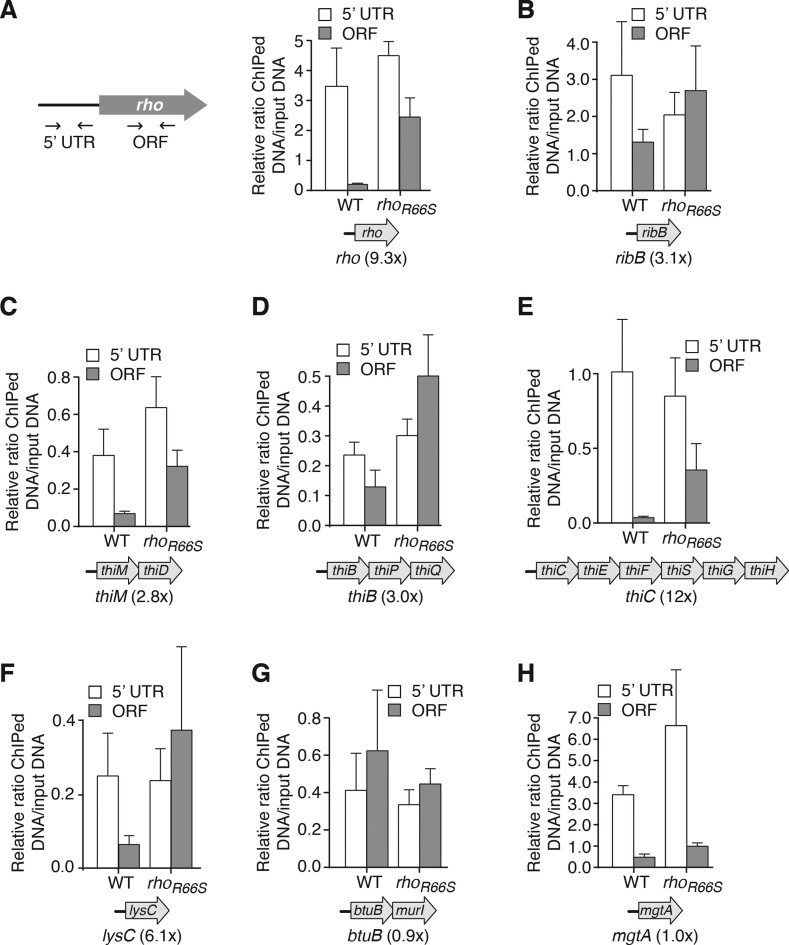
Monitoring the RNA polymerase (RNAP) occupancy of Escherichia coli riboswitches using chromatin immunoprecipitation (ChIP). (A) Left, schematic representing ChIP-qPCR targeting 5΄ untranslated regions (UTR) and ORF regions for rho. Right, ChIP-qPCR data showing RNAP (β subunit) occupancy at indicated locations of rho. Values indicated represent the relative enrichment of ChIP DNA to the input control in wild-type cells or cells expressing the R66S Rho mutant from its native locus. The Rho termination score is represented below the plot by the ratio of RNAP association in the ORF versus the transcript 5΄ UTR in the rho mutant, normalized to the equivalent in the wild-type (ORFR66S/UTRR66S)/(ORFWT/UTRWT). (B–H) ChIP-qPCR data showing RNAP occupancy for ribB (B), thiM (C), thiB (D), thiC (E), lysC (F), btuB (G) and mgtA (H). Values represent the relative enrichment of ChIP DNA to the input control in wild-type cells or cells expressing the R66S Rho mutant from its native locus. The Rho termination score is shown as ‘(#x)’ below each plot.
Figure 3.
Figure 3.
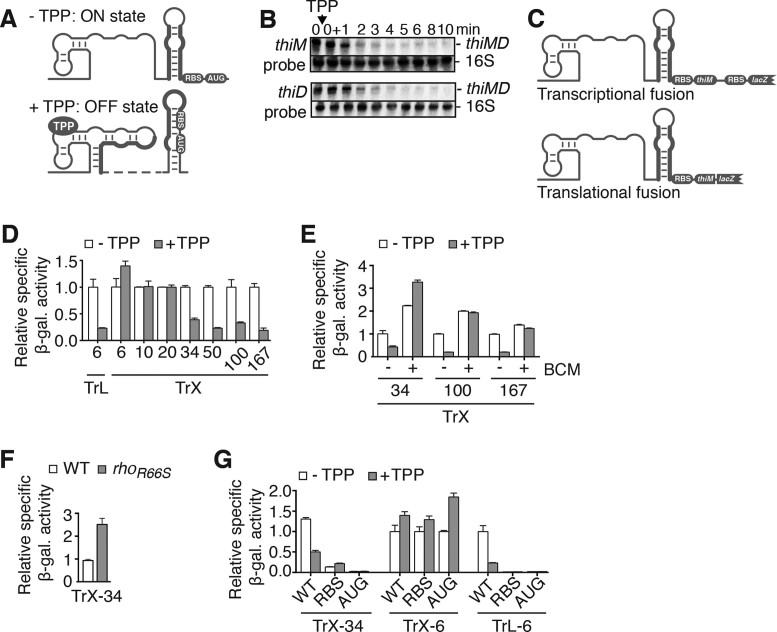
The Escherichia coli thiM riboswitch uses Rho-dependent transcription termination to modulate mRNA levels. (A) Schematic representing thiM riboswitch translational control. In the absence of TPP, the anti-sequestering stem (bold) exposes the RBS and allows translation initiation. TPP binding sequesters both the RBS and the AUG start codon. The dotted line represents the immediate connectivity between linked regions. (B) Northern blot analysis of thiMD mRNA levels. Total RNA was extracted at the indicated times immediately before (0−) and after (0+) addition of TPP (0.5 mg/ml). Probes were designed to detect thiM (top panel) and thiD (bottom panel). RNA species are indicated on the right of the gels. 16S rRNA was used as a loading control. (C) Transcriptional (thiM–lacZ) and translational (ThiM–LacZ) fusions of the thiM riboswitch. The transcriptional fusion contains RBS sequences for both thiM and lacZ, thus allowing to monitor mRNA levels. In contrast, the translational fusion comprises a single RBS sequence and reports on both mRNA and protein levels. (D) β-Galactosidase assays of translational ThiM–LacZ (TrL) and transcriptional thiM–lacZ (TrX) fusions performed in the absence or presence of 500 μg/ml TPP. The number of thiM codons is indicated below the histograms. Values were normalized to the activity obtained in the absence of TPP. The average values of three independent experiments with standard deviations (SDs) are shown. (E) β-Galactosidase assays of the wild-type strain performed in the absence or presence of 500 μg/ml TPP or 25 μg/ml bicyclomycin (BCM). The number of thiM codons is indicated below histograms. Values were normalized to enzymatic activity obtained for wild-type constructs without ligand. The average values of three independent experiments with SDs are shown. (F) β-Galactosidase assays of the wild-type and R66S strains performed in LB media using a transcriptional thiM–lacZ fusion (TrX-34). Values were normalized to enzymatic activity obtained for the wild-type construct. The average values of three independent experiments with SDs are shown. (G) β-Galactosidase assays of transcriptional thiM–lacZ (TrX) or translational ThiM–LacZ (TrL) fusions. The numbers of thiM codons are indicated below each data set. Assays were performed in the absence or presence of 500 μg/ml TPP using the wild-type, and RBS (G142C) and AUG start codon (U152A) mutants. Values were normalized to enzymatic activity obtained for the WT construct in the absence of TPP. The average values of three independent experiments with SDs are shown.
Figure 4.
Figure 4.
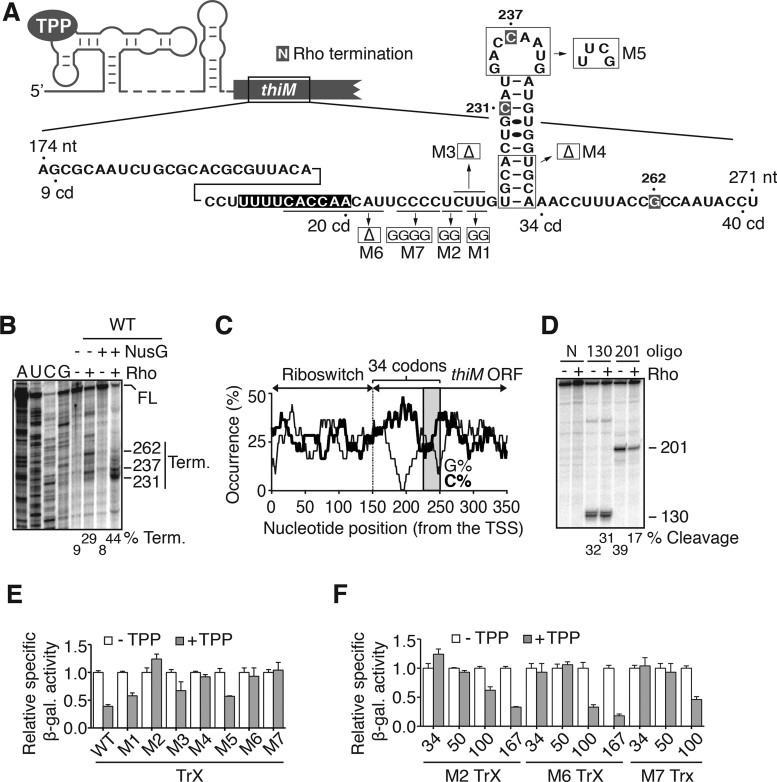
A defined mRNA region is used for the control of Rho-dependent transcription termination. (A) Schematic representing thiM ORF comprising codons 9–40. Nucleotides highlighted in gray and in black represent Rho termination sites and the 201–210 nt region, respectively. Mutations and deletions (Δ) are shown in the structure. (B) In vitro transcriptions performed using wild-type thiM mRNA. Transcriptions were done in the absence (−) or presence (+) of 50 nM NusG or 50 nM Rho. Read-through and termination transcripts are indicated at the right. Termination efficiencies are indicated below. Note that a read-through product of 400 nt is expected. (C) Sequence analysis of cytosine (C%) and guanine (G%) distribution in the thiM sequence. A scanning window of 25 nt was used to determine C and G occurrences as a function of the transcription start site (TSS). The shaded region represents the position of the stem-loop. (D) RNase H probing of Rho binding on thiM mRNA. RNase H assays were performed in the absence (−) or presence (+) of 50 nM Rho. Cleavage assays were done using DNA oligonucleotides targeting regions 130–139 (130) or 201–210 (201). Cleavage products and cleavage efficiencies are indicated on the right and below, respectively. Non-cleaved transcripts (N) are shown as controls. (E) β-Galactosidase assays of transcriptional thiM–lacZ fusions performed in the absence or presence of 500 μg/ml TPP. Measurements were performed for mutants targeting the C-rich region (M1–M3, M6 and M7) and the stem-loop (M4 and M5). Values were normalized to the activity obtained in the absence of TPP. The average values of three independent experiments with SDs are shown. (F) β-Galactosidase assays of transcriptional thiM–lacZ fusions of M2, M6 and M7 mutants in the context of various sizes of thiM open reading frame. Enzymatic activities were conducted in the absence or presence of 500 μg/ml TPP. Values were normalized to the enzymatic activity obtained in the absence of TPP. The average values of three independent experiments with SDs are shown.
Figure 5.
Figure 5.
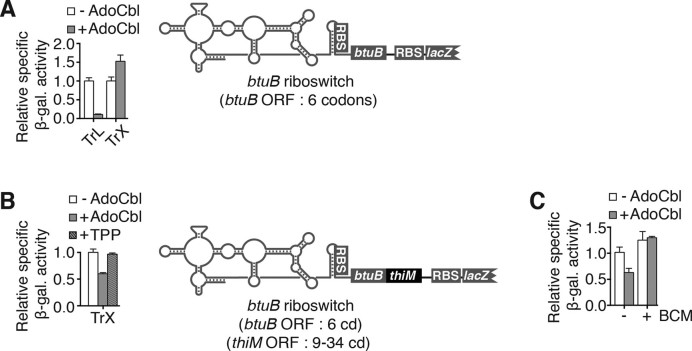
The control of mRNA levels is not dependent on riboswitch identity. (A and B) β-Galactosidase assays using translational BtuB–LacZ and transcriptional btuB–lacZ fusions (A) and transcriptional btuB–thiM–lacZ fusions (B). Enzymatic activities were measured in the absence or presence of 5 μM adenosylcobalamin (AdoCbl) or 500 μg/ml TPP. Values were normalized to enzymatic activity obtained without ligand. Schematics representing transcriptional constructs are shown on the right. The average values of three independent experiments with SDs are shown. (C) β-Galactosidase assays of the wild-type strain performed in the absence or presence of 5 μM AdoCbl or 25 μg/ml BCM. Values were normalized to enzymatic activity obtained for wild-type constructs without ligand. The average values of three independent experiments with SDs are shown.
Figure 6.
Figure 6.
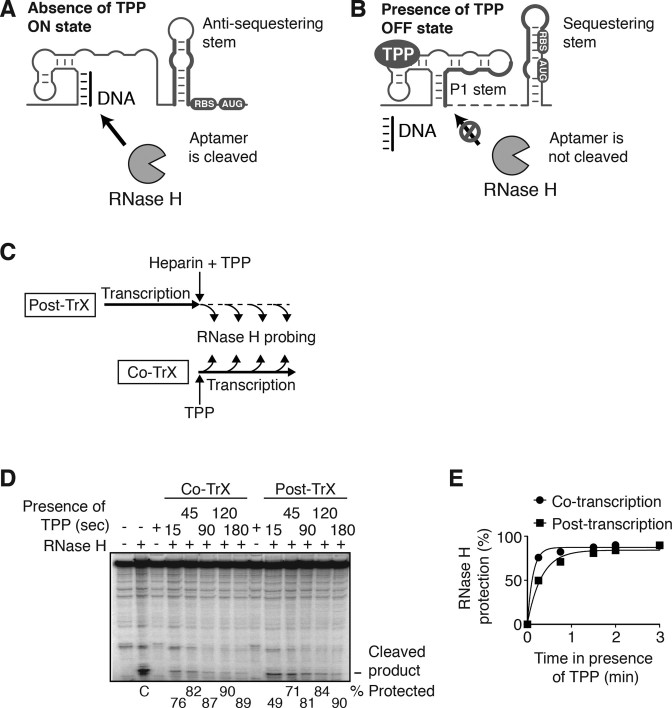
RNase H cleavage assays monitoring co- and post-transcriptional TPP binding to the thiM riboswitch. (A) Representation of the thiM riboswitch in the absence of TPP. Because the riboswitch is in the ON state, the incubation of a DNA oligonucleotide specifically hybridizing to the aptamer domain results in RNase H cleavage activity of the riboswitch. (B) Representation of the thiM riboswitch in presence of TPP. TPP binding leads to the adoption of the OFF state in which the P1 stem is formed. In this condition, DNA oligonucleotide binding to the riboswitch is not possible and RNase H cleavage of the riboswitch is not observed. (C) Experimental setup assessing TPP binding to the thiM riboswitch. Addition of TPP is performed either at the beginning or at the end of the transcription reaction, thereby allowing TPP binding to occur either cotranscriptionally or post-transcriptionally, respectively. Under these conditions, full-length transcription is achieved in <15 s and the presence of heparin ensures that no transcription re-initiation occurs. (D) RNase H assays performed on nascent thiM mRNAs. Transcription was performed using Escherichia coli RNAP and RNase H reactions were performed for 15 s in all cases. A control (lane C) shows the cleaved product in the absence of TPP, consistent with accessibility of the P1 stem to oligonucleotide binding and RNase H cleavage. Cotranscriptional studies were carried out by adding TPP (10 μM) at the beginning of the transcription and by performing RNase H assays at the indicated times. Post-transcriptional TPP binding studies were conducted similarly, but TPP was added at the end of transcription. The DNA probe was designed to target the P1 stem. (E) Quantification analysis of RNase H experiments shown in panel A. Data were fitted with a single-exponential model and yielded apparent TPP binding rates of 0.13 ± 0.02 and 0.05 ± 0.01 s−1 for co- and post-transcriptional binding, respectively. The model assumes that no cleavage protection is obtained in the absence of TPP.
Figure 7.
Figure 7.
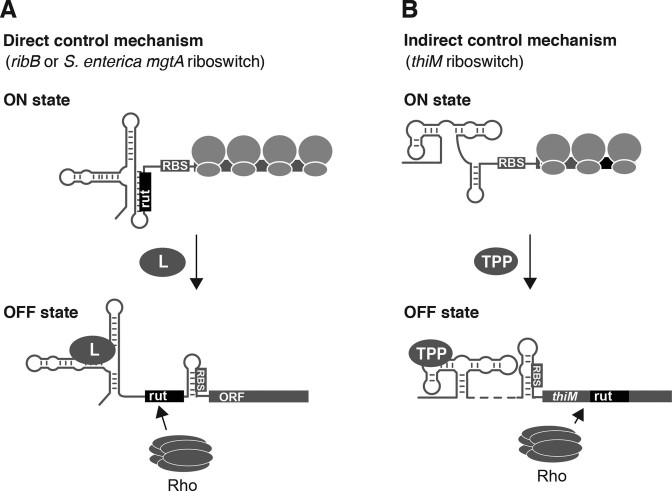
Proposed model describing how the thiM riboswitch modulates Rho-dependent transcription termination upon the inhibition of translation. (A) Direct control mechanism of Rho-dependent transcription termination. The Escherichia coli ribB and Salmonella enterica mgtA riboswitches allow efficient genetic expression at low ligand (L) concentrations (ON state). However, the recognition of their respective metabolite leads to the selective exposition of a rut site, thus resulting in Rho-dependent transcription termination (OFF state). (B) Indirect control mechanism of Rho-dependent transcription termination. The thiM riboswitch adopts the ON state in which the initiation of thiM translation is efficiently performed. However, upon TPP binding, the riboswitch folds into the OFF state whereby translation initiation is inhibited. As a result, a rut sequence located in the coding region is available for Rho binding, therefore promoting premature transcription termination of the thiMD operon.

References

    1. Serganov A., Nudler E.. A decade of riboswitches. Cell. 2013; 152:17–24. - PMC - PubMed
    1. Breaker R.R. Riboswitches and the RNA World. Cold Spring Harb. Perspect. Biol. 2012; 4:1–15. - PMC - PubMed
    1. Haller A., Souliere M.F., Micura R.. The dynamic nature of RNA as key to understanding riboswitch mechanisms. Acc. Chem. Res. 2011; 44:1339–1348. - PubMed
    1. Loh E., Dussurget O., Gripenland J., Vaitkevicius K., Tiensuu T., Mandin P., Repoila F., Buchrieser C., Cossart P., Johansson J.. A trans-acting riboswitch controls expression of the virulence regulator PrfA in Listeria monocytogenes. Cell. 2009; 139:770–779. - PubMed
    1. Mellin J.R., Koutero M., Dar D., Nahori M.-A., Sorek R., Cossart P.. Sequestration of a two-component response regulator by a riboswitch-regulated noncoding RNA. Science. 2014; 345:940–943. - PubMed

MeSH terms

LinkOut - more resources