. 2017 Oct 21;43(6):1251-1261.
doi: 10.1093/schbul/sbx010.

Ethnic Minority Status, Age-at-Immigration and Psychosis Risk in Rural Environments: Evidence From the SEPEA Study

Affiliations

Ethnic Minority Status, Age-at-Immigration and Psychosis Risk in Rural Environments: Evidence From the SEPEA Study

James B Kirkbride et al. Schizophr Bull. .

Abstract

Objective: Several ethnic minority groups experience elevated rates of first-episode psychosis (FEP), but most studies have been conducted in urban settings. We investigated whether incidence varied by ethnicity, generation status, and age-at-immigration in a diverse, mixed rural, and urban setting.

Method: We identified 687 people, 16-35 years, with an ICD-10 diagnosis of FEP, presenting to Early Intervention Psychosis services in the East of England over 2 million person-years. We used multilevel Poisson regression to examine incidence variation by ethnicity, rural-urban setting, generation status, and age-at-immigration, adjusting for several confounders including age, sex, socioeconomic status, population density, and deprivation.

Results: People of black African (incidence rate ratio: 4.06; 95% confidence interval [CI]: 2.63-6.25), black Caribbean (4.63; 95% CI: 2.38-8.98) and Pakistani (2.31; 95% CI: 1.35-3.94) origins were at greatest FEP risk relative to the white British population, after multivariable adjustment. Non-British white migrants were not at increased FEP risk (1.00; 95% CI: 0.77-1.32). These patterns were independently present in rural and urban settings. For first-generation migrants, migration during childhood conferred greatest risk of psychotic disorders (2.20; 95% CI: 1.33-3.62).

Conclusions: Elevated psychosis risk in several visible minority groups could not be explained by differences in postmigratory socioeconomic disadvantage. These patterns were observed across rural and urban areas of our catchment, suggesting that elevated psychosis risk for some ethnic minority groups is not a result of selection processes influencing rural-urban living. Timing of exposure to migration during childhood, an important social and neurodevelopmental window, may also elevate risk.

Keywords: early intervention; epidemiology; ethnicity; incidence; migration; social determinants; urbanicity.


Figures

Fig. 1.
Fig. 1.
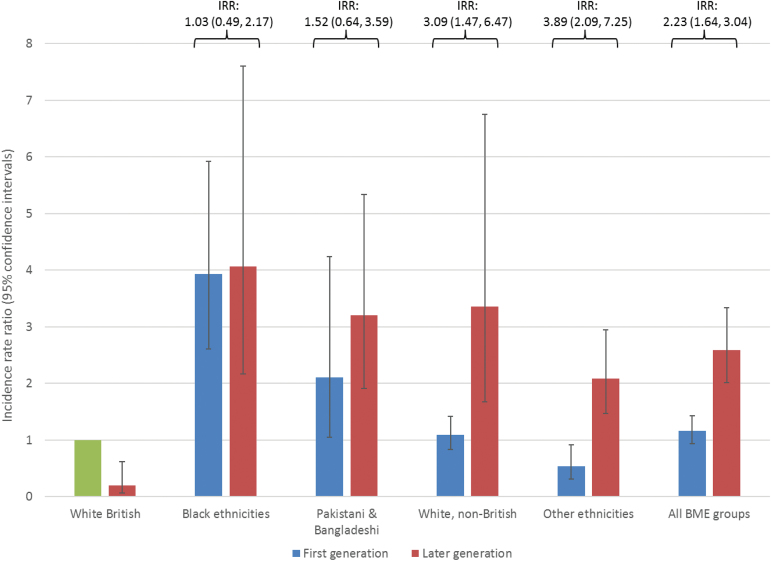
Incidence rate ratios for first-episode psychosis (FEP) by generation status and broad ethnic group. Overall there was evidence that FEP risk by generation status varied by ethnic group (LRT-χ2P-value for interaction between ethnicity and generation status on 3 degrees of freedom: χ2 = 9.2; P = .03). Thus, compared with the UK-born white British group, rates were raised to a similar extent for first- and later-generation black and Pakistani and Bangladeshi groups, with no statistically significant differences in risk by generation (supplementary table 3). For non-British white and other ethnic groups, excess rates were confined to later-generation groups. Foreign-born white British groups and first generation “other” ethnic groups were at significantly reduced psychosis risk compared with the UK-born white British group. All incidence rate ratios are adjusted for age and sex. The white British (UK-born) reference population is shown in green, with the white British (born overseas) shown in red. BME: black and minority ethnic. Data corresponding to this figure are presented in supplementary table 3.
Fig. 2.
Fig. 2.
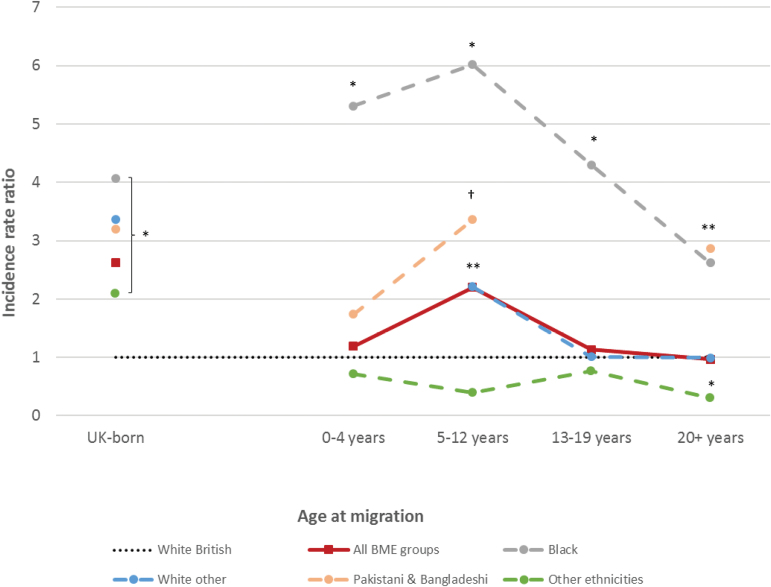
Incidence of all clinically relevant psychotic disorders by age-at-immigration, major ethnic group, and generation status. Incidence rate ratios (IRR) by age-at-immigration show a peak with childhood migration (5–12 years old) for all black and minority ethnic (BME) groups overall (IRR: 2.20; 95% CI: 1.33–3.62). There was no evidence that this effect differed by 5-category ethnicity (LRT χ2 on 16 df: 23.1; P = .11). This finding was independently replicated in first-generation black (IRR: 6.02; 95% CI: 2.69–13.47) and non-British white (IRR: 2.21; 95% CI: 1.05–4.68) immigrants, with a trend in this direction for Pakistani and Bangladeshi (IRR: 3.36; 95% CI: 0.84–13.49; P = .09). IRRs appeared to decrease in relation to later age-at-immigration. Only first-generation black (IRR: 2.62; 95% CI: 1.24–5.55) and Pakistani and Bangladeshi migrants (IRR: 2.87; 95% CI: 1.18–6.94) who moved to the United Kingdom in adulthood were at significantly increased psychosis risk compared with the white British population. People from the “other ethnicities” group who migrated aged 20 years or older were at significantly decreased risk of psychosis compared with the UK-born white British group (IRR: 0.31; 95% CI: 0.11–0.82). IRR for second- and later-generation UK-born groups are shown for comparison. There were insufficient first-episode psychosis participants of foreign-born white British descent (n = 3) to analyze results by age-at-immigration. All IRRs adjusted for age group and sex. 95% confidence intervals omitted for presentational purposes. *P < .05. P = .09.

References

    1. Bourque F, van der Ven E, Malla A. A meta-analysis of the risk for psychotic disorders among first- and second-generation immigrants. Psychol Med. 2011;41:897–910. - PubMed
    1. Cantor-Graae E, Selten JP. Schizophrenia and migration: a meta-analysis and review. Am J Psychiatry. 2005;162:12–24. - PubMed
    1. Kirkbride JB, Errazuriz A, Croudace TJ, et al. Incidence of schizophrenia and other psychoses in England, 1950–2009: a systematic review and meta-analyses. PLoS One. 2012;7:e31660. - PMC - PubMed
    1. Selten JP, van der Ven E, Rutten BP, Cantor-Graae E. The social defeat hypothesis of schizophrenia: an update. Schizophr Bull. 2013;39:1180–1186. - PMC - PubMed
    1. van Os J, Rutten B, Myin-Germys I, et al. Identifying gene-environment interactions in schizophrenia: contemporary challenges for integrated, large-scale investigations. Schizophr Bull. 2014;40: 729–736. - PMC - PubMed

MeSH terms