


Validation of the German version of the Mediterranean Diet Adherence Screener (MEDAS) questionnaire
- PMID: 28521737
- PMCID: PMC5437541
- DOI: 10.1186/s12885-017-3337-y
Validation of the German version of the Mediterranean Diet Adherence Screener (MEDAS) questionnaire
Abstract
Background: Health benefits of the Mediterranean Diet (MD) have been shown in different at-risk populations. A German translation of the Mediterranean Diet Adherence Screener (MEDAS) from the PREvención con DIeta MEDiterránea (PREDIMED) consortium was used in the LIBRE study, investigating effects of lifestyle-intervention on women with BRCA1/2 mutations. The purpose of the present study is to validate the MEDAS German version.
Methods: LIBRE is a multicentre (three university hospitals during this pilot phase), unblinded, randomized, controlled clinical trial. Women with a BRCA1/2 mutation of age 18 or over who provided written consent were eligible for the trial. As part of the assessment, all were given a full-length Food Frequency Questionnaire (FFQ) and MEDAS at baseline and after 3 months. Data derived from FFQ was compared to MEDAS in order to evaluate agreement or concordance between the two questionnaires. Additionally, the association of dietary intake biomarkers in the blood (β-carotene, omega-3, omega-6 and omega-9 fatty acids and high-sensitivity C-reactive protein (hsCRP)) with some MEDAS items was analyzed using t-Tests and a multivariate regression.
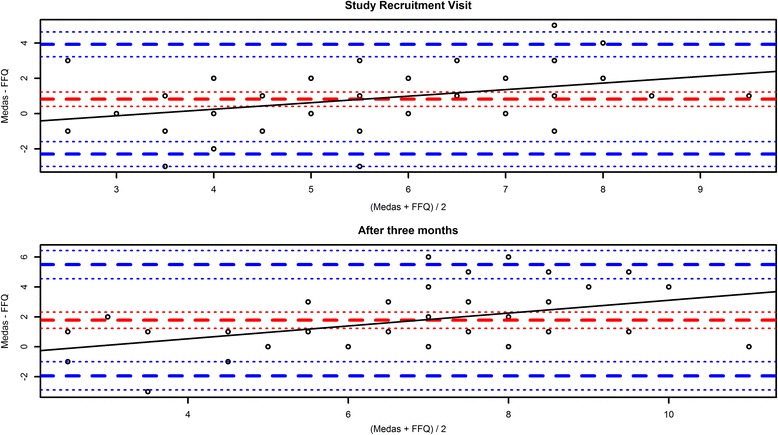
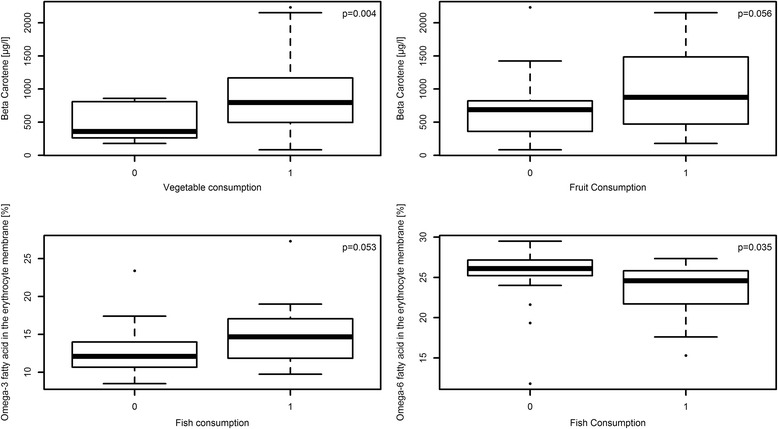
Results: The participants of the LIBRE pilot study were 68 in total (33 Intervention, 35 Control). Only participants who completed both questionnaires were included in this analysis (baseline: 66, month three: 54). The concordance between these two questionnaires varied between the items (Intraclass correlation coefficient of 0.91 for pulses at the highest and -0.33 for sugar-sweetened drinks). Mean MEDAS scores (sum of all items) were 9% higher than their FFQ counter-parts at baseline and 15% after 3 months. Higher fish consumption (at least 3 portions) was associated with lower omega-6 fatty acid levels (p = 0.026) and higher omega-3 fatty acid levels (p = 0.037), both results being statistically significant.
Conclusions: We conclude that the German MEDAS in its current version could be a useful tool in clinical trials and in practice to assess adherence to MD.
Trial registration: ClinicalTrials.gov , registered on March 12, 2014, identifier: NCT02087592 . World Health Organization Trial Registration, registered on 3 August 2015, identifier: NCT02087592 .
Keywords: BRCA1/2; Food frequency; Hereditary breast cancer; Mediterranean diet adherence; Validation.
Figures
References
-
- Damasceno NR, Sala-Vila A, Cofan M, Perez-Heras AM, Fito M, Ruiz-Gutierrez V, Martinez-Gonzalez MA, Corella D, Aros F, Estruch R, et al. Mediterranean diet supplemented with nuts reduces waist circumference and shifts lipoprotein subfractions to a less atherogenic pattern in subjects at high cardiovascular risk. Atherosclerosis. 2013;230(2):347–353. doi: 10.1016/j.atherosclerosis.2013.08.014. - DOI - PubMed
-
- Domenech M, Roman P, Lapetra J, de la Corte FJ G, Sala-Vila A, de la Torre R, Corella D, Salas-Salvado J, Ruiz-Gutierrez V, Lamuela-Raventos RM, et al. Mediterranean diet reduces 24-hour ambulatory blood pressure, blood glucose, and lipids: one-year randomized, clinical trial. Hypertension. 2014;64(1):69–76. doi: 10.1161/HYPERTENSIONAHA.113.03353. - DOI - PubMed
Publication types
MeSH terms
Substances
Associated data
LinkOut - more resources
Full Text Sources
Other Literature Sources
Medical
Research Materials
Miscellaneous
