


Does adult attachment style mediate the relationship between childhood maltreatment and mental and physical health outcomes?
- PMID: 28522128
- PMCID: PMC5685930
- DOI: 10.1016/j.chiabu.2017.05.002
Does adult attachment style mediate the relationship between childhood maltreatment and mental and physical health outcomes?
Abstract
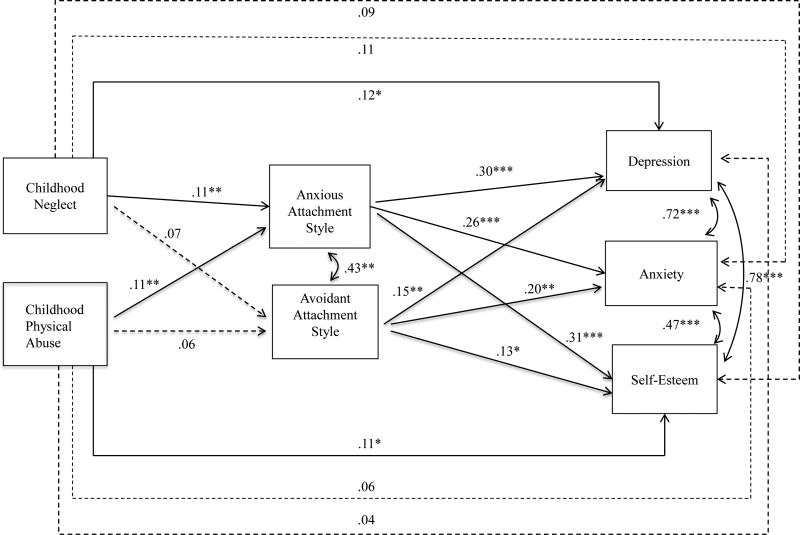
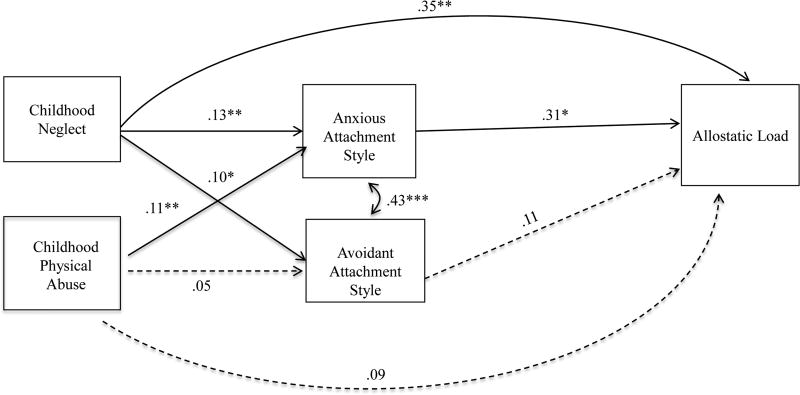
Attachment theory has been proposed as one explanation for the relationship between childhood maltreatment and problematic mental and physical health outcomes in adulthood. This study seeks to determine whether: (1) childhood physical abuse and neglect lead to different attachment styles in adulthood, (2) adult attachment styles predict subsequent mental and physical health outcomes, and (3) adult attachment styles mediate the relationship between childhood physical abuse and neglect and mental and physical health outcomes. Children with documented cases of physical abuse and neglect (ages 0-11) were matched with children without these histories and followed up in adulthood. Adult attachment style was assessed at mean age 39.5 and outcomes at 41.1. Separate path models examined mental and physical health outcomes. Individuals with histories of childhood neglect and physical abuse had higher levels of anxious attachment style in adulthood, whereas neglect predicted avoidant attachment as well. Both adult attachment styles (anxious and avoidant) predicted mental health outcomes (higher levels of anxiety and depression and lower levels of self-esteem), whereas only anxious adult attachment style predicted higher levels of allostatic load. Path analyses revealed that anxious attachment style in adulthood in part explained the relationship between childhood neglect and physical abuse to depression, anxiety, and self-esteem, but not the relationship to allostatic load. Childhood neglect and physical abuse have lasting effects on adult attachment styles and anxious and avoidant adult attachment styles contribute to understanding the negative mental health consequences of childhood neglect and physical abuse 30 years later in adulthood.
Keywords: Adult attachment style; Allostatic load; Mental health; Neglect; Physical abuse; Physical health outcomes.
Copyright © 2017 Elsevier Ltd. All rights reserved.
Figures
References
-
- Ainsworth MD. Attachments beyond infancy. American Psychologist. 1989;44(4):709–716. - PubMed
-
- Baer JC, Martinez CD. Child maltreatment and insecure attachment: A meta-analysis. Journal of Reproductive and Infant Psychology. 2006;24(3):187–197.
-
- Barnett D, Ganiban J, Cicchetti D. Maltreatment, negative expressivity, and the development of Type D attachments from 12- to 24-months of age. Monographs of the Society for Research in Child Development. 1999;64(3):97–118. - PubMed
-
- Bartholomew K. Avoidance of intimacy: An attachment perspective. Journal of Social and Personal Relationships. 1990;7(2):147–178.
-
- Bartholomew K, Horowitz LM. Attachment styles among young adults: A test of a four-category model. Journal of Personality and Social Psychology. 1991;61(2):226–244. - PubMed
Publication types
MeSH terms
Grants and funding
LinkOut - more resources
Full Text Sources
Other Literature Sources
Medical
