Estimation of the Number of Women Living with Metastatic Breast Cancer in the United States
- PMID: 28522448
- PMCID: PMC5833304
- DOI: 10.1158/1055-9965.EPI-16-0889
Estimation of the Number of Women Living with Metastatic Breast Cancer in the United States
Abstract
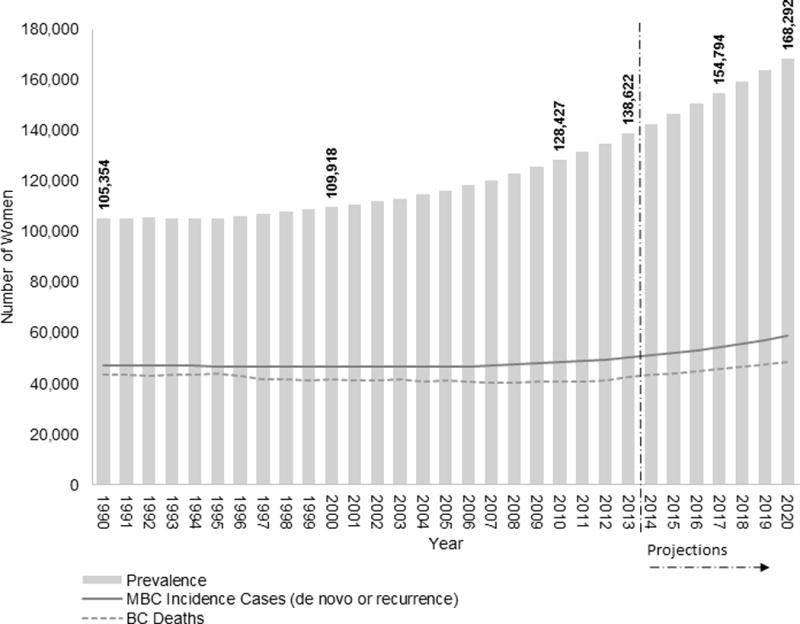
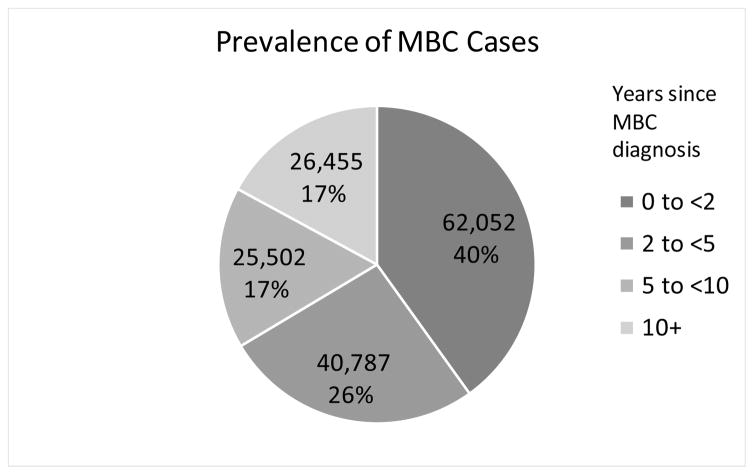
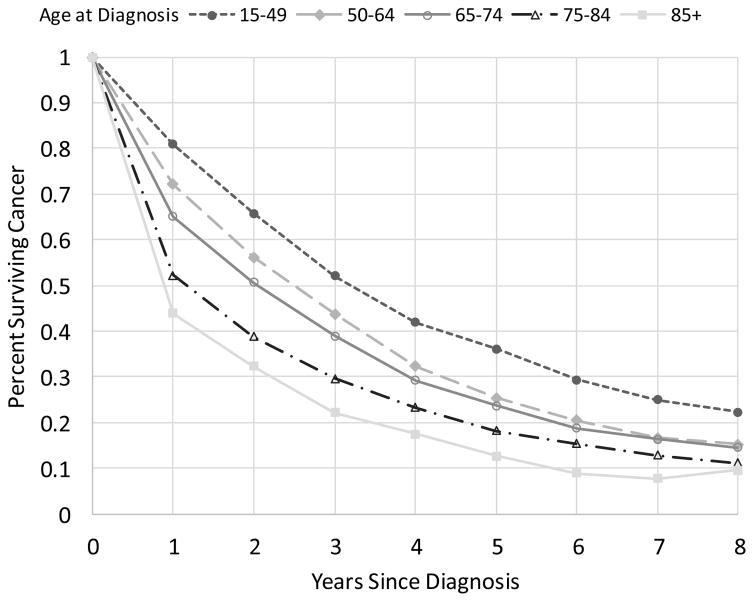
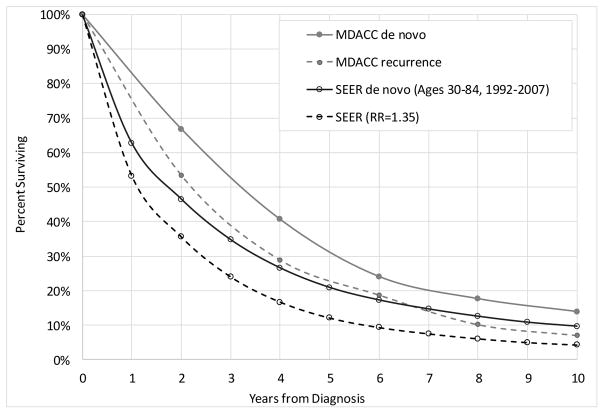
Background: Distant metastatic breast cancer (MBC), including metastases found at diagnosis (de novo) and those occurring later (recurrence), represents the most severe form of the disease, when resource utilization is most intensive. Yet, the number of women living with MBC in the United States is unknown. The objective of this article is to use population-based data to estimate the prevalence of MBC.Methods: We used a back-calculation method to estimate MBC prevalence from U.S. breast cancer mortality and survival from the Surveillance, Epidemiology and End Results (SEER) registries. On the basis of the illness-death process, this method assumes that each observed breast cancer death is the result of MBC, either de novo or a recurrence with metastatic disease.Results: We estimate that by January 1, 2017, there will be 154,794 women living with MBC in the United States, three in four initially diagnosed with stage I-III breast cancer who later progressed to MBC.Median survival and 5-year relative survival for de novo MBC increased over the years, especially in younger women. We estimate a two-fold increase in 5-year relative survival rate from 18% to 36%, for women diagnosed with de novo MBC at age 15-49 between 1992-1994 and 2005-2012, respectively.Conclusions: This study demonstrates an increasing number of women in the United States living with MBC, likely the result of improvements in treatment and aging of the U.S.
Population: Impact: The increasing burden of MBC highlights the importance of documenting recurrence to foster more research into the specific needs of this understudied population. Cancer Epidemiol Biomarkers Prev; 26(6); 809-15. ©2017 AACR.
©2017 American Association for Cancer Research.
Figures
References
-
- Miller KD, Siegel RL, Lin CC, Mariotto AB, Kramer JL, Rowland JH, et al. Cancer treatment and survivorship statistics, 2016. CA: a cancer journal for clinicians. 2016 Jul;66(4):271–89. - PubMed
-
- Cleeland CS, Mayer M, Dreyer NA, Yim YM, Yu E, Su Z, et al. Impact of symptom burden on work-related abilities in patients with locally recurrent or metastatic breast cancer: Results from a substudy of the VIRGO observational cohort study. Breast. 2014 Dec;23(6):763–9. - PubMed
-
- Mayer M. Lessons learned from the metastatic breast cancer community. Semin Oncol Nurs. 2010 Aug;26(3):195–202. - PubMed
Publication types
MeSH terms
Grants and funding
LinkOut - more resources
Full Text Sources
Other Literature Sources
Medical