Review
. 2017:978:39-62.
doi: 10.1007/978-3-319-53889-1_3.

Rubinstein-Taybi Syndrome and Epigenetic Alterations

Affiliations
Review

Rubinstein-Taybi Syndrome and Epigenetic Alterations

Edward Korzus. Adv Exp Med Biol. 2017.

Abstract

Rubinstein-Taybi syndrome (RSTS) is a rare genetic disorder in humans characterized by growth and psychomotor delay, abnormal gross anatomy, and mild to severe mental retardation (Rubinstein and Taybi, Am J Dis Child 105:588-608, 1963, Hennekam et al., Am J Med Genet Suppl 6:56-64, 1990). RSTS is caused by de novo mutations in epigenetics-associated genes, including the cAMP response element-binding protein (CREBBP), the gene-encoding protein referred to as CBP, and the EP300 gene, which encodes the p300 protein, a CBP homologue. Recent studies of the epigenetic mechanisms underlying cognitive functions in mice provide direct evidence for the involvement of nuclear factors (e.g., CBP) in the control of higher cognitive functions. In fact, a role for CBP in higher cognitive function is suggested by the finding that RSTS is caused by heterozygous mutations at the CBP locus (Petrij et al., Nature 376:348-351, 1995). CBP was demonstrated to possess an intrinsic histone acetyltransferase activity (Ogryzko et al., Cell 87:953-959, 1996) that is required for CREB-mediated gene expression (Korzus et al., Science 279:703-707, 1998). The intrinsic protein acetyltransferase activity in CBP might directly destabilize promoter-bound nucleosomes, facilitating the activation of transcription. Due to the complexity of developmental abnormalities and the possible genetic compensation associated with this congenital disorder, however, it is difficult to establish a direct role for CBP in cognitive function in the adult brain. Although aspects of the clinical presentation in RSTS cases have been extensively studied, a spectrum of symptoms found in RSTS patients can be accessed only after birth, and, thus, prenatal genetic tests for this extremely rare genetic disorder are seldom considered. Even though there has been intensive research on the genetic and epigenetic function of the CREBBP gene in rodents, the etiology of this devastating congenital human disorder is largely unknown.

Keywords: CBP; CREBBP; EP300; Epigenetic; HDAC; Histone acetylation; Memory; RSTS; Rubinstein-Taybi syndrome; p300.


Figures

Fig. 3.1
Fig. 3.1
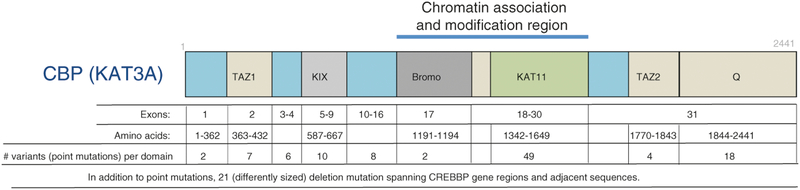
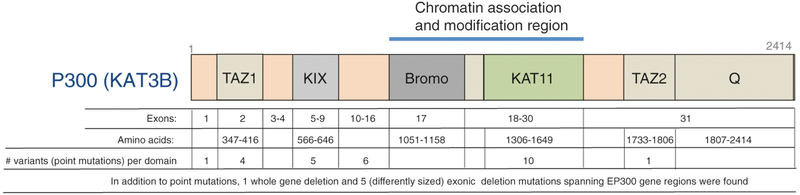
Structure of CBP/p300 protein family. CBP and p300 proteins belong to the same family of coactivator of transcription and share 63% identity and 73% similarity with the highest homology as mapped to functional domains. A central part of CBP/p300 protein encompasses chromatin association and the modification region. The N-terminal and C-terminal regions, which include a variety of motives that provide a platform for specific protein-protein interactions, enable the formation of multiprotein complexes critical for a cellular signal- and promoter-specific gene expression regulation. CBP was discovered as a CREB-binding protein and a phosphorylation-dependent interaction between CREB’s KID domain and CBP’s KIX domain. Further research demonstrated that more than 400 proteins could interact with CBP/p300 proteins. The schematic shows examples of these interaction partners’ interacting predominantly with regions containing zinc finger motives. The central region of CBP/p300 contains domains supporting chromatin-modifying functions. While bromodomain (Bromo) provides ability for chromatin recognition, the KIT11 domain has lysine acetyltransferase enzymatic activity targeting primary histone N-terminals and nonhistone nuclear proteins [7, 8]. For more detailed information, see the text. The diagram does not show proper proportions and is based on data from UniGene (CREBBP, NP_004371.2; EP300, NP_001420.2; and [8, 9]). CBP’s known domains from the N-terminal are NRID nuclear receptor interaction domain, TAZ1 transcriptional adapter zinc-binding domain 1, KIX CREB binding, Bromo bromodomain, PHD plant homeodomain, KIT11 lysine acetyltransferase, ZZ zinc finger domain, TAZ2, Q polyglutamine stretch, NRs nuclear hormone receptors, SRC steroid receptor coactivator
Fig. 3.2
Fig. 3.2
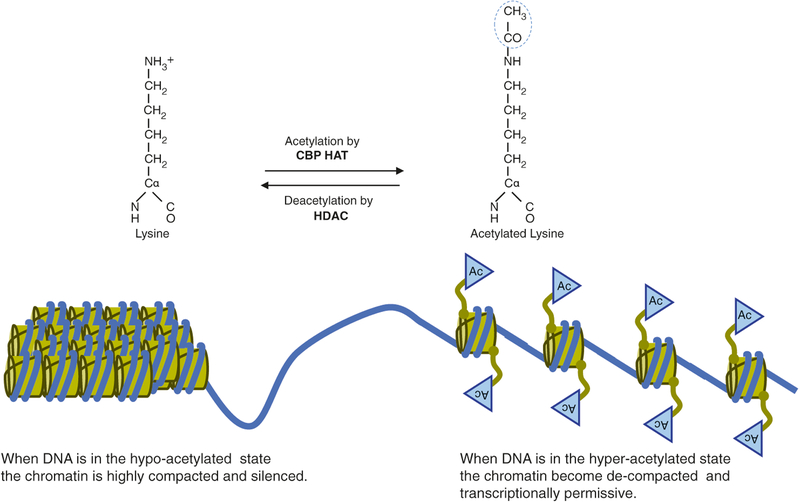
Histone acetylation controls chromatin structure and function. Although CBP’s function as a platform to recruit other required coactivators appears to be indispensable, the requirement for HAT activity is transcription unit specific and may depend on the structure of chromatin at a specific locus [12, 13]. Histone deacetylase (HDAC)-mediated hypo-acetylation of histones promotes a compact chromatin structure state, subsequently silencing transcription. Promoter-specific recruitment of chromatin remodeling factors, such as CBP HAT, facilitates de-compaction of the chromatin structure, where genes are accessible for large multiprotein complexes that mediate gene expression (i.e., RNA polymerase II holoenzyme). CBP HAT has been implicated in epigenetic mechanisms that control higher cognitive functions [14]
Fig. 3.3
Fig. 3.3
CREBBP germline mutations in RSTS1 patients. CREBBP germline mutations account for 50–60% of RSTS cases. About 50% of mutations associated with RSTS1 have been mapped to chromatin association and the modification region in the CREBBP gene (Fig. 3.1). CREBBP germline mutations in RSTS patients include 106 point mutations and 21 deletions, such as exonic and whole-gene deletions, with some encompassing flanking genes. Only a few mosaic mutations in the CREBBP gene have been reported (not shown). Data used for analysis were reported in Leiden Open Variation Database [20], Gervasini et al. (2010) [21], and UniGene database (CREBBP: NP_004371.2)
Fig. 3.4
Fig. 3.4
EP300 germline mutations in RSTS patients. To date, 34 EP300 mutations in known RSTS2 cases have been reported worldwide [25]. Mutations in the EP300 gene account for about 10% of all RSTS cases. EP300 germline mutations in RSTS patients include 27 point mutations, six exonic deletions, and one whole-gene deletion. About 40% of mutations associated with RSTS2 have been mapped to chromatin association and the modification region in the EP300 gene (Fig. 3.1). Data used for analysis were reported in the Leiden Open Variation Database [20], Negri et al. (2016) [25], and the UniGene database (EP300: NP_001420.2)
Fig. 3.5
Fig. 3.5
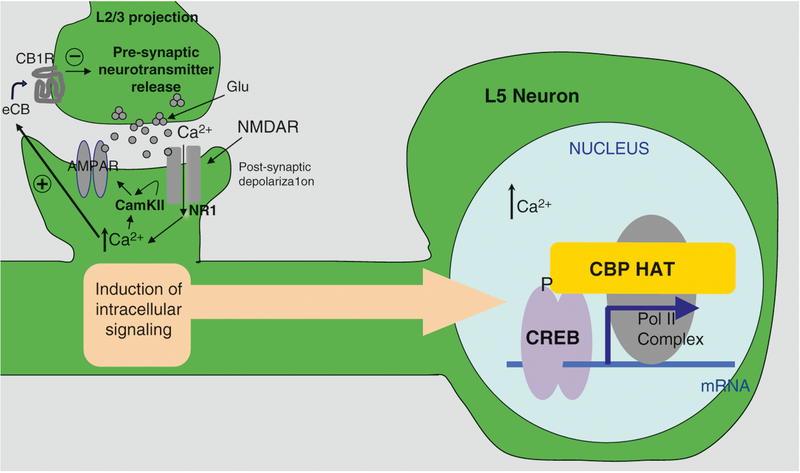
Putative molecular mechanism underlying alterations of synaptic strength potentially associated with cognitive performance, including memory formation. Studies have revealed that a number of synaptic (e.g., NMDAR, CaMKII) and nuclear (e.g., CREB and CBP) molecules could be critical for long-term memory consolidation. Long-term potentiation, or LTP, is an induced increase in synaptic efficacy. Many believe that LTP is a laboratory model for learning and memory [89]. Involvement of glutamate receptors, such as NMDAR, in LTP was demonstrated by Susumu Tonagawa at a molecular level [90] and by Richard Morris in behavioral studies [91]. Neuronal activity induces glutamate release into the synaptic cleft. Glutamate acts on the α-amino-3-hydroxy-5-methyl-4-isoxazolepropionic acid receptors (AMPARs) and NMDARs. However, initially, Na+ flows only through AMPAR because NMDAR is blocked by Mg. Postsynaptic depolarization removes the Mg2+ block, and then Ca2+ (and Na+) can flow through NMDAR. The resultant rise in Ca2+ levels within the dendritic spine is the critical trigger for LTP. Ca2+ influx activates CaMKII through autophosphorylation, and activated CaMKII induces molecular changes in postsynaptic neurons, yielding a change in synaptic strength called LTP. Ca2+ influx in dendritic spines activates intracellular signaling pathways, directing CREB phosphorylation, which is required but not sufficient for NMDA-induced gene expression. Studies of Drosophila, Aplysia, and mice clearly demonstrated the requirement for CREB in long-term memory. Further studies implicated CREB’s partner, CBP, as an obligatory component of the molecular mechanism underlying learning and memory [14, 92, 93]. AMPAR is α-amino-3-hydroxy-5-methyl-4-isoxazolepropionic acid receptor, NR1 is an obligatory subunit of postsynaptic NMDAR, CaMKII is Ca2+/Calmodulin-dependent protein kinase, CREB is a transcription factor, and CBP is coactivator of transcription and histone acetyltransferase (HAT)
Fig. 3.6
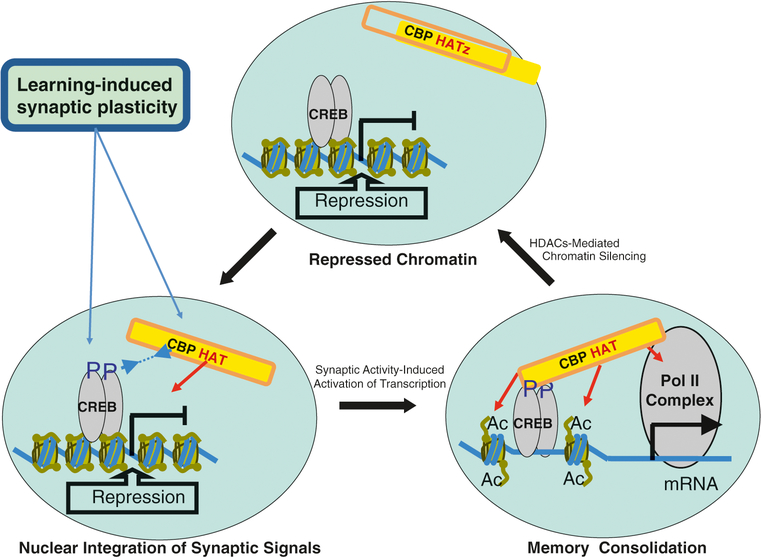
Fig. 3.6
Proposed model for CBP HAT involvement in long-term memory consolidation. Before activation, target genes are repressed by chromatin structure. Signal-inducing CREB phosphorylation must occur but is not sufficient. It is well known that CBP is independently regulated in response to NMDA. A second signal is required to remove chromatin repression. This can be accomplished by CBP-dependent histone acetylation. The covalent modification by HAT activity leaves long-lasting marks on chromatin at the target genes. This represents a very attractive mechanism for the regulation of long-lasting transcriptional changes associated with long-term synaptic and behavioral plasticity. The proposed model postulates that two signals—the first signal induces CREB and the second signal removes repression of target genes by chromatin acetylation—are required to occur during initial learning. This sort of the acetylation-mediated covalent modification by CBP could change requirements for subsequent transcriptional activation of genes in response to future signals. This would open a temporal window in which cellular signals, which would not recruit acetyltransferase, would nevertheless stimulate transcription required for memory consolidation. Chromatin opening at the target genes by acetylation would allow for prolonged transcription, even in the absence of an initial stimulus. After execution of “memory program,” these transiently activated gene expression would shut down via default mechanisms controlled by ubiquitous HDACs, allowing for a homeostatic update of integrated circuits. Model initially presented in Korzus et al. (2004) [14], modified by author

References

    1. Rosenfeld MG, Glass CK. Coregulator codes of transcriptional regulation by nuclear receptors. J Biol Chem. 2001;276(40):36865–8. - PubMed
    1. Neely KE, Workman JL. Histone acetylation and chromatin remodeling: which comes first? Mol Genet Metab. 2002;76(1):1–5. - PubMed
    1. Fischle W, Wang Y, Allis CD. Histone and chromatin cross-talk. Curr Opin Cell Biol. 2003;15(2):172–83. - PubMed
    1. Chrivia JC, Kwok RP, Lamb N, Hagiwara M, Montminy MR, Goodman RH. Phosphorylated CREB binds specifically to the nuclear protein CBP. Nature. 1993;365(6449):855–9. - PubMed
    1. Eckner R, Ewen ME, Newsome D, Gerdes M, DeCaprio JA, Lawrence JB, Livingston DM. Molecular cloning and functional analysis of the adenovirus E1A-associated 300-kD protein (p300) reveals a protein with properties of a transcriptional adaptor. Genes Dev. 1994;8(8):869–84. - PubMed

MeSH terms

LinkOut - more resources