Complications Following Radiofrequency Ablation of Benign Thyroid Nodules: A Systematic Review
- PMID: 28524837
- PMCID: PMC5455047
- DOI: 10.4103/0366-6999.206347
Complications Following Radiofrequency Ablation of Benign Thyroid Nodules: A Systematic Review
Abstract
Objective: This systematic review examined whether radiofrequency ablation (RFA) is a safe treatment modality for benign thyroid nodules (BTNs).
Data sources: PubMed, Embase, and the Cochrane Library database were searched for articles that (a) targeted human beings and (b) had a study population with BTNs that were confirmed by fine-needle aspiration cytology and/or core needle biopsy.
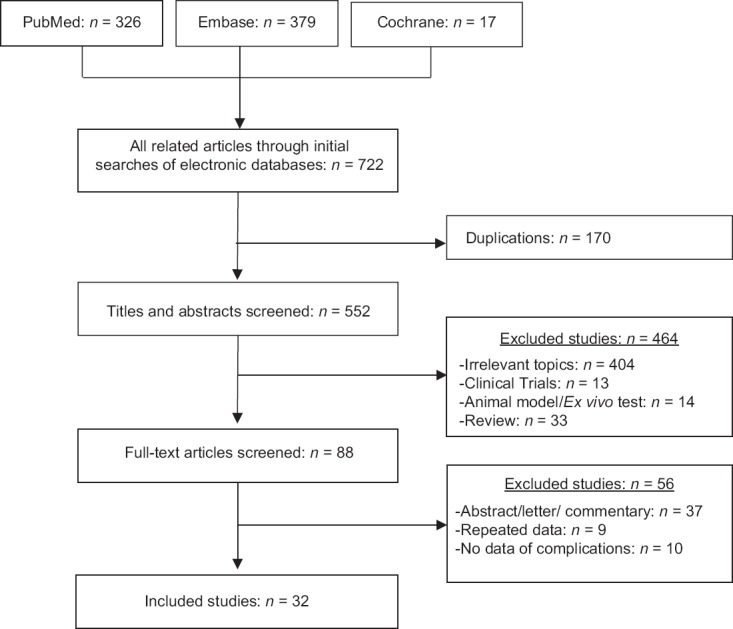
Study selection: Thirty-two studies relating to 3409 patients were included in this systematic review.
Results: Based on literatures, no deaths were associated with the procedure, serious complications were rare, and RFA appears to be a safe and well-tolerated treatment modality. However, a broad spectrum of complications offers insights into some undesirable complications, such as track needle seeding and Horner syndrome.
Conclusions: RFA appears to be a safe and well-tolerated treatment modality for BTNs. More research is needed to characterize the complications of RFA for thyroid nodules.
Conflict of interest statement
There are no conflicts of interest.
Figures
References
-
- Sharen G, Zhang B, Zhao R, Sun J, Gai X, Lou H. Retrospective epidemiological study of thyroid nodules by ultrasound in asymptomatic subjects. Chin Med J. 2014;127:1661–5. doi: 10.3760cma.j.issn.0366-6999.20132469. - PubMed
-
- Gharib H, Papini E, Garber JR, Duick DS, Harrell RM, Hegedüs L, et al. American Association of Clinical Endocrinologists, American College of Endocrinology, and Associazione Medicai Endocrinologi Medical Guidelines for clinical practice for the diagnosis and management of thyroid nodules-2016 update. Endocr Pract. 2016;22:622–39. doi: 10.4158/ep161208.gl. - PubMed
-
- Haugen BR, Alexander EK, Bible KC, Doherty GM, Mandel SJ, Nikiforov YE, et al. 2015 American Thyroid Association management guidelines for adult patients with thyroid nodules and differentiated thyroid cancer: The American Thyroid Association guidelines task force on thyroid nodules and differentiated thyroid cancer. Thyroid. 2016;26:1–133. doi: 10.1089/thy.2015.0020. - PMC - PubMed
-
- Huan Q, Wang K, Lou F, Zhang L, Huang Q, Han Y, et al. Epidemiological characteristics of thyroid nodules and risk factors for malignant nodules: A retrospective study from 6,304 surgical cases. Chin Med J. 2014;127:2286–92. doi: 10.3760cma.j.issn.0366-6999.20132469. - PubMed
-
- Gharib H. Changing trends in thyroid practice: Understanding nodular thyroid disease. Endocr Pract. 2004;10:31–9. doi: 10.4158/ep.10.1.31. - PubMed
Publication types
MeSH terms
LinkOut - more resources
Full Text Sources
Other Literature Sources
Medical